Lifespan Vault earns an affiliate commission when you buy through links on this page, at no extra cost to you. It does not change our rankings or our verdicts.
QUICK VERDICT
The wearable answer to a problem the desk-based light box never solved: how to actually get bright light onto your retina at the times that move your circadian phase, without sitting still for 30 minutes.
Price: $220 · Verified: 2026-07-09
RETIMER15Use it at Re-Time →The wearable answer to a problem the desk-based light box never solved: how to actually get bright light onto your retina at the times that move your circadian phase, without sitting still for 30 minutes.
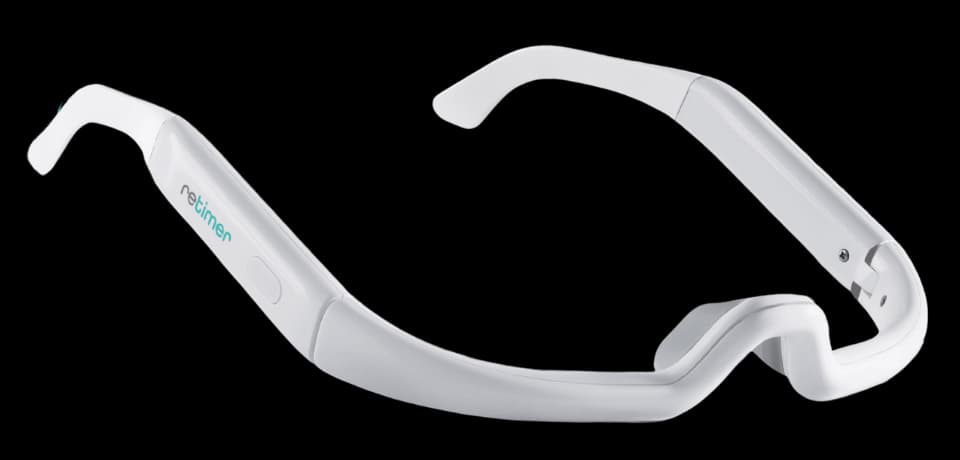
Re-Time is an Adelaide-based spin-out of Flinders University sleep research. The product is a pair of glasses that direct soft green light at the wearer's eyes, bright enough to suppress melatonin and shift the circadian phase, gentle enough that you can wear them while doing email, eating breakfast, or pacing the kitchen.
The mechanism is mainstream sleep medicine. Light hits the melanopsin-containing retinal ganglion cells in your eye, which gate the SCN, which sets every other clock in your body. Bright light in the morning advances the rhythm (helps early-rising); bright light in the evening delays it (helps shift workers and west-coast meetings). The thing every protocol gets wrong: getting enough lux onto the retina for long enough. A 10,000 lux desk box works but requires you to sit still. Re-Timer brings the light source onto your face, so the protocol runs in parallel with whatever else you're doing.
Who actually uses this: jet-lagged executives (re-set the rhythm in 2 days vs the usual 5-7), shift workers running irregular schedules, parents of sleep-disrupted kids, light-deprived office workers in winter at high latitudes, anyone with delayed sleep phase syndrome who's trying to get to sleep before midnight. The price point ($199-299) is dramatically below clinic-grade light therapy ($800-1,500) and the research credibility is real, Flinders has published multiple peer-reviewed papers on phase shifting using the device.
Where it gives ground: green light is softer than the blue-light boxes (Litebook, Verilux, Carex) but the studies show comparable melanopic effect. Battery life is real (4-5 hours of continuous use) but you're charging the unit. Aesthetic is "obviously a medical device", not subtle.
RETIMER15Frequent transcontinental travelers wanting to pre-shift before flights, shift workers, anyone with delayed sleep phase who can't fall asleep before 1-2am, light-deprived northern-latitude workers in winter, founders with chronically-shifted Monday-morning starts.
You already use a 10,000-lux desk light box consistently and the desk-bound protocol fits your schedule. Or you have any photosensitive condition (migraine, retinal disease) - consult an ophthalmologist first.
Specifications
Featured in these curated stacks
We’ve included this product in 1 editorial bundle - groupings of 4-7 items that work as a system.
Where this fits
Re-Time Re-Timer 3 cross-shops across several editorial surfaces on this site: the full brand catalog, the buyer-intent tags this item carries, the price band it qualifies for and the in-depth guides for its category.
Re-Time Re-Timer 3 - buyer FAQ
How is this different from a 10,000-lux desk light box?
The mechanism is identical (bright light onto retina shifts circadian phase). The difference is delivery format - Re-Timer is wearable so you can run the 30-50 minute protocol while doing other things. Desk boxes require you to sit in front of them. Lux at the eye is lower with Re-Timer (~500 vs 10,000) but the green-wavelength specificity targets melanopsin more efficiently, so net melanopic effect is comparable in published studies.
Why green light instead of blue?
Both wavelengths drive the melanopsin-mediated circadian response. Blue light boxes generate more photic glare and discomfort at high lux; green light delivers similar melanopic effect at lower intensity, which made the wearable form factor viable. The trade-off is well-validated in the Flinders research underlying the product.
Will this help with seasonal affective disorder?
Some users report SAD relief, but Re-Timer's clinical research is focused on circadian phase shifting rather than mood disorder treatment. For SAD-specific use, the established protocol is a 10,000-lux blue-light box for 30 minutes within the first hour of waking. Re-Timer can supplement but probably shouldn't replace.
How long does it take to shift my schedule?
Published Flinders studies show ~1 hour of phase shift per day of consistent use. So if you want to wake up 3 hours earlier (5am instead of 8am), it takes about 3 days of morning use. Jet lag pre-shifting before a transatlantic flight typically takes 2-4 days of evening or morning use depending on direction.
What should I know before long-term use?
We do not offer medical guidance and cannot tell you whether this is appropriate for you. Anyone with retinal disease, photophobia, migraine with aura, or taking light-sensitizing medication should speak to an ophthalmologist before use, and so should anyone who is uncertain. Questions about intensity and duration are best answered by a clinician who knows your history.
Re-Time Re-Timer 3 Circadian Light Therapy Glasses
$220 · Verified 2026-07-09
Use code RETIMER15 - 15% off Re-Timer