RKIN U1-W Countertop Reverse Osmosis Purifier
Zero-install countertop RO with hot and cold dispensing, alkaline remineralization, and app monitoring.
Lifespan Vault earns an affiliate commission when you buy through links on this page, at no extra cost to you. It does not change our rankings or our verdicts.
QUICK VERDICT
Reverse osmosis is the most thorough consumer water treatment you can buy, and it normally means an under-sink install. The RKIN U1-W puts a full 5-stage RO system on the counter: fill the 1-gallon tank, and it dispenses purified water hot or cold with no plumbing at all.
- Best for
- Renters and small households who want true reverse osmosis with hot and cold dispensing and zero plumbing, and who accept brand-stated (unpublished) test results in place of NSF certification.
- Drawback
- Not NSF-certified; the third-party test report is not published
- Editor score
- 7.8/10 (how we rank)
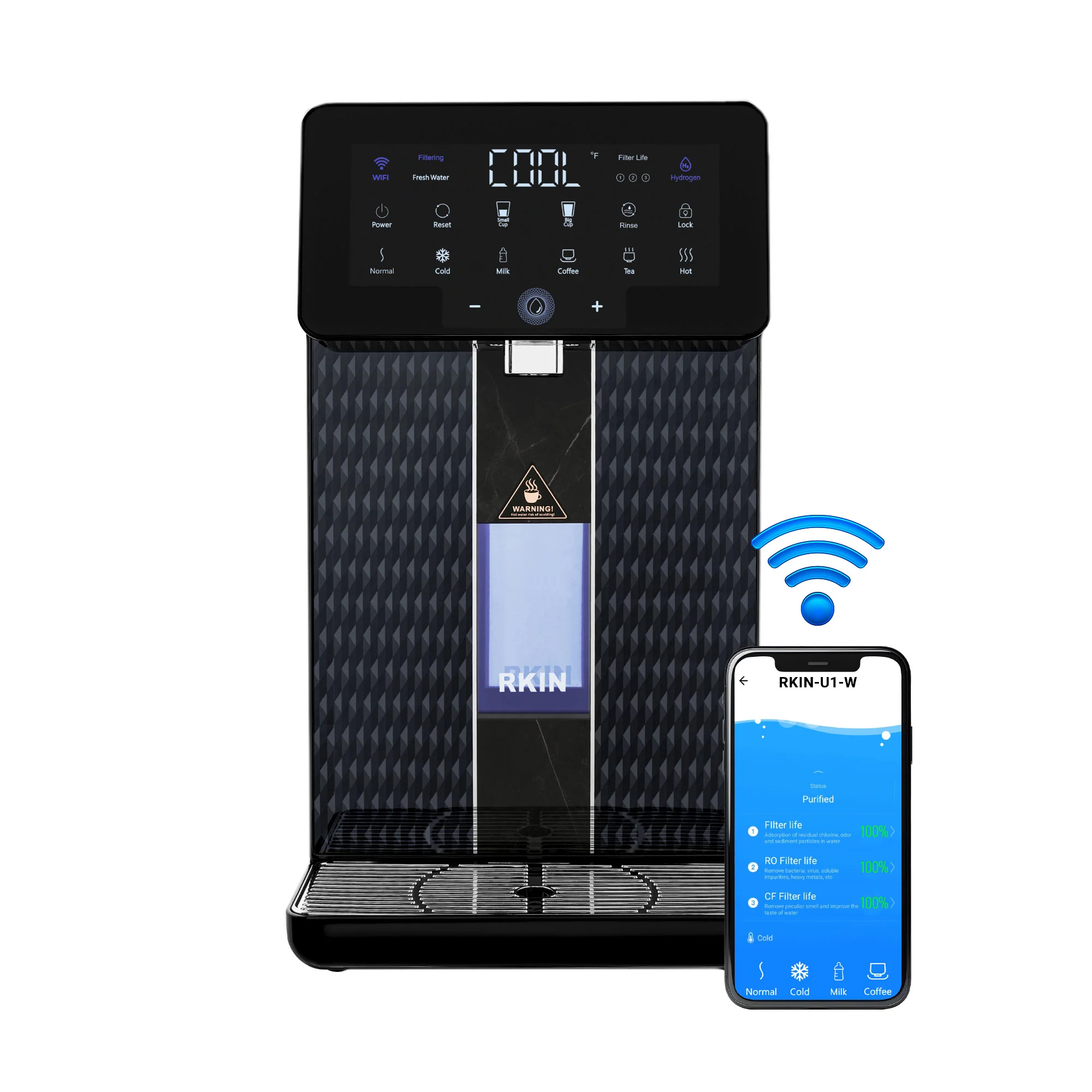
The U1-W runs water through a sediment and carbon pre-filter, a 200 GPD RO membrane, an alkaline remineralization post-filter, and a hydrogen module with UV to keep stored water fresh. A touch panel shows water quality and filter status, hot and cold dispense on demand, and the U1-W adds app monitoring (the older U1 lacks it). At 9.5 by 17 by 19 inches and 26 lb it lives on a counter, which makes it the RO option for renters, condos, and RVs.
Honest trade-offs. RKIN states third-party testing for reduction of TDS, fluoride, lead, PFOA and PFOS, and chromium, but does not name the lab or publish the report, and the unit is not NSF-certified, which matters in a category where Boroux and others lead with certification. Like all RO, roughly half of each fill becomes wastewater, and each fill yields about half a gallon of purified water, sized for one to two people rather than a big household. The alkaline pH and hydrogen features are taste and marketing features; we attach no health claims to them.
Ownership costs are reasonable: about $130 a year in filters via the bundle, with a 1-year unconditional satisfaction guarantee.
Renters and small households who want true reverse osmosis with hot and cold dispensing and zero plumbing, and who accept brand-stated (unpublished) test results in place of NSF certification.
You want NSF-certified reduction claims (Boroux leads there), you need high-volume water for a large family, or wastewater bothers you (RO discards roughly half of each fill).
Pros
- True RO on a countertop, zero install, renter-friendly
- Hot and cold dispensing with adjustable temperature
- 5-stage stack with UV storage protection and app monitoring (U1-W)
- Sane filter costs (~$130/yr) and a 1-year unconditional guarantee
Cons
- Not NSF-certified; the third-party test report is not published
- About half of each fill becomes wastewater; half-gallon batches suit 1-2 people
Specifications
Most often compared with
Where this fits
RKIN U1-W 4-in-1 Countertop RO cross-shops across several editorial surfaces on this site: the full brand catalog and the in-depth guides for its category.
RKIN U1-W 4-in-1 Countertop RO - buyer FAQ
Does the RKIN U1-W need plumbing?
No. It is a countertop unit: you fill the 1-gallon top tank by hand and it produces about half a gallon of purified water per fill in under 7 minutes, dispensing hot or cold. That zero-install design is the whole point, making real reverse osmosis possible in rentals, condos, and RVs.
Is the RKIN U1-W NSF certified?
No. RKIN states third-party testing for reduction of TDS, fluoride, lead, PFOA/PFOS, and chromium, but the lab is unnamed and the report unpublished, and the unit carries no NSF certification. If certified claims are your deciding factor, a WQA-certified system like the Boroux Legacy is the alternative we cover.
How much does the RKIN U1-W cost to run?
The unit is $749, verified August 16, 2026 against RKIN's own store data, and up from the $670 we recorded in July, so treat the round $1,125 compare-at as a standing anchor rather than a real discount. Filters run about $130 a year via the 1-year bundle, with the RO membrane replaced every 12 to 24 months at $82.99.
Does reverse osmosis waste water?
Yes, inherently. The U1-W recovers roughly half of each fill as purified water and discards the rest as wastewater, about a 1:1 ratio, which is typical for countertop RO. If minimizing wastewater matters most, a gravity filter wastes none but does not use an RO membrane.