Issue 002 - The $18 gadget that keeps the whole stack alive
The counter-clutter issue. Four months of daily mixing, the $18 gadget that keeps a stack alive, three jars with three relationships to the number on the label, and the third pole in the Function Health comparison.
Issue 002 of the Vault Weekly. One issue per week. No promo, no sponsorships. This week is the counter-clutter issue: what four months of daily mixing taught us about the supplement stack you actually keep using.
This week's three things
1. The $18 gadget that keeps the whole stack alive
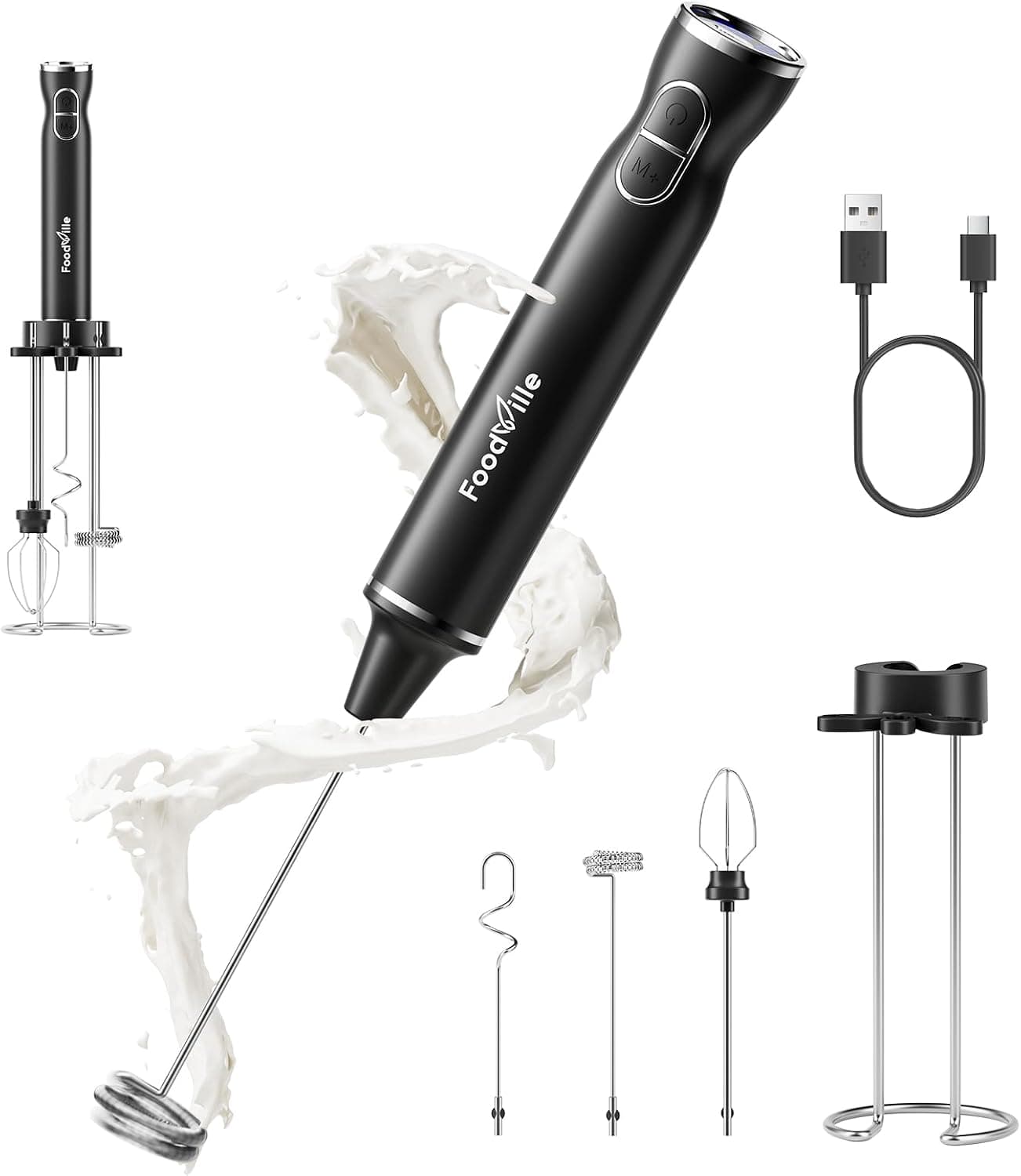
We shipped four hands-on supplement reviews this week, and the most important product in the batch is not a supplement. It is the FoodVille MF06 rechargeable frother, $17.99 at our August 28 price check. It sells through Amazon, and Amazon pricing moves, so check the live page.
We bought ours at retail in April and have run it every day since, two to four drinks a day: colostrum, collagen, creatine, protein. One charge has lasted over a month at that pace; the brand advertises up to three months under lighter use, a brand-stated figure. One warning from four months in: at a brand-stated 17,000 to 25,000 RPM it will throw a full cup over the rim, so start on a low speed and leave headroom.
Here is the editorial point. The supplement industry sells optimization: a better form, a higher dose, a new ingredient. Almost nobody sells adherence, and adherence is where stacks die. The tub you abandon at 60 percent full because it clumps in a shaker returns exactly nothing. Our stack survived four months because the friction dropped to seconds a drink. One honest gadget beat three abandoned tubs. If your counter has a graveyard of half-finished powders, the fix might cost $18, not $89.
2. Three jars, three relationships with the number on the label
The three powders the frother mixes make a useful lesson in label reading, because each treats numbers differently.
BUBS Naturals Collagen Peptides gives you a number you can check: it holds listing 1404731 in the public NSF Certified for Sport database, which tests every batch for banned substances and label accuracy. 20 g of types I and III collagen per scoop, $47 for a 28-serving tub, about $1.68 a serving, verified August 2026. Most collagen jars say third-party tested without naming the party. A checkable listing is a materially stronger claim.
Cowboy Colostrum Unflavored publishes no number at all, deliberately. $69 for 40 scoops of 3 g whole colostrum, verified August 2026 against the brand store. Where most of the category defats and standardizes colostrum to a quoted IgG percentage, Cowboy sells whole, full-fat colostrum and argues, and this is the brand's argument to weigh, that stripping the raw material to chase one antibody number discards the fats and cofactors it came with. The trade: you cannot comparison-shop it on IgG, because there is no IgG figure. You are buying sourcing claims and whole-food logic instead. We mix it daily, which is a statement about our routine, not an outcome claim.
Organised Daily Blend sits in the third camp: the numbers exist but are not published. It is a UK-made freeze-dried blend of eight whole-food ingredients, grass-fed beef organs plus collagen peptides plus colostrum plus honey, dates, maple syrup, and salt, at $79 promoted and $89 list for 30 servings, verified August 2026. One scoop consolidates what would otherwise be three products, and it genuinely does not taste like an organ supplement. The honest trade-off: no per-ingredient grams per scoop, so you cannot line its collagen up against a dedicated 20 g tub. Blend convenience or dose transparency, pick one. Organised is not an affiliate partner; the mention is editorial.
A footnote for budget stacks, and a fourth lesson: the number that rides along. The Clear Wellness 360 Magnesium Glycinate Complex is $25.99 for 90 one-a-day bisglycinate capsules, about 29 cents a day, but every capsule carries a fixed 5,000 IU of vitamin D3 you cannot decouple if you already dose D separately. A combo capsule is convenient exactly until you want to change one dial.
3. The third pole in the Function Health fight
Two comparison posts went live this week: Function Health alternatives and Labcorp OnDemand vs Function Health. Both add a category most lab comparisons skip: the care membership.
The usual framing is two poles, an a la carte lab menu (Labcorp panels from $49) versus a testing membership (Function's $365 for 160-plus markers). The third pole wraps the same labs in a clinician team that acts on them. Geviti Plus is the clearest example at $127 a month, $1,529 billed annually, verified August 2026: a 100-plus marker panel drawn twice a year plus quarterly clinician visits. That is roughly four times Function's price, and it answers a different question. Buy the lab menu for answers a la carte, the testing membership for breadth and trend lines, and the care membership when you want the results to arrive with a clinician attached. Geviti is not an affiliate partner either; the comparison is simply incomplete without that pole.
This week's editor's pick
WalkingPad A1 Pro at $529, verified August 2026. The company that invented the folding walking pad, in its office spec: rated to 300 pounds, a brand-stated under-65 dB motor, and a 180-degree fold that takes it down to 32.5 by 21.5 by 5 inches, roughly a small suitcase. The honest counter: no incline at any price, and the UREVO SpaceWalk 3S has 9 incline levels for $299.99. Heavier users and tight-storage apartments take the A1 Pro; incline chasers take the 3S.
Until next week
Reply and tell us the supplement you abandoned half-finished, and why. The answers shape what we test next. A real person reads them.
- Ryan, Founder Lifespan Vault
Products mentioned


The Longevity Gear Buyer's Checklist
The specs that actually decide whether a sauna, cold plunge, red light panel, or smart ring is worth it, plus the real price range for each. Get the free PDF, plus one weekly email on the gear worth buying.