ARX Omni Adaptive Resistance Machine
ARX's flagship: seventeen cable-driven exercises with clip-on handles and attachments, the same motorized adaptive resistance and software as the Alpha, in 37 square feet.
Any link to this brand on this page is untracked and earns us nothing. Lifespan Vault earns an affiliate commission if you buy the alternative suggested on this page, at no extra cost to you. Neither changes our rankings or our verdicts.
QUICK VERDICT
ARX's flagship at $46,000: seventeen exercises on one cable-driven machine, motor-matched resistance on every rep including the lowering phase, and force data on a dashboard. The numbers ARX leads with come from a study it cites, not from us.
- Best for
- Home and studio buyers who want the full ARX exercise list, grips and attachments on one machine, with per-rep force data. ARX names founders building a studio around one machine, clinics that need movement-specific loading, and home-gym owners replacing a room of equipment.
- Skip if
- You enjoy free weights and have the hours for them, you do not want a single-purpose $46,000 machine with a $200 a month software bill, or you cannot give it a dedicated 20A (110V) or 15A (220V) non-GFCI circuit and 37 square feet.
- Tier
- Ultra-premium
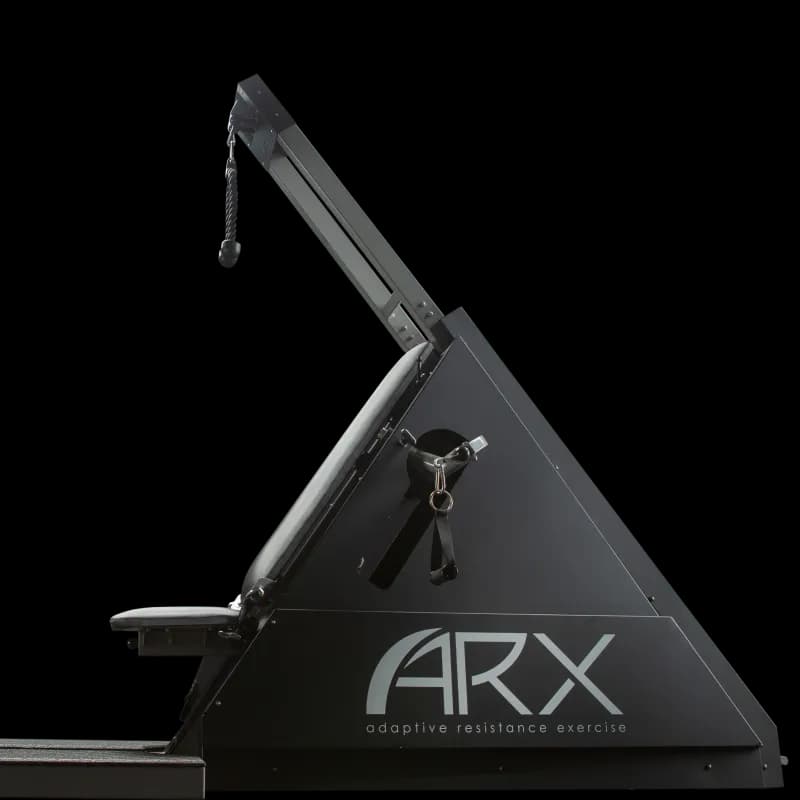
The Omni is the flagship of the two machines ARX builds in Austin, Texas. In place of a weight stack, a computer-controlled motor pushes back with exactly the force you produce at every point in the rep, including the lowering, or eccentric, phase ARX says weights cannot load. On the Omni that resistance runs through a cable system with clip-on handles and attachments, so one machine covers seventeen exercises: belt squat, deadlift, Romanian deadlift, hamstring curl, calf raise, horizontal press, incline press, decline press, overhead press, pec fly, pulldown, pullover, row, high pull, shrug, biceps curl and triceps pressdown. ARX says it does the work of 10+ machines.
ARX gives the footprint as 37 square feet in its Omni heading and as 38 square feet, 42 by 129 by 90 inches, in its comparison table, at about 700 pounds. Power is 110V on a dedicated 20A circuit or 220V on a dedicated 15A circuit, and ARX states its machines are not compatible with GFCI outlets. ARX describes the workout as about 15 minutes, twice a week, and says any rep scheme runs on it: standard, negative-only, positive-only, static, time-under-tension and partial-range sets, with adjustable rep speed, set, pause and rest times.
The hardware price is $46,000, $3,000 above the Alpha. The software is a separate subscription, identical on both machines: $200 a month for home use, $400 a month commercial, with lifetime licenses available. It records total force, max force in both directions, rep speed, range of motion, intensity, exercise time and fatigue to a dashboard. ARX quotes third-party financing at about $1,200 a month; that is a lender payment, not the price. New machines include a one-year warranty, a two-to-four-week lead time and the ARX Certified Course, and the purchase runs through a Talk to ARX call.
Be clear whose numbers these are. The figures ARX leads with, twice the muscle gain, 90 percent greater strength gain, 2.5 times the fat loss, 3.5 times the cardiovascular improvement, in 72 percent less training time, come from a 12-week Western Colorado University study commissioned by the American Council on Exercise in 2021. That is the brand's cited study; we have not tested an Omni. ARX's XPRIZE Healthspan involvement has not reported results, and "trusted by Tony Robbins, Dave Asprey and Ben Greenfield" is ARX's line, not ours.
Who ARX names for the Omni: founders building a studio around one machine, clinics that need movement-specific loading, and home-gym owners replacing a room of equipment. Weigh that against a $46,000 single-purpose machine, a monthly software bill, a dedicated circuit, about 700 pounds to site, and ARX's own concession that barbells win on cost and track record. If the full library matters, this is the machine; if six guided movements will do, the Alpha saves $3,000 and 16 square feet.
Home and studio buyers who want the full ARX exercise list, grips and attachments on one machine, with per-rep force data. ARX names founders building a studio around one machine, clinics that need movement-specific loading, and home-gym owners replacing a room of equipment.
You enjoy free weights and have the hours for them, you do not want a single-purpose $46,000 machine with a $200 a month software bill, or you cannot give it a dedicated 20A (110V) or 15A (220V) non-GFCI circuit and 37 square feet.
Specifications
Most often compared with
Where this fits
ARX Omni cross-shops across several editorial surfaces on this site: the full brand catalog, the price band it qualifies for and the in-depth guides for its category.
ARX Omni - buyer FAQ
ARX Omni vs ARX Alpha: which model?
Adaptive resistance is the technology both share, not a model name; the choice is exercise range against footprint. The Omni puts seventeen exercises through a cable system with clip-on handles and attachments in 37 square feet at about 700 pounds, and ARX says its cable system allows more exercises and more types of grips. The Alpha runs six exercises on a guided sled in 21 square feet at about 700 pounds and is the machine ARX designed to be easiest to learn. Published hardware prices are $46,000 and $43,000. The software, and what it measures, is identical on both.
What does an ARX Omni cost to own, beyond the $46,000?
The $46,000 is the hardware purchase price ARX publishes for the Omni. Software is separate and required: $200 a month for home use or $400 a month commercial, with lifetime licenses available. ARX quotes third-party financing at about $1,200 a month and does not finance in-house; a lender payment is never the price. The machine needs its own 110V 20A or 220V 15A circuit, so budget an electrician. A complimentary one-year warranty, the ARX Certified Course, and delivery and install arranged with ARX come with every new machine, and the purchase itself runs through a Talk to ARX call.
Does the ARX claim of 15 minutes twice a week hold up?
It rests on one study, which ARX cites and we have not replicated. In 2021 the American Council on Exercise commissioned a 12-week study at Western Colorado University comparing ARX with moderate-intensity weight training, later published in the International Journal of Research in Exercise Physiology. ARX reports that its group trained twice a week for 15 minutes against 45 minutes three times a week and came out with 2 times the muscle gain, 90 percent greater strength gain, 2.5 times the fat loss and 3.5 times the cardiovascular improvement. Those are the brand's figures from the brand's cited study; we have not tested an Omni.
Can I buy a used ARX Omni from a third party?
You can, but ARX strongly discourages it and the reasons are structural. The software license is non-transferable, and without an active license the machine will not run at all: no workout, no force data. ARX reviews every serial number individually before it will sell a new license, not every machine qualifies, the warranty ends when the machine changes hands, resale buyers must complete ARX Certified Training before use, and moving the machine requires consulting ARX. ARX asks buyers to submit the serial number for verification before money moves, and keeps a waitlist for used machines it sells directly.
What can the ARX Omni software program and track?
ARX says any resistance program runs on it: standard reps, negative-only, positive-only, static (isometric) protocols, time-under-tension sets and partial-range reps, with adjustable rep speed, set time, pause time and rest time. The drive system and load cell feed the motor controller and the software in a feedback loop, and it records total force, max force in both the concentric and eccentric directions, rep speed, range of motion, intensity, exercise time and fatigue, stored in the ARX cloud and shown on an online dashboard. The software is a subscription, identical on Alpha and Omni, and ARX says a session can run without a trainer.