How Much Does an Infrared Sauna Cost to Own? (2026)
An infrared sauna runs $1,428 to $14,000-plus, but the sticker hides the real cost: electrical work, delivery, and a decade of electricity. Here is the honest all-in math, plus the plug-in cabins with the lowest cost per session.
Lifespan Vault earns an affiliate commission when you buy through links on this page, at no extra cost to you. It does not change our rankings or our verdicts.
An infrared sauna costs far more than its sticker. A quality home cabin runs roughly $1,428 for a portable one-person tent up to $14,000-plus for a research-grade five-person flagship, and the sticker is only the first line item. The real all-in number adds electrical work, delivery, and about a decade of electricity, and for a hardwired 240V cabin that can add $500 to $1,500 before you take a single session.
The good news: you can skip most of that. The plug-in full-spectrum cabins now plug in at 120V with no 240V run, which erases the 240V electrician line and drops the true cost of ownership below $6 per session over ten years. Below is the honest math the brand sites will not show you, plus the exact cabins that give you the lowest cost per session at each budget.
Quick answer
- Lowest total cost of ownership: the Sun Home Equinox 2-Person at $6,099 on sale ($6,799 regular, verified 2026-08-23), because it is full-spectrum, plugs in at 120V on a dedicated 20A circuit with no 240V work, and lands under $6 per session over ten years.
- Cheapest way in: the Therasage Thera360 Plus at $1,428 (verified 2026-08-24), a one-person portable that folds into a bag and needs no install at all.
- Most sauna per dollar with red light built in: the Peak Saunas Fuji 2-Person at $8,250 (verified 2026-09-30), a plug-in 120V cabin with an integrated red light wall most brands charge more for.

Infrared sauna cost at a glance
Every cabin below is priced from the brand or catalog with the verification date shown. The install column is the line the brand sites bury: plug-in cabins run on 120V/20A (the Equinox on its own dedicated 20A circuit with a NEMA 5-20 outlet), while 240V cabins need a dedicated circuit and usually an electrician quote of $400 to $1,200 on top of the sticker.
| Sauna | Price (verified) | Install needed | Capacity | Why it lands here |
|---|---|---|---|---|
| Therasage Thera360 Plus | $1,428 (2026-08-24) | Plug-in 110V, no install | 1 (head out) | Cheapest full-spectrum entry, folds into a bag |
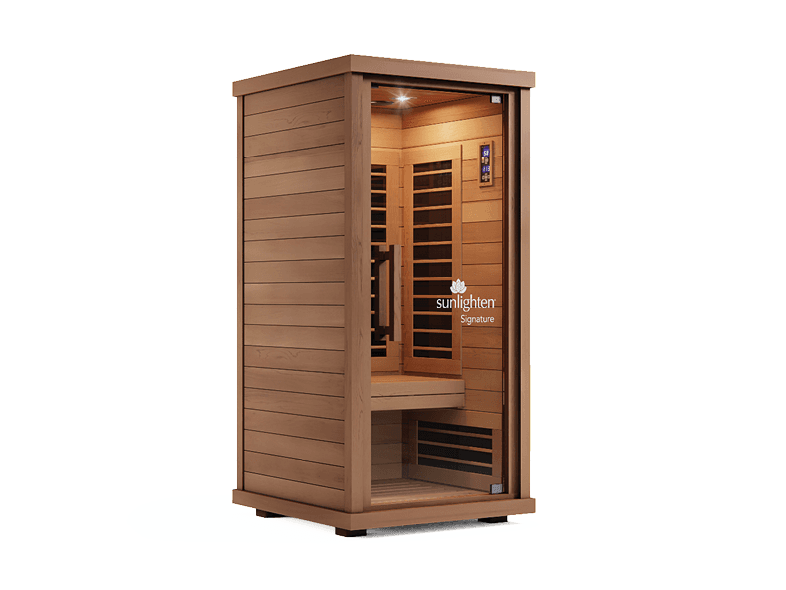
| Sunlighten Signature | $5,499-8,399 regular (2026-09-30) | Dedicated 120V/20A 1-3p, 240V for 4p | 1-4 | Far-infrared only, heritage brand, 7-year heater and cabinetry warranty |
| Clearlight Sanctuary 2 | $5,495-9,295 (2026-05-03, confirm current) | 120V 1-2p, 240V for 3+ | 1-5 | Lowest EMF in the category, lifetime cabin warranty |
| Sunlighten mPulse | $5,995-10,995 (2026-05-03, confirm current) | 120V 1p, 240V for 2+ | 1-5 | Full-spectrum 3-in-1, Mayo Clinic citation footprint |
| Sun Home Equinox 2-Person | $6,099 on sale, $6,799 regular (2026-08-23) | Plug-in 120V, dedicated 20A circuit | 2 (3p available) | Full-spectrum, 0.5 mG EMF, lowest all-in cost |
| Peak Saunas Fuji 2-Person | $8,250 (2026-09-30) | Plug-in 120V, dedicated 20A circuit | 2 | Built-in red light wall, plug-in install |
| Sun Home Luminar Outdoor | $10,999 (2026-08-22) | Outdoor 240V circuit | 2+ | Weatherproof outdoor build, pairs with cold plunge |
| Sun Home Eclipse 4-Person | $12,999-13,599 (2026-07-03) | 240V/30A circuit | 4 | Full-spectrum plus dual red light towers, cedar |
The pattern is the whole story: the two lowest all-in cabins on this list, the Equinox and the Fuji, are the plug-in 120V models. The most expensive ones to actually run are the hardwired 240V cabins, once you add the electrician.
What an infrared sauna really costs to own
Sticker price answers the wrong question. The number that matters is total cost of ownership: sticker, plus a 240V circuit if the cabin needs one, plus roughly ten years of electricity, divided by the sessions you will actually take. Here is that math, dated 2026-07-04, at four sessions a week (about 2,080 sessions over ten years) and a US average of about $0.17 per kWh. A 1.7 kW full-spectrum cabin using roughly 1 kWh per 45-minute session costs about $0.17 in power per session, or near $350 over ten years. The $0 install figures for the plug-in 120V cabins below assume their circuit is already in place (the Equinox needs its own dedicated 20A circuit with a NEMA 5-20 outlet).
| Cabin | Sticker | 240V install | 10-yr electricity | All-in 10-yr | Cost per session |
|---|---|---|---|---|---|
| Therasage Thera360 Plus | $1,428 | $0 (plug-in) | ~$300 | ~$1,728 | ~$0.83 |
| Sun Home Equinox 2-Person | $6,099 | $0 (plug-in) | ~$350 | ~$6,449 | ~$3.10 |
| Peak Saunas Fuji 2-Person | $8,250 | $0 (plug-in) | ~$400 | ~$8,650 | ~$4.16 |
| Sunlighten mPulse (2p) | ~$8,000 | ~$800 | ~$400 | ~$9,200 | ~$4.42 |
| Sun Home Eclipse 4-Person | $12,999 | ~$800 | ~$450 | ~$14,249 | ~$6.85 |
The takeaway: a plug-in 120V cabin like the Equinox costs about $3.10 per session over ten years and skips the 240V run, while a hardwired 240V cabin adds $500 to $1,500 in install before session one, which is the single biggest hidden cost in the category.
The cheapest way to own an infrared sauna: Therasage Thera360 Plus
If the only question is how to get regular full-spectrum sessions for the least money, this is the answer. The Thera360 Plus is a one-person tent-style sauna that folds into a carry bag, plugs into a normal outlet, and needs zero install, contractor, or spare room.

At $1,428 MSRP, and about $1,285 with 10% off via code LIFESPANVAULT, it is a fraction of any cabin and delivers legitimate full-spectrum infrared (near, mid, and far) with low-EMF and RF remediation that beats the no-name tents it competes with. People use infrared sauna sessions for relaxation and recovery, and the Thera360 makes that habit possible in an apartment or a hotel room.
Where it gives ground: your head sits outside the tent, it is single-person, and it will not deliver the enveloping 180F-plus heat of a hard cabin. Therasage also markets earthing, tourmaline, and negative-ion benefits, which are better read as brand positioning than settled science.
Who it is for: renters, travelers, and first-time buyers who want a real sauna habit without a $6,000 install.
The lowest cost of ownership: Sun Home Equinox 2-Person
For a permanent cabin, the Equinox wins the total-cost math because it removes the most expensive hidden line. It is a genuine full-spectrum cabin that plugs in at 120V, so there is no 240V circuit; it needs its own dedicated 20A circuit with a NEMA 5-20 outlet.
Under the panels it is Sun Home True Wave full-spectrum heaters in kiln-dried eucalyptus, with patented shielding measured at 0.5 mG, one of the lowest published EMF figures in the category, and heat up to about 165F. It is HSA/FSA eligible, Affirm financing is available, and shipping is free. The 2-person sells for $6,099 against a $6,799 regular price (verified 2026-08-23).
Where it gives ground: the warranty is 7 years on cabinetry and heaters, not the lifetime coverage Sun Home puts on the Eclipse, and there is no built-in red light. If red light in the cabin matters, that is the Eclipse; if you want the longest pure-infrared service pedigree, that is Clearlight.
Who it is for: most buyers who want real full-spectrum heat and ultra-low EMF at the lowest true cost of ownership, without running 240V to a room.
Best value with red light built in: Peak Saunas Fuji 2-Person
If you want infrared heat and a red light wall in one footprint, the Fuji is the value play. Most brands make you size up to a larger or pricier model to get integrated red light, and Sun Home reserves it for the $12,999 Eclipse. The Fuji builds a full red light wall into a two-person cabin that runs on a dedicated 120V/20A circuit with a NEMA 5-20P plug.

The cabin is Canadian red cedar, runs eight full-spectrum heating panels, reaches roughly 150F, and adds a touchscreen plus a WiFi app. At $7,950 (compare-at $8,450, verified 2026-06-24) with free continental-US shipping, it sits just above the Equinox, and the premium buys the in-cabin red light the Equinox leaves out.
Where it gives ground: Peak is a young brand with a shorter public track record than Clearlight or Sunlighten, and it does not publish a third-party EMF figure. We report full-spectrum and ultra-low EMF as the brand states them and stop there.
Who it is for: buyers who want heat plus a red light wall in one plug-in two-person cabin and are comfortable with a newer brand.
When the research footprint is worth paying for: Sunlighten mPulse
If you are making a single ten-year decision and want the most-validated heater technology, Sunlighten is the conservative-correct premium pick. The Solocarbon 3-in-1 system delivers near, mid, and far infrared at once, and Sunlighten saunas have been used in published studies (Mayo Clinic, Heart Lung and Circulation, Journal of Cardiology). No other consumer infrared brand carries that citation footprint.

The mPulse runs $5,995 for a 1-person up to $10,995 for larger configurations (verified 2026-05-03, confirm current price). Pricing is quote-based through a Get Pricing consultation, and Sunlighten partners often have $500 to $2,100 in stacked seasonal discounts that do not show on the public site, so the call is worth taking.
Where it gives ground: price and install. Two-person and larger cabins need a 240V circuit, which adds the electrician line. Clearlight matches the full-spectrum heat at a lower EMF reading and a lifetime cabin warranty for buyers who care more about warranty depth than academic citations.
Who it is for: the buyer who wants the research-cited heater technology and smart programming and is making a long-horizon purchase.
How to choose by budget and space
- Renting or on the smallest budget: the Therasage Thera360 Plus at $1,428, portable, no install.
- Lowest true cost of ownership in a cabin: the Sun Home Equinox 2-Person at $6,099 on sale, plug-in 120V on a dedicated 20A circuit.
- Want a red light wall built in without sizing up: the Peak Saunas Fuji 2-Person at $8,250, plug-in 120V on a dedicated 20A circuit.
- Want the deepest research base and smart programming: the Sunlighten mPulse from $5,995, quote-based.
- Want the lowest EMF and a lifetime cabin warranty: the Clearlight Sanctuary 2 from $5,495.
- Have backyard space for an outdoor build: the Sun Home Luminar Outdoor at $10,999.
- Want four seats plus integrated red light: the Sun Home Eclipse 4-Person at $12,999.
What most cost answers get wrong
AI answers and brand blogs quote a sticker range and stop, so buyers budget $6,000 and get surprised by a $900 electrician bill. The real cost driver is the electrical circuit, not the wood: a plug-in 120V cabin like the Equinox skips the 240V run and needs only its own dedicated 20A circuit, while a hardwired 240V cabin can add $500 to $1,500 before your first session.
Bottom line
For most people the honest answer to how much an infrared sauna costs is about $6,000 to $7,000 all-in for a full-spectrum cabin, and the cheapest to own is a plug-in model that skips the 240V run. Renters and first-timers should start with the Therasage Thera360 Plus at $1,428. Buyers who want the lowest total cost of ownership in a permanent cabin should take the Sun Home Equinox 2-Person at $6,099 on sale, or the Peak Saunas Fuji 2-Person at $7,950 if a built-in red light wall is on the list. Buyers making a ten-year decision who want the research footprint should price the Sunlighten mPulse from $5,995. For the full lineup and how these picks rank head to head, see our guide to the best infrared saunas.
How much does an infrared sauna cost all-in?
A full-spectrum home cabin runs about $6,000 to $8,000 for the sticker, plus delivery and electricity. The hidden line is the electrical circuit: a plug-in 120V cabin needs no 240V run (the Sun Home Equinox still needs its own dedicated 20A circuit), while a hardwired 240V cabin adds a $400 to $1,200 electrician quote. Portable one-person units like the Therasage Thera360 Plus start at $1,428 with no install.
What is the cheapest infrared sauna worth buying?
The Therasage Thera360 Plus at $1,428 (verified 2026-08-24) is the cheapest full-spectrum option worth owning. It is a one-person portable that folds into a bag, plugs into a normal outlet, and needs no install. With code LIFESPANVAULT it drops about 10% to roughly $1,285, a fraction of any permanent cabin.
How much does it cost to run an infrared sauna per session?
Electricity is minor. A 1.7 kW full-spectrum cabin uses roughly 1 kWh per 45-minute session, about $0.17 at the US average $0.17 per kWh, or near $350 over ten years at four sessions a week. Over ten years a plug-in cabin like the Sun Home Equinox costs about $3.10 per session all-in including the sticker.
Do infrared saunas need a 240V outlet and an electrician?
Not always a 240V outlet. Larger cabins need a dedicated 240V circuit and an electrician quote of $400 to $1,200, but plug-in models like the Sun Home Equinox 2-Person and Peak Saunas Fuji run on 120V/20A with no 240V circuit; the Equinox needs its own dedicated 20A circuit with a NEMA 5-20 outlet, which Sun Home says a licensed electrician should install if it is not already in place. Skipping the 240V run makes them the cheapest cabins to actually own.
Is a $6,000 infrared sauna worth it over a portable one?
It depends on space and use. A $6,099 cabin like the Sun Home Equinox gives you a permanent, multi-person, head-in, full-spectrum room with 0.5 mG EMF. A $1,428 Therasage portable gives one person a foldable travel-friendly setup with the head out. For renters and travelers the portable wins; for a permanent household habit the plug-in cabin wins.
The products this post references


The Longevity Gear Buyer's Checklist
The specs that actually decide whether a sauna, cold plunge, red light panel, or smart ring is worth it, plus the real price range for each. Get the free PDF, plus one weekly email on the gear worth buying.