Lifespan Vault earns an affiliate commission when you buy through links on this page, at no extra cost to you. It does not change our rankings or our verdicts.
We expected to like the Kineon MOVE+ less than a full-body panel. Three small modules against a wall of LEDs looked like a downgrade, and $499 looked like a lot for what it is. A month of daily use changed that view for one plain reason: it is the red light device we actually use, two or three times a day, without planning around it.
Kineon sent us the MOVE+ for this review, together with its Extender strap, which Kineon sells separately. It arrived on 16 September 2026, and from that week we followed Kineon's neck protocol, running sessions of about ten minutes two to three times a day.
Quick answer
- Buy it if your panel sits unused because it needs you to stop and sit in one spot: the MOVE+ straps on and goes where you go
- Buy it if you work on one area at a time, a neck, a wrist, a knee: three modules wrap the area you choose
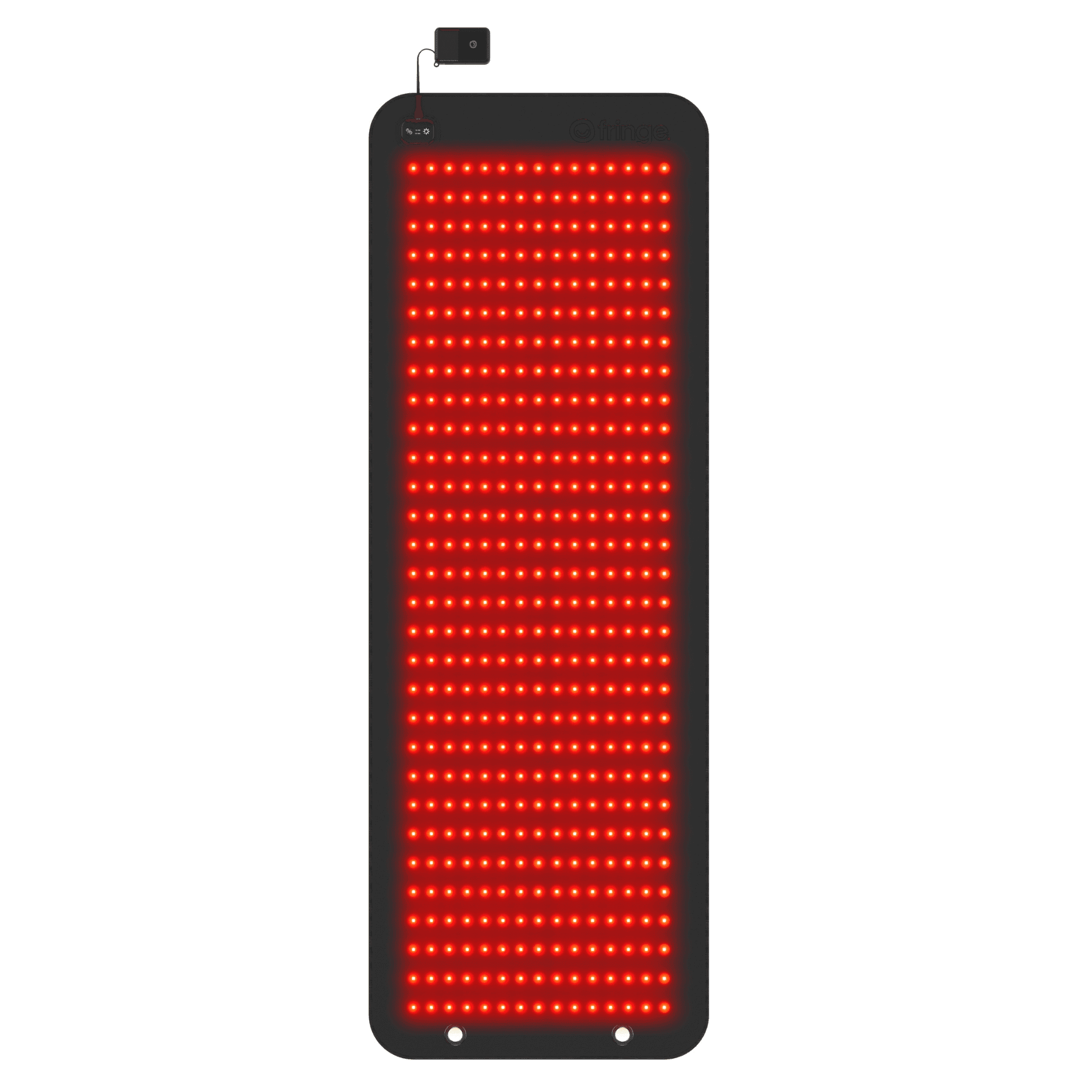
- Skip it if you want whole-body coverage in one session: a panel or a mat covers far more skin, and the Fringe mat is the one we use for that

What changed: it comes with us
The difference is where a session can happen. A panel session happens in the one place in the house where the panel lives, for ten to thirty minutes, with little else going on. A MOVE+ session happens wherever we already are. Over the month we ran sessions in the car, at work, on the couch, while getting ready in the morning, at night before bed, and a few times in bed while falling asleep.
That is why it got more use than our full-body panel, and more than the Fringe mat we also like (see our Fringe hands-on review). Neither of those delivers worse light. They ask for a block of time in a fixed place, and the MOVE+ does not. For red light at home, the device you keep using beats the device with the bigger spec sheet that you stop using.
Using it
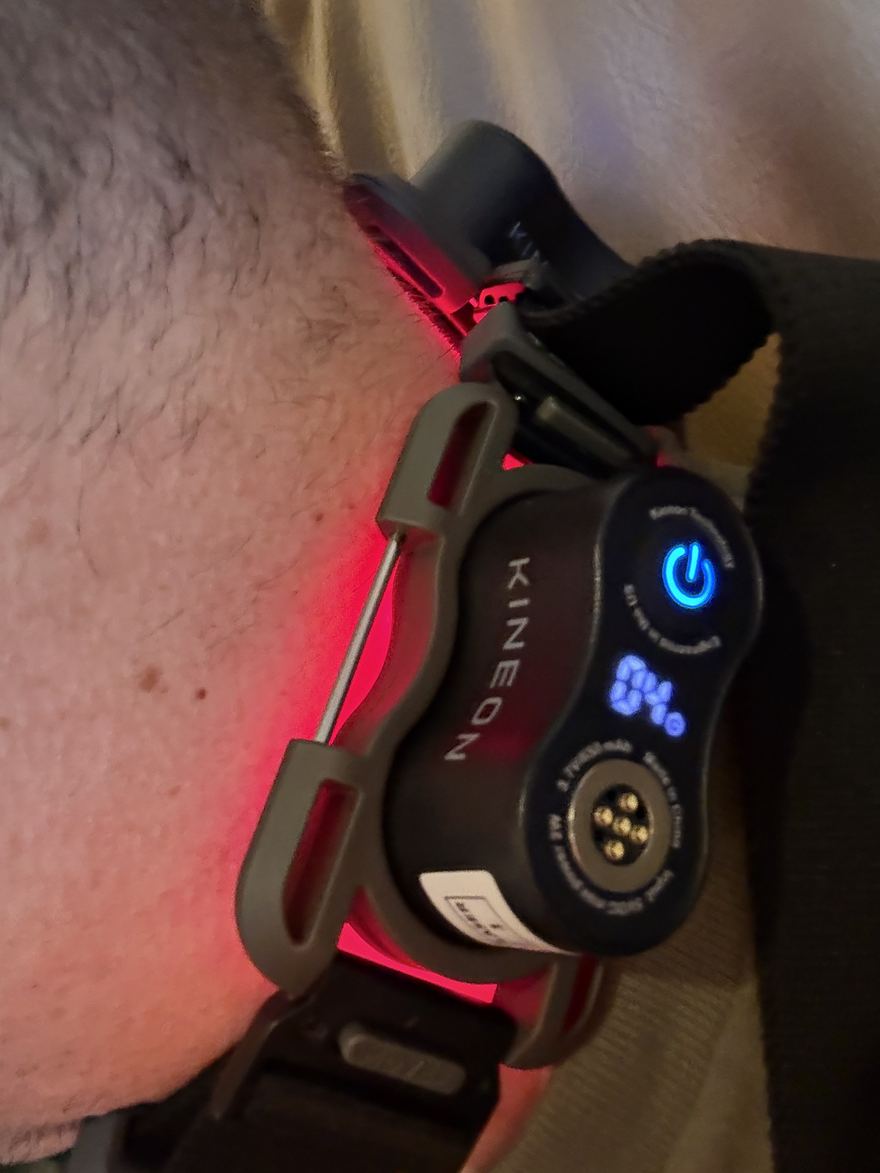
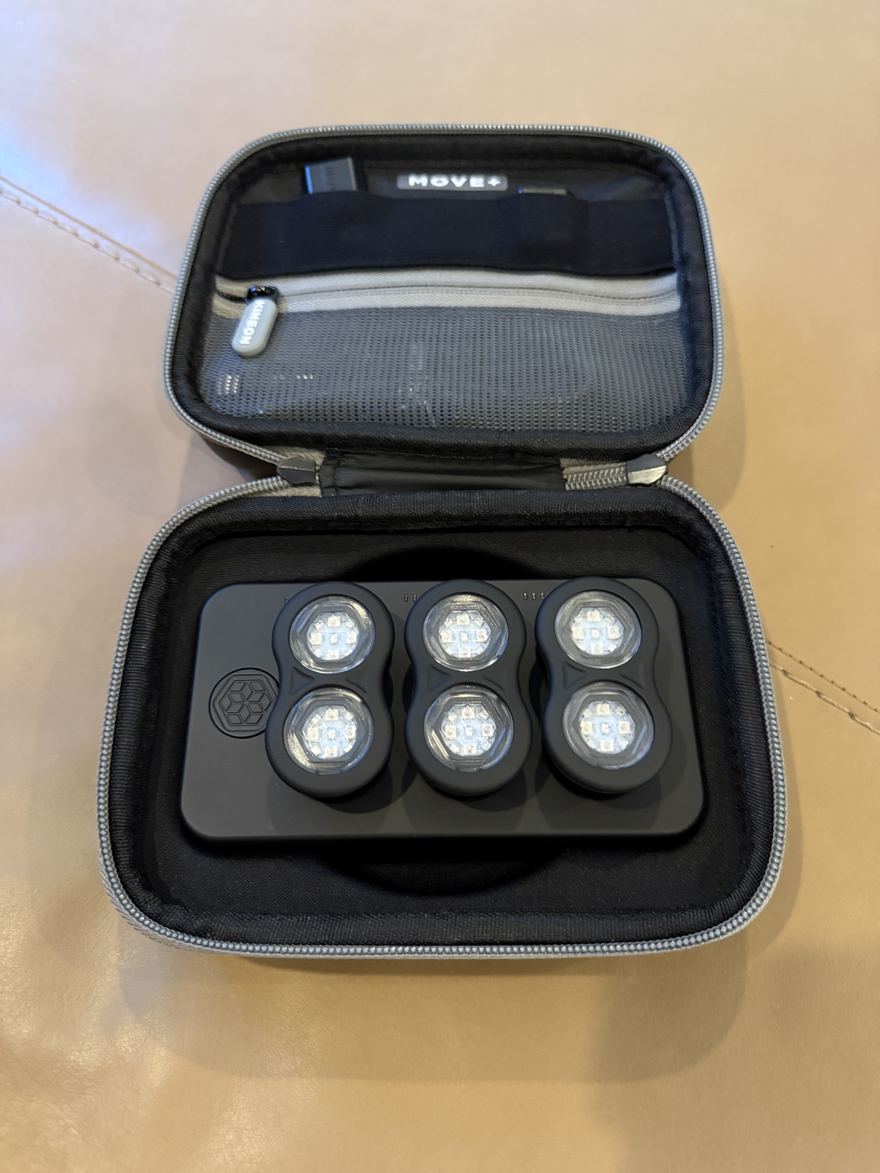
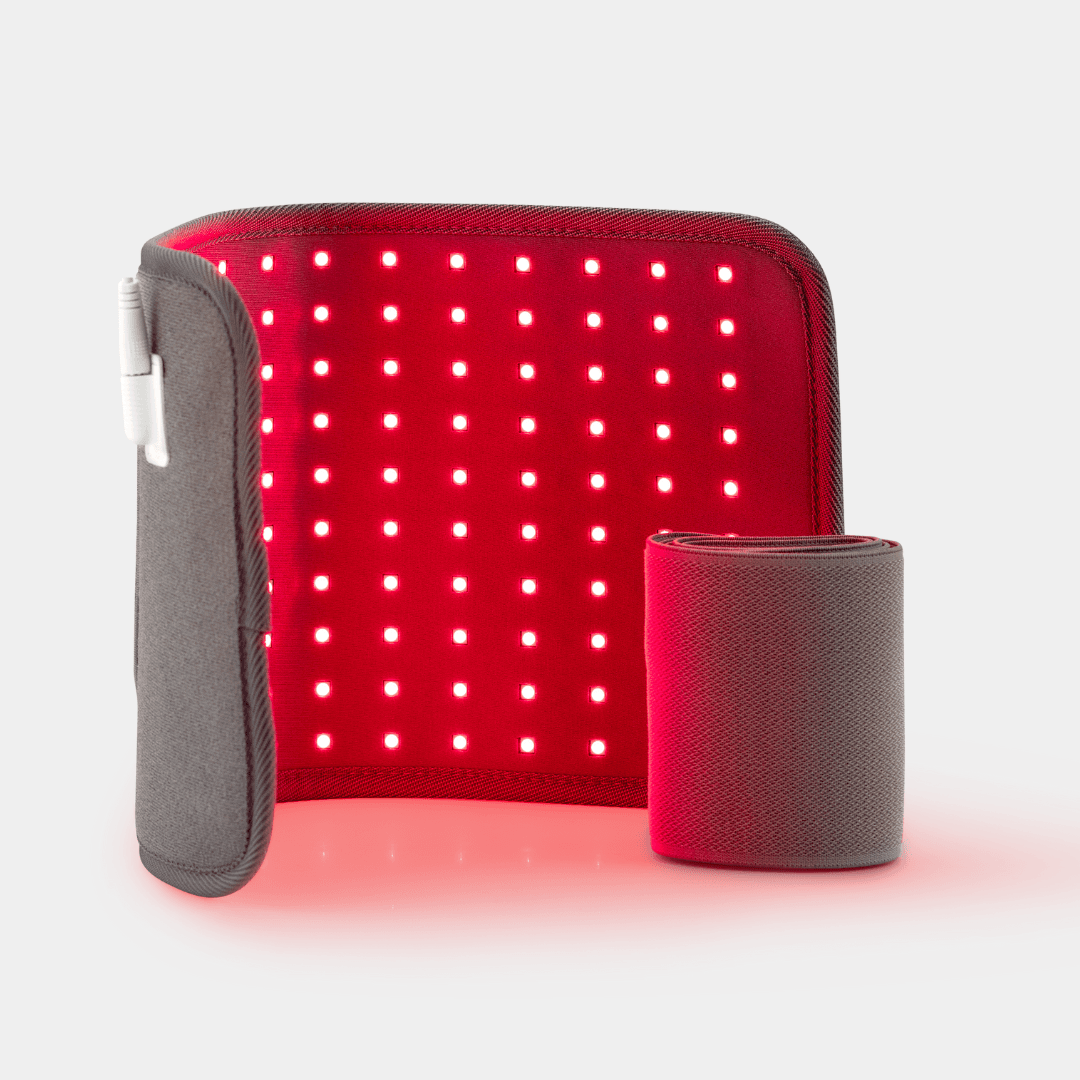
Setup takes minutes. The three modules charge in their case, so putting the device away and charging it are the same motion. The modules sit on the strap, the strap goes around the area, and one press of a power button starts all three at once. A short buzz confirms power on and power off, a small touch that makes it feel like a finished product rather than a gadget.
Our unit ran sessions of five, ten or fifteen minutes. We settled on ten, two to three times a day:
- Neck: most sessions, following Kineon's neck protocol
- Hands and wrists: after long days at a keyboard, as a routine rather than to treat anything; afterwards our hands felt looser, a feeling we would describe as decompressed
- Knees: occasional sessions
Because it straps on, a session costs no time of its own. That is the whole case for this format.
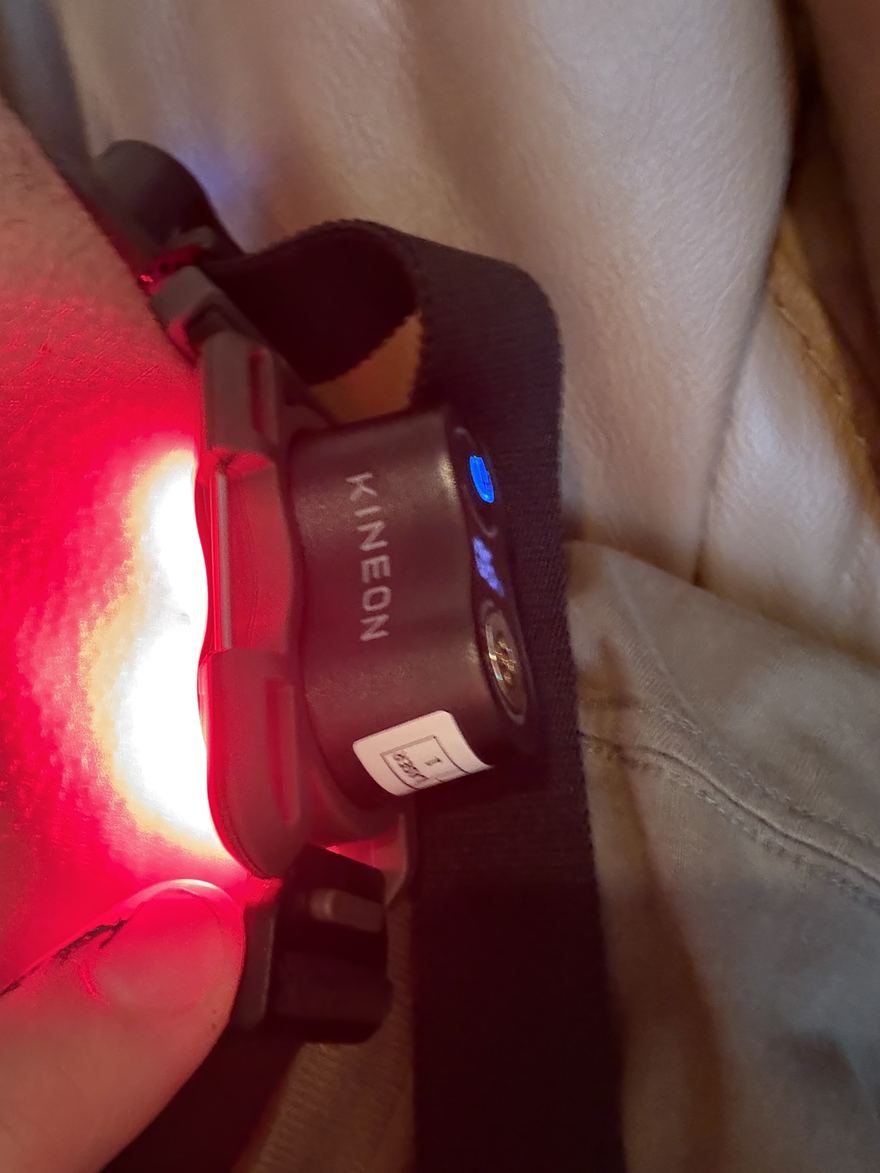
Battery was never a problem. At two to three sessions a day we regularly used it for several days at a time without charging, and the modules never ran flat on us.
Specs, verified
| Spec | Kineon MOVE+ | Source |
|---|---|---|
| Price | $499, shown against $699 | kineon.io, 10 October 2026 |
| Modules | 3, each with 2 emission areas | Brand published |
| Light per module | 8 x 660nm deep-red LEDs and 10 x 808nm near-infrared Class 1 laser diodes | Brand published |
| Optical power | Lasers 5mW each, 50mW per module; LEDs 80mW per emission area | Brand published |
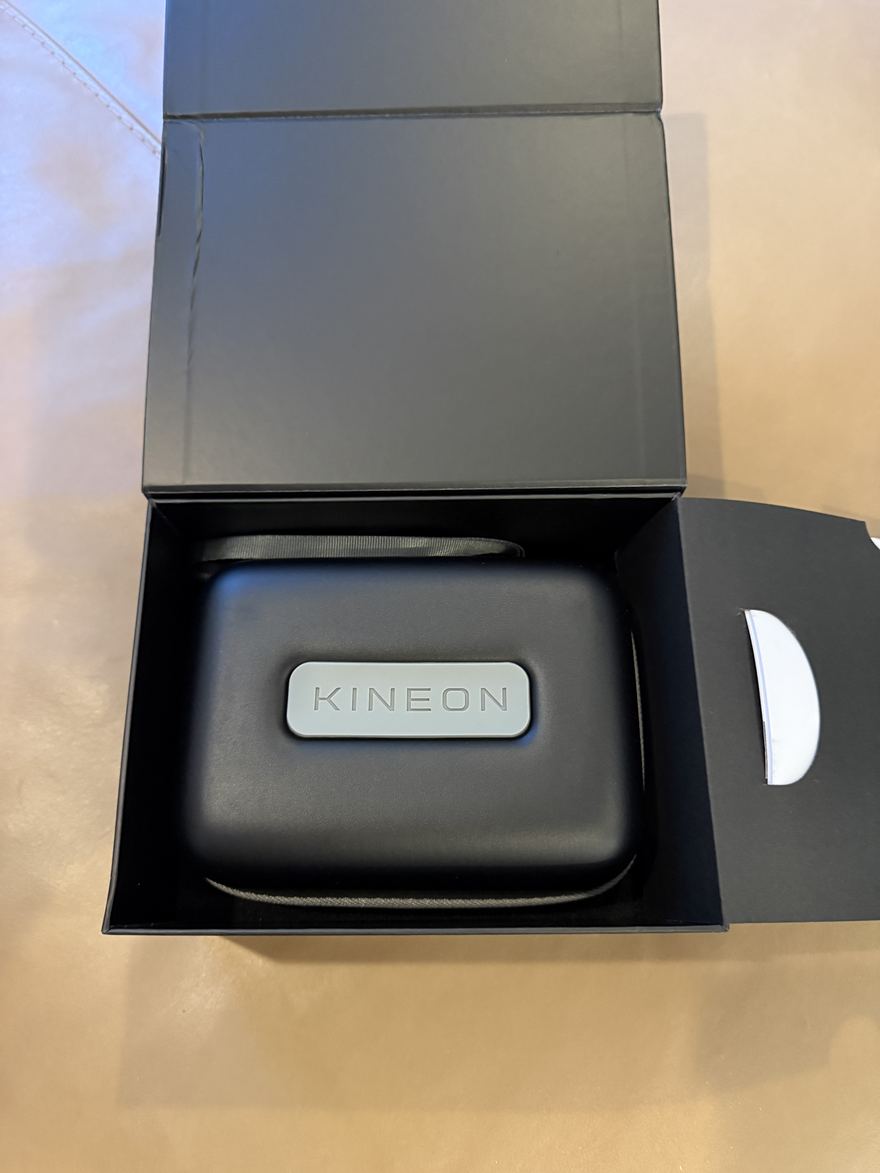
| In the box | Travel case, 3 modules, Adjustable Strap 3.0, charge case, charge cable, user manual, quick start guide | Brand published |
| Session length | 5, 10 or 15 minutes on our unit | Our unit |
| Battery | Several days between charges at two to three sessions a day; never ran flat | Our unit |
| Trial and warranty | 30-day trial, easy returns, 1-year warranty, lifetime support | Brand published |
What we experienced, and what that is worth
This section is one person's month, reported because leaving it out would be dishonest, and framed carefully because one user is not evidence.
The neck was the reason for the test: a long-running area of stiffness and pain. Over the month of near-daily sessions, the neck pain eased noticeably, and turning the head felt freer than it did on day one.
We are not telling you the MOVE+ did that. We ran no controls and measured nothing, and a month is long enough for plenty else to change: sleep, posture, workload, the simple habit of stopping to sit still for ten minutes. One person with no comparison cannot separate those. What we can report is the sequence, plainly: we used it most days for a month, and those things happened over the same period.
Kineon's product page says a single five-minute session "activates an increase in blood flow" and shows an "80% reduction in shoulder pain" between day 1 and day 30. Those are Kineon's statements, and we report them as Kineon's rather than adopting them as ours.
Build: better than the price suggested
Before the box was open, $499 looked steep for three small modules. In hand, the price makes more sense. The connectors seat cleanly, the case is solid and well thought out, the modules feel finished, and the packaging was done with care. It is the kind of build that makes a device feel like something to keep rather than something to try.
The clearest sign of the verdict: we would seriously consider buying a second unit, either to run two areas at once or so two people in the house can each use one.
Where it gives ground
Packing the strap away is fiddly. It has to be folded tight to fit the mesh holder in the case before the case will zip. It is a small thing, and it is the only design annoyance we hit in a month.
It covers one area at a time, by design. Three modules wrap a neck, a wrist or a knee. They do not cover a back or a whole body, and they are not meant to.
Kineon's product page does not print battery life or the session lengths, so the session options and battery experience in this review are what our unit did, not Kineon's specifications.
$499 is a sale price against $699, and it moves with Kineon's promotions, so check the current figure before buying.
Who it is for
The MOVE+ is for the person whose problem is one area and whose obstacle is time. If a panel has turned into furniture in your house, this is the format that removes the reason you stopped. If you want the whole body covered in one sitting, a panel or a mat still does that better, and the MOVE+ is a companion to one rather than a replacement.
How we tested, and our relationship with Kineon
Kineon sent the MOVE+ and the Extender strap free for this review. We earn a commission if you buy through our links, at no cost to you. Kineon saw our findings before publication and had no say over the verdict, which is ours. Every specification above was read from Kineon's US product page on 10 October 2026; everything under "What we experienced" is one person's use, not a measurement.
Is the Kineon MOVE+ worth $499?
For us, yes, and we did not expect to say so. The price reads high for three small modules, but the build is well made and it is the red light device we used most over a month, two or three times a day, because it straps on and goes anywhere. If your goal is whole-body coverage, a panel or mat is the better buy.
How long is a Kineon MOVE+ session?
Our unit offered sessions of five, ten or fifteen minutes. We settled on ten minutes, two to three times a day, following Kineon's neck protocol. Kineon's product page does not print the session lengths, so this is what our unit did rather than a brand specification.
Can you use the MOVE+ while doing other things?
Yes, and that is its main advantage. We used it in the car, at work, on the couch, while getting ready in the morning, before bed and in bed. A panel needs you to sit in one place; the MOVE+ needs only a strap around the area.
How long does the Kineon MOVE+ battery last?
Kineon's product page does not print a battery figure. In our month of use, at two to three ten-minute sessions a day, we regularly went several days between charges and the modules never ran flat.
Kineon MOVE+ or a red light panel?
Pick by the problem. For one area at a time, a neck, wrist or knee, the MOVE+ is easier to use daily and got more use from us than our full-body panel. For whole-body coverage in one session, a panel or a mat covers far more skin.
What comes in the Kineon MOVE+ box?
Kineon lists a travel case, three modules, the Adjustable Strap 3.0, a charge case, a charge cable, a user manual and a quick start guide. The Extender strap is sold separately; ours came with one.
Did the MOVE+ help your neck?
Over a month of near-daily sessions our neck pain eased noticeably and turning the head felt freer. We ran no controls and measured nothing, and plenty else can change in a month, so read it as one person's experience, not a result to expect.
The products this post references
The Longevity Gear Buyer's Checklist
The specs that actually decide whether a sauna, cold plunge, red light panel, or smart ring is worth it, plus the real price range for each. Get the free PDF, plus one weekly email on the gear worth buying.