Lifespan Vault earns an affiliate commission when you buy through links on this page, at no extra cost to you. It does not change our rankings or our verdicts.
Most red light hardware fails on the same thing, and it is not the spec sheet. It is whether you use it. Panels get bought, used enthusiastically for two weeks, then moved to a corner, then to a closet. The device that wins is the one that survives contact with an ordinary evening.
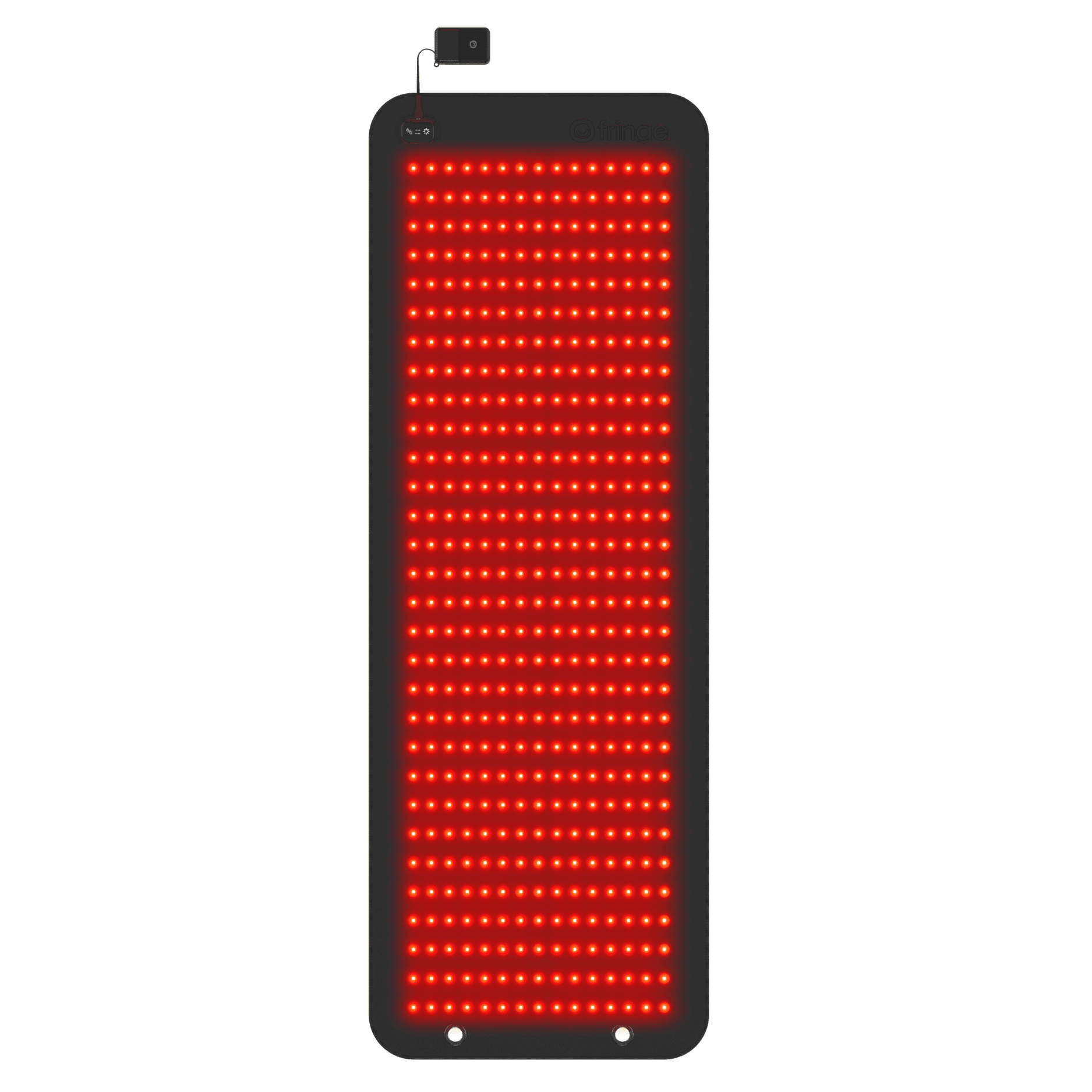
We bought the Fringe Heals Red Light Therapy Mat at the full $749 price in late July and have used it nightly since. This is the first hands-on red light verdict on this site, and it exists because the mat cleared the only bar that matters: it is still in use three weeks later.
Quick answer
- Buy it if you have failed to stick with a panel: the Fringe mat at $749 removes the setup friction that kills panel habits
- Buy it if you want a session you can do while doing something else: reading, winding down, lying in bed
- Skip it if the problem is one joint, not the whole body: the NovaaLab Light Pad at $349.90 concentrates on a single zone
What actually changed: it gets used
The honest headline of three weeks with this mat is boring and it is the entire point. It gets used every night, and no other red light device we own has managed that.
The routine is roll it out on the bed while winding down, plug it in, press the power button, lie down. That is the whole ritual. A pillow props up and the session runs while reading. Nothing about it requires dedicating a block of time to standing in front of a light.
Compare that with a full-body panel, which is the thing this replaced in practice. A panel needs floor space, a clear wall, and thirty minutes of standing or sitting in front of it doing nothing else. Every one of those is a small reason to skip a night, and small reasons compound. The mat has none of them.
The spec we thought was a weakness
Fringe publishes 20 to 40 mW/cm2 maximum at 0 inches. Next to a NovaaLab Light Pad publishing up to 150 mW/cm2, that reads as a shortfall, and we said so on the product page before testing.
Three weeks in, that reading was wrong, and the reason is thermal. The mat warms only slightly in use. It is not uncomfortable to lie on, and it does not turn a wind-down into a sweat. We have run over an hour in a single sitting, well past the 15 and 30 minute auto-timer cycles, without getting hot.
That is the trade the intensity number does not show, and the arithmetic settles it. Dose is irradiance multiplied by time. An hour on the mat at its published 40 mW/cm2 works out to about 144 joules per square centimetre. Ten minutes on a NovaaLab pad at its published 150 mW/cm2 works out to about 90. The lower-intensity surface delivers more energy per square centimetre, because you can stay on it longer, and it does that across 1,632 square inches instead of 129.
So lower irradiance is not a weakness and it is not secretly a strength either. It is a different way of arriving at a dose: less power held longer over more skin, rather than more power held briefly on one spot. Both are legitimate. Which one you want depends on whether the problem is one joint or a whole body.
Two honest limits on that maths. Both irradiance figures are brand-published at zero inches and neither is independently measured, ours included. And more delivered energy is not automatically better; the photobiomodulation literature describes a dose-response window rather than a straight line, so we are comparing what the devices deliver, not claiming an outcome.
Specs, verified
| Spec | Fringe Heals Mat | Source |
|---|---|---|
| Price | $749 single, $1,275 two-pack | fringeheals.com |
| Wavelengths | 660nm red + 850nm near-infrared, 1:2 ratio | Brand published |
| LEDs | 450 at 0.36W, 3 chips each, 1,350 chips, 162W | Brand published |
| Irradiance | 20 to 40 mW/cm2 max at 0 inches | Brand published |
| Size and weight | 68 x 24 inches, 7.3 lbs | Brand published |
| Sessions | Auto timer 15 or 30 min, 2 brightness levels | Brand published |
| Power | DC 12V-3A, or 20,000mAh bank (2 to 3 thirty-minute sessions) | Brand published |
| EMF | 0.0mG at 0 inches on battery, flicker under 1% | Brand stated |
| Warranty and returns | 1-year limited, 60-day return | Brand published |
What we experienced, and what that is worth
This section is one person's experience over roughly three weeks, reported because leaving it out would be dishonest, and framed carefully because a single user is not evidence.
Over that period, sleep was noticeably better. Ankle pain that had been present is gone, and shoulder pain is gone.
We are not telling you the mat did that. We ran no controls, measured nothing, and changed other things in the same weeks as anyone would. Pain resolves on its own, sleep responds to a dozen inputs, and the act of lying still for half an hour before bed is itself a sleep intervention independent of any light. A sample of one person with no blinding cannot separate those.
What we can report is the sequence, plainly: we used it nightly for three weeks and those things happened over the same period. Read it as a reason to look at the research, not as a result you should expect.
Fringe states the device is FDA registered for pain relief and increased blood flow. That is a manufacturer statement about a regulatory registration, which is not the same as a clinical outcome, and we report it as theirs rather than adopting it as ours.
The battery is a bigger deal than it sounds
The mat ships with a 20,000mAh power bank, which Fringe rates at two to three thirty-minute sessions or four to five fifteen-minute ones per charge. On paper that reads as a convenience feature. In use it is what makes the mat portable, and it means a session does not require being near an outlet.
It is also the configuration Fringe cites for the 0.0mG EMF figure, since running off a battery removes the mains-powered field entirely. Anyone who cares about EMF should note that the claim is specific to battery operation.
Where it gives ground
The auto timer runs 15 or 30 minutes, so an hour-long session means restarting it. Minor, but real.
At 68 by 24 inches it covers a body lying down, not a body standing, so it is a back-or-front proposition per session rather than both at once.
The panel is flexible, recycled polyurethane and natural rubber, so it will wrap around a torso, a leg, a knee or a shoulder if you want to concentrate it on one area. Nothing secures it there, though. Fringe includes a carrying strap for transport, not a body strap, so wrapping is a hold-it-in-place arrangement rather than a fastened wrap. Useful to know if you are weighing this against a device built to strap on.
And the irradiance question stands honestly unresolved. We can report comfort and adherence from three weeks of use. We cannot report delivered dose, because measuring that needs equipment we do not have, and we are not going to infer it from a brand-published figure.
Bottom line
The Fringe Heals mat at $749 is the red light device that survived our evenings. Its lower published intensity turns out to be the feature that makes an hour comfortable, and the format removes the friction that quietly kills panel habits.
Buy it if adherence is your actual problem, which for most people who own red light hardware it is. Skip it if your problem is one joint rather than a whole body: the NovaaLab Light Pad at $349.90 concentrates its output on a single zone, which is the right tool for a knee or an elbow and the wrong one for a nightly full-body session.
One disclosure worth stating plainly: we paid full retail for this mat, and no one paid us for this review.
Is the Fringe red light mat worth $749?
It depends on whether adherence is your problem. We paid $749 in late July and used it nightly for three weeks, which no other red light device we own has managed. If you already own a panel that sits unused, the mat solves the actual failure. If you want maximum intensity on a single joint, the NovaaLab Light Pad at $349.90 publishes up to 150 mW/cm2 over one zone for less than half the price.
Does the Fringe mat get hot to lie on?
Barely. This was the surprise of testing. The mat warms only slightly, and we have run over an hour in a single sitting without getting hot or sweating. That comfort is the practical upside of the 20 to 40 mW/cm2 published irradiance: a surface intense enough to compete with a 150 mW/cm2 spot device would not be one you could lie on comfortably for an hour.
How long does the Fringe mat battery last?
Fringe rates the included 20,000mAh power bank at two to three thirty-minute sessions or four to five fifteen-minute sessions per charge. The mat also runs on a DC 12V-3A adapter with a 6ft cord. Battery operation is the configuration Fringe cites for its 0.0mG EMF figure, since running off a bank removes the mains field.
What wavelengths does the Fringe mat use?
660nm red and 850nm near-infrared in a 1:2 ratio, meaning each of the 450 LEDs carries one red chip and two near-infrared chips for 1,350 chips total at 162W. It runs continuous wave with no pulsing, and Fringe publishes light flicker under 1%. All figures are brand-published and verified against fringeheals.com.
Did the mat fix your pain and sleep?
We do not know, and neither does anyone else from three weeks of one person's use. Sleep was better and two areas of pain resolved over the period we used it nightly. We ran no controls and measured nothing, other things changed in those weeks, and lying still for thirty minutes before bed is itself a sleep intervention independent of light. Read it as a reason to look at the research, not a result to expect.
The products this post references


The Longevity Gear Buyer's Checklist
The specs that actually decide whether a sauna, cold plunge, red light panel, or smart ring is worth it, plus the real price range for each. Get the free PDF, plus one weekly email on the gear worth buying.