Lifespan Vault earns an affiliate commission when you buy through links on this page, at no extra cost to you. It does not change our rankings or our verdicts.
Water-to-Go is a portable purification brand, not a home filtration brand, and that distinction decides whether any of it is worth your money. The company sells three bottle sizes that all run one identical cartridge, which Water-to-Go rates at up to 99.999% removal of contaminants including viruses, bacteria, parasites, heavy metals, chemicals, pesticides, and microplastics. The virus rating is the brand's own published claim and it is the line most squeeze-style filter bottles do not advertise, since those are typically rated for bacteria and protozoa only.
Here is the direct answer. If you travel or hike and want the most filtered water per fill, buy the Water-to-Go Extra Large 1L at $69.99, verified 2026-08-14. If your actual problem is the water at your kitchen sink, buy nothing from this brand, because a certified under-sink unit like the Frizzlife SP99 at $109.99 on sale, verified 2026-06-27, does a job the bottle is not built to do. And whichever shell you pick, the number that decides the real cost is the Replacement Filter Twin Pack at $49.99, verified 2026-08-14, which comes to about 12.5 cents per rated liter and roughly $100 a year.
Quick answer
- Travelers and hikers who want maximum volume per fill: the Water-to-Go Extra Large 1L at $69.99, a full liter per fill so refill stops come half as often.
- Day-bag and commuter carry: the Water-to-Go Large 26 oz at $64.99, the size most likely to fit the pocket you actually use.
- Existing owners stocking before a trip: the Water-to-Go Replacement Filter Twin Pack at $49.99, six rated months of filtration and the only recurring cost in the system.
At a glance
| Product | Capacity | Verified price | Price verified | Rated filter life | Colors |
|---|---|---|---|---|---|
| Extra Large 1L | 33.8 fl oz (1L) | $69.99 | 2026-08-14 | 200 L / 53 gal per filter | Cloud Grey, Jet Black |
| Large 26 oz | 26 oz (75cl) | $64.99 | 2026-08-14 | 200 L / 53 gal per filter | Grey Red, Grey White |
| Small 18.5 oz | 18.5 fl oz (55cl) | $59.99 | 2026-08-14 | 200 L / 53 gal per filter | Black, Green |
| Replacement Filter Twin Pack | 2 filters | $49.99 | 2026-08-14 | about 6 months for one bottle | n/a |
Who Water-to-Go actually is
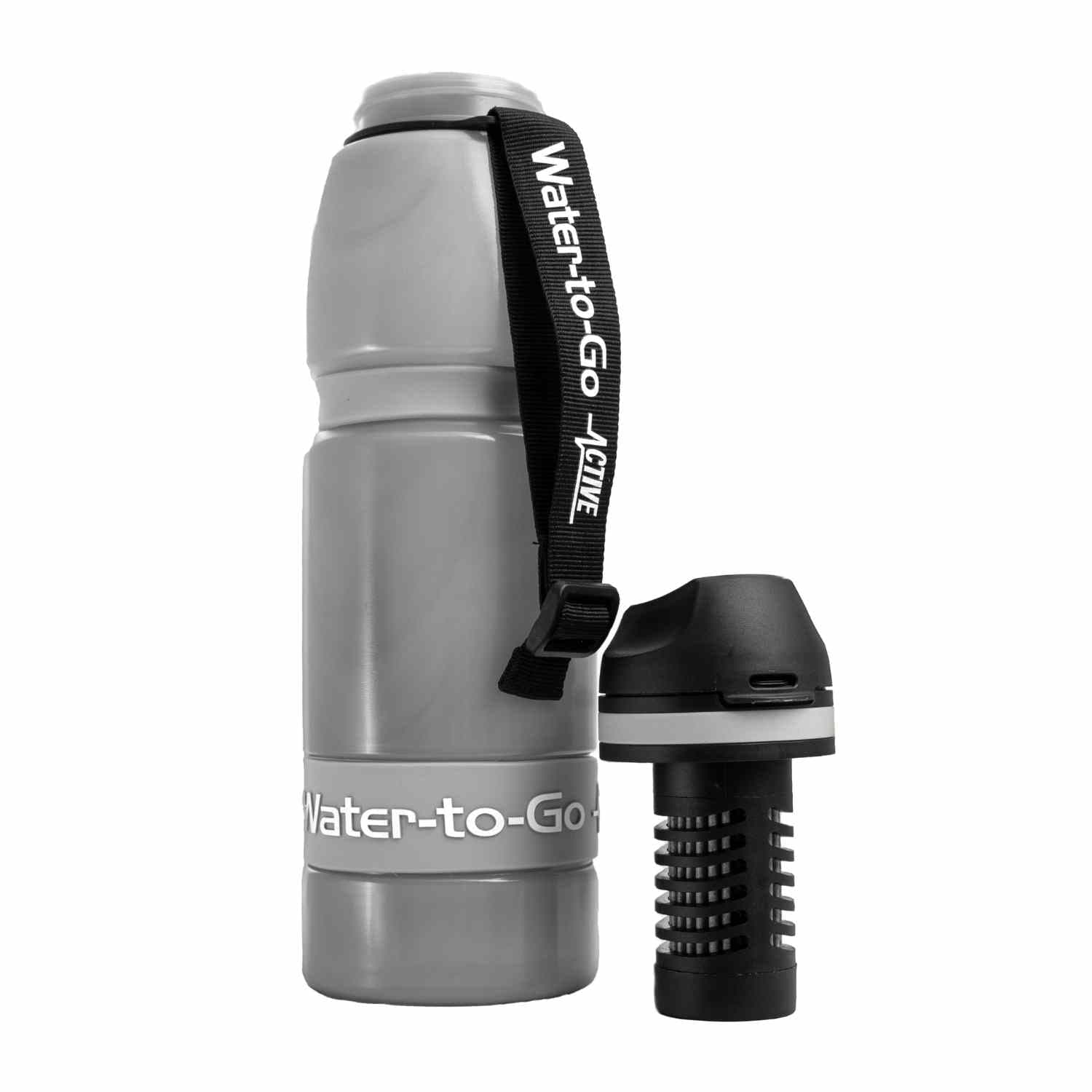
Water-to-Go sells one filtration element in three shells. The Small, the Large, and the Extra Large all take the same cartridge, which the brand describes as a 3-in-1 filter combining a small physical pore size, activated carbon, and electropositive nanofiltration. Water-to-Go explains the mechanism as a carbon-loaded nanofiber mesh whose strands carry millions of tiny positively charged hairs, so contaminants carrying a negative charge are attracted and held. On the twin pack listing the brand states the same three stages slightly differently: small pore mechanical trapping, a positive electrical charge, and activated carbon held loose within the membrane.
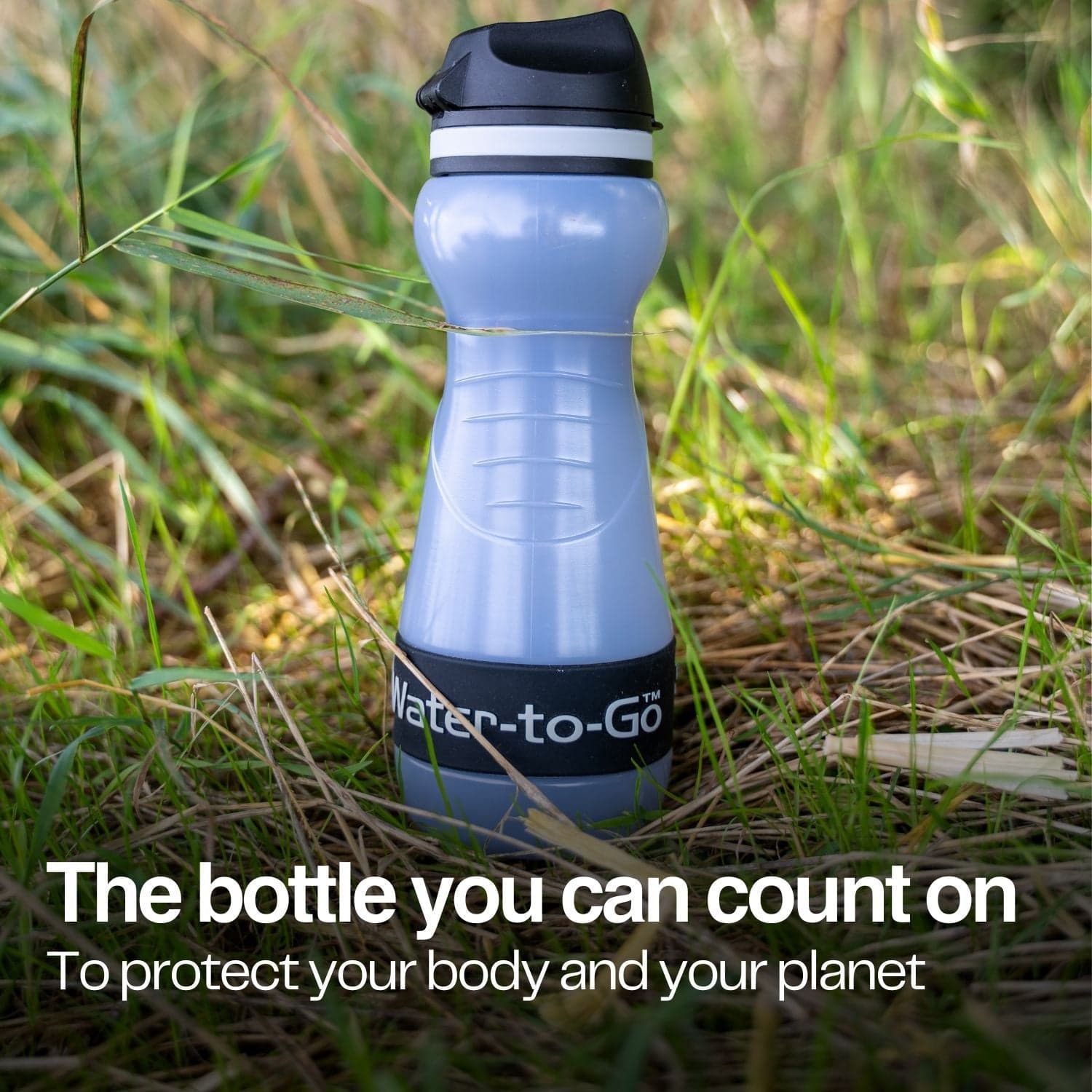
The bottle bodies are made from a sugarcane-derived bioplastic, excluding the lid and the filter shroud. Water-to-Go states that all components are BPA free and FDA approved, that the bottle is recyclable and the filter medium is compostable, and that the sugarcane bottle is produced with 60% less energy and 40% less greenhouse gases than a regular plastic bottle. Those are the brand's figures, not measurements we ran. Packaging is recycled cardboard printed with vegetable inks. Returns run 60 days with a prepaid label the company supplies, and the lid design carries what Water-to-Go calls a No Leak Lifetime Guarantee. Everything we have carded sits on the Water-to-Go brand hub.
On third-party testing, be precise about what exists. Water-to-Go names the London School of Hygiene and Tropical Medicine in the UK, Bangalore Test House in India, BCS Laboratories in the USA, and SGS. What we do not have in our verified data is an NSF/ANSI or WQA listing under the brand. That gap matters less for a travel bottle than for a system plumbed into your house, but it is the honest state of the evidence.
The flagship: Extra Large 1L
At 33.8 fl oz the Extra Large is the biggest bottle Water-to-Go lists, sold in Cloud Grey and Jet Black at $69.99, verified 2026-08-14. Both variants were listed in stock. The verified specs on our card: filter life of 200 liters, or 53 gallons, which the brand frames as about three months at two to three tap refills a day; the 3-in-1 filter technology described above; a sugarcane bioplastic body with lid and filter shroud excluded; a 15 minute activation soak with the filter fully submerged before first use, with the brand stating a filter can be safely reactivated three times; a three year shelf life for an unactivated filter kept dry in its original packaging; and dishwasher-safe cleaning with the filter removed first.
The use case is narrow and real. You fill from a tap, a stream, or a hotel sink you do not trust, and you drink through the lid. At a liter per fill you hit refill points half as often as the Small does, which is the entire argument for the extra $10.
Where the Extra Large gives ground
It is not a desalinator. Water-to-Go states the filter is not effective on sea water, and separately that the filter must not be frozen, since a frozen filter will not work properly until it is defrosted with lukewarm water. Sediment-heavy water shortens filter life below the 200-liter rating, so anyone drawing from silty backcountry sources should expect a shorter cartridge life and pre-settle murky water where possible. The brand also says the bottles are designed to purify as you drink, not to fill another vessel, so a glass or a cooking pot is out. Flow is slower than a normal bottle by design, which Water-to-Go attributes to the filter doing its job. Finally, the liter shell is the least likely of the three to fit a bike cage or a slim daypack pocket.
The Large 26 oz: the fit pick
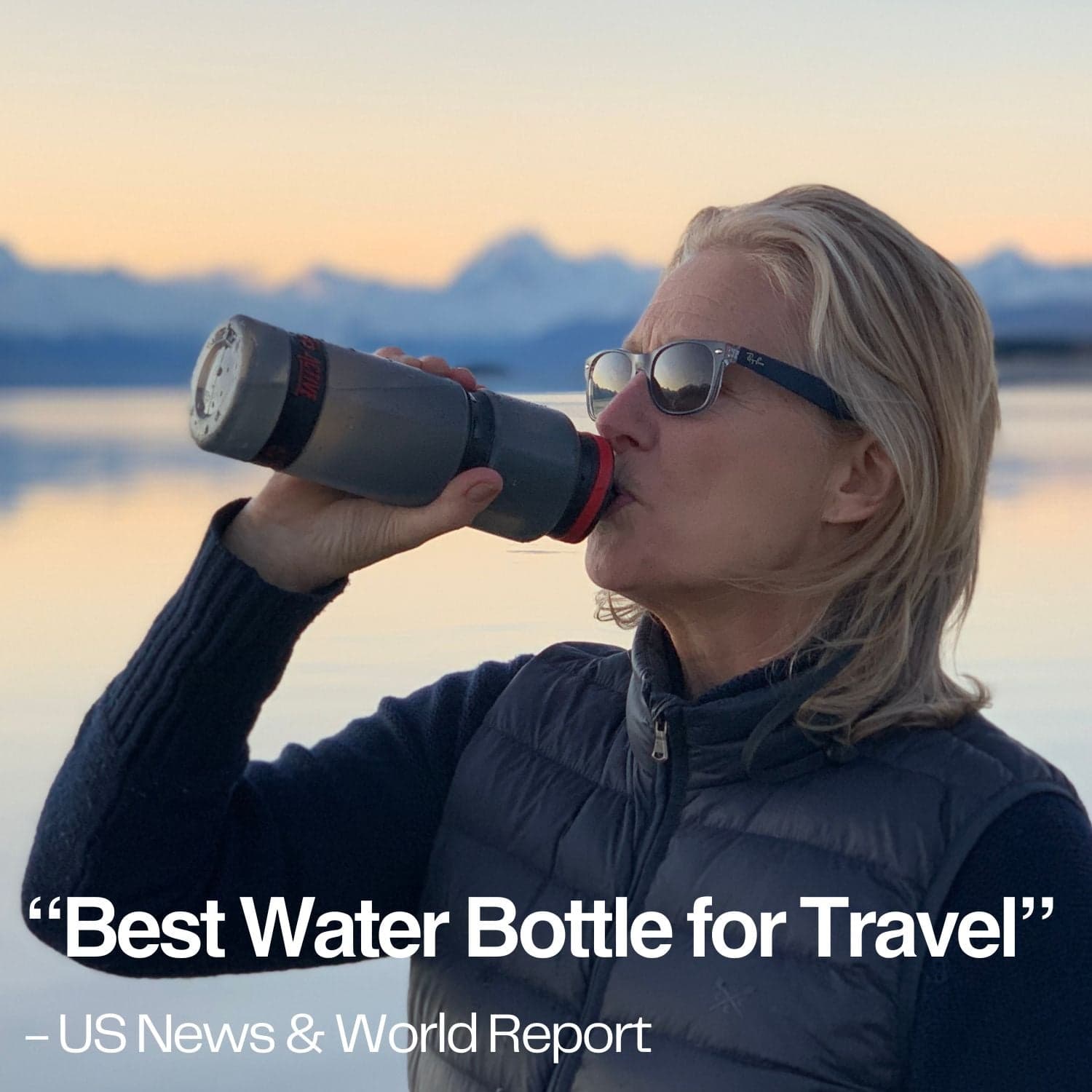
The Large sits in the middle at 26 oz (75cl), $64.99, verified 2026-08-14, in Grey Red and Grey White. Water-to-Go highlights that this model was named a best water bottle for travel by US News and World Report. It runs the identical cartridge, so nothing about filtration changes. The brand's own arithmetic on this size is useful: 200 liters comes to roughly 266 full bottles per filter.
Where the Large gives ground
The case for the Large is fit, not price. It costs only $5 less than the Extra Large while holding roughly 7.8 fl oz less per fill, so if capacity per dollar is what you are optimizing, the liter bottle wins outright. Every line-wide limit still applies: no sea water, no freezing, shorter life on sediment, no pouring filtered water out for cooking. And if you want to mix electrolytes or protein powder, Water-to-Go says powders are captured by the filter, so you have to unscrew the filter, mix with water you already trust, then reattach it.
The Small 18.5 oz: the packable pick
The Small is the entry point at $59.99, verified 2026-08-14, an 18.5 fl oz (55cl) bottle in Black and Green. Same cartridge, same 200-liter rating, which at this size the brand puts at roughly 363 fills. Our card also records the 15 minute activation soak, the three year unactivated shelf life, and that the bottle is recyclable with a compostable filter medium.
Where the Small gives ground
You refill nearly twice as often as with the liter bottle. For airport-to-hotel travel with taps everywhere that is a non-issue. For long stretches between water sources it is exactly why the bigger shells exist. It is also the worst value per ounce of capacity in the range: $10 less than the Extra Large buys you 15.3 fewer fluid ounces per fill. Buy it because it fits the bag you carry, not because it is the cheap one.
The twin pack is the real product
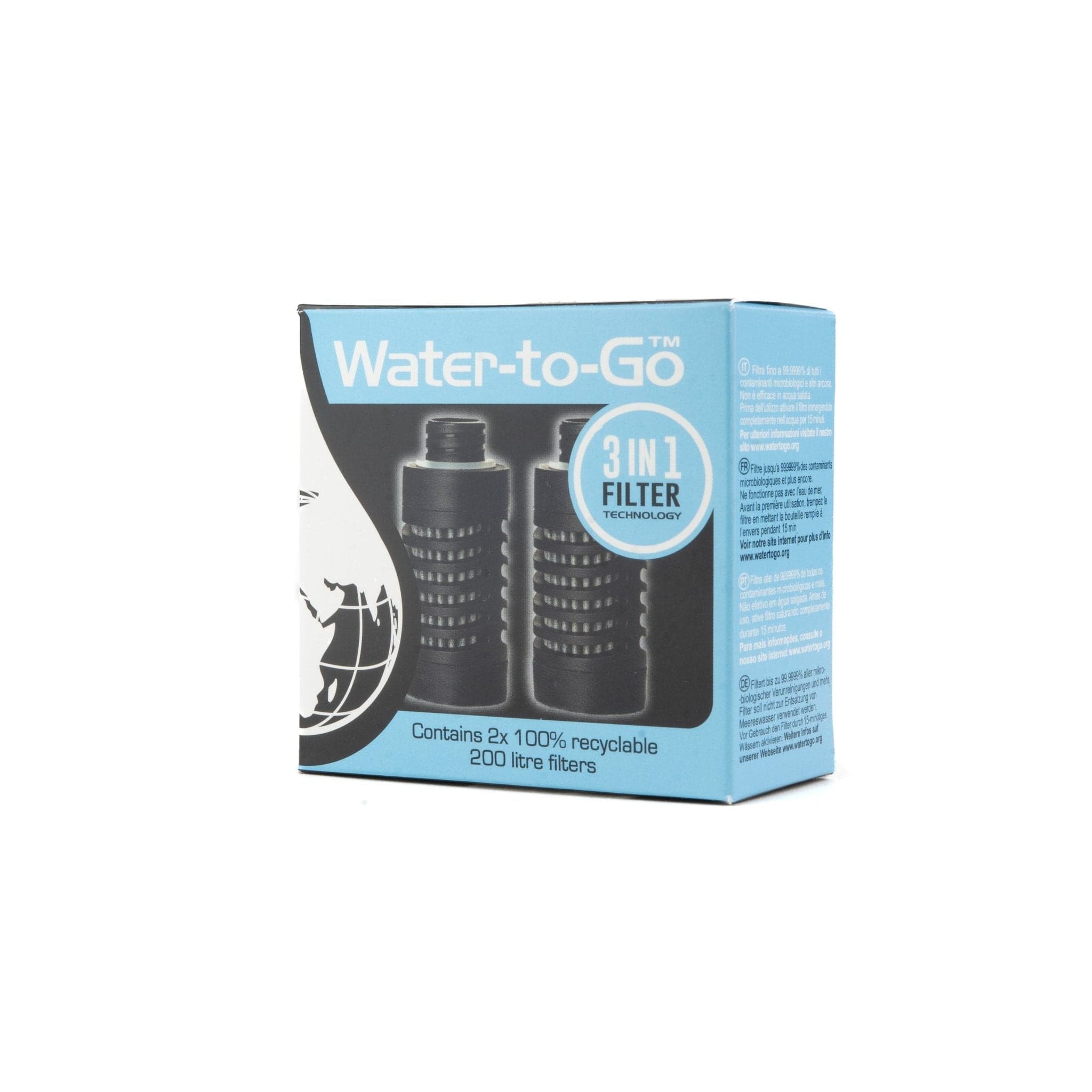
Every honest read of this brand ends at the Replacement Filter Twin Pack, $49.99, verified 2026-08-14. Two filters, each rated for three months or 200 liters (53 gallons), whichever comes first, and the pack fits all Water-to-Go bottles. That last part is the quiet advantage: a household running a Small and a Large stocks exactly one filter type, with no size matching or model-year guesswork.
The arithmetic is straightforward. Two filters at 200 liters each is 400 rated liters for $49.99, about 12.5 cents per liter. That is the figure to hold against bottled water on a long trip. Because the bottles ship with a cartridge already, year one on the Extra Large is $69.99 plus one $49.99 twin pack, so $119.98 covering roughly nine rated months. Steady state after that is two packs a year, close to $100. No subscription is required, and Water-to-Go says that if you bought the bottle from its own site it emails a reminder after three months.
Where the twin pack gives ground
The rated three months is a ceiling, not a promise. The brand itself recommends replacing every two months where the water supply is particularly unsafe, which pushes a solo user toward six filters a year, or about $150. Sediment cuts life further, and powders in the bottle do the same. Filters are not designed to be flushed, so you cannot rinse life back into one. And the reactivation allowance is finite: three soaks, then replace.
Portable purification versus a home system
These are different problems, and conflating them is how people overspend. A home filter treats one known input, your pressurized municipal or well supply, continuously, at a tap, with certified performance you can look up. A purifier bottle treats an unknown input, once, in the volume you can carry. Our whole house versus under-sink comparison (Sponsored by Kind Water) covers the home side of that split, and the home air and water quality setup (Sponsored by Kind Water) piece frames which jobs are worth covering at all.
The price comparison is unflattering to the bottle if you use it wrong. The Frizzlife SP99 is certified to NSF/ANSI 42 and 53, tested by IAPMO, and runs $109.99 on sale against $129.99 regular, verified 2026-06-27, including a lead-free faucet and a claimed sub-15-minute install. That is less than the $119.98 you spend on an Extra Large plus its first twin pack, and it covers the water you actually cook with. Buy the bottle for the water you cannot control, not the water you can.
How Water-to-Go compares to three catalog alternatives
The Boroux Legacy at $355 with two filters, verified 2026-08-16, is the answer when confirmable certification is the deciding factor. We checked WQA listings for NSF/ANSI 42, NSF/ANSI/CAN 372, and NSF/ANSI 401 ourselves in the WQA database, with the scope note that the Foundation element is listed for materials safety only, not contaminant-reduction performance. It needs no plumbing or power, but it is a countertop tower, not luggage.
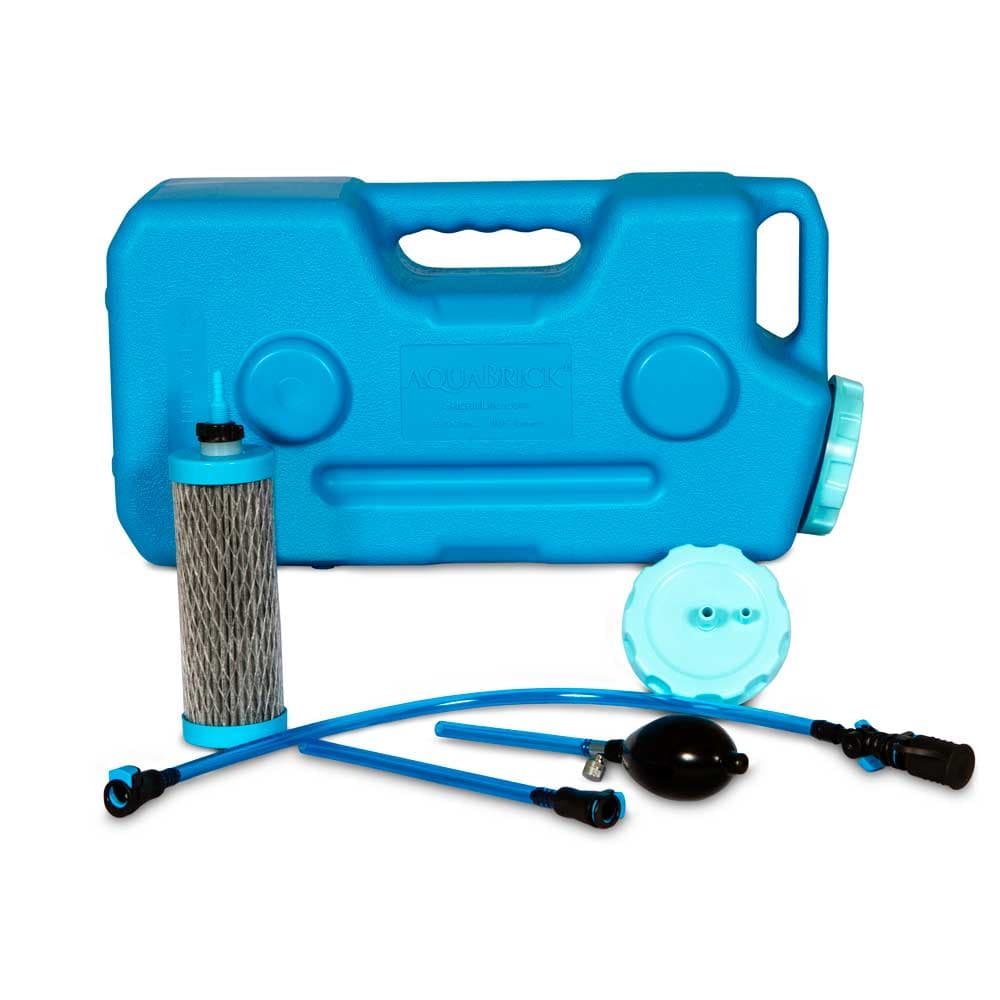
The Sagan Life AquaBrick at $184.99, verified 2026-06-27, is the closest thing here to a competitor on Water-to-Go's own turf, and it beats the bottle on two counts. Its DuraFlo filter is rated for up to 700 gallons versus 53 gallons per Water-to-Go cartridge, and it dispenses through a spigot, so it can fill a pot the bottles explicitly cannot. It is a 3-gallon stackable brick with a hand pump, so it goes in a truck or a cabin, not a daypack.
The Frizzlife SP99 at $109.99 on sale, verified 2026-06-27, is the home answer, and the honest limit there is PFAS: its page certifies NSF/ANSI 42 and 53 but does not list certified PFAS reduction. For the full landscape, the best water filtration guide lays out every tier we cover, and our best filtered water bottle roundup sizes the three Water-to-Go shells against each other in more detail.
Who should buy which
- Frequent international travelers: the Extra Large 1L at $69.99. The virus rating the brand publishes is the reason to choose Water-to-Go over a bacteria-and-protozoa bottle, and a liter per fill suits long transit days.
- Commuters and day hikers: the Large 26 oz at $64.99, or the Small 18.5 oz at $59.99 if pocket fit is the constraint. Identical filtration either way, so pick the shell your bag takes.
- Anyone who already owns a bottle: the twin pack at $49.99 before the trip, not after. Unopened filters keep three years in original packaging, so buying ahead costs you nothing.
- Households fixing their kitchen tap: none of these. Start with the Frizzlife SP99 at $109.99 on sale, or the Boroux Legacy at $355 if you rent or want no plumbing.
- Preparedness and off-grid buyers: the Sagan Life AquaBrick at $184.99, rated to 700 gallons, is the better tool than a bottle rated to 53.
Bottom line
Water-to-Go is a good answer to a specific question: how do you drink water you did not source yourself. The Extra Large 1L at $69.99, verified 2026-08-14, is the right default because it costs $10 more than the Small and carries nearly twice the water, and every shell runs the same cartridge so the size choice is about fit alone. Go in knowing the running cost, not just the sticker: about 12.5 cents per rated liter, roughly $100 a year at the brand's three-month cadence, and more if you follow its own advice to swap every two months where water is particularly unsafe. And do not ask it to be a home filter, because it cannot fill a pot, it will not touch sea water, and a certified under-sink unit costs less than the bottle plus its first twin pack.
Is Water-to-Go worth buying if I already filter my water at home?
Only if you drink water you did not pour at home. A home system treats one tap under pressure. Water-to-Go treats whatever you can fill from, and Water-to-Go rates its cartridge at up to 99.999% removal of contaminants including viruses. At $69.99 for the 1L bottle, verified 2026-08-14, it is travel gear, not a home upgrade.
How much do Water-to-Go filters cost per year?
The Replacement Filter Twin Pack is $49.99, verified 2026-08-14, and each of the two filters is rated for 200 liters, or 53 gallons, which the brand frames as about three months. At that cadence one person needs two packs a year, roughly $100, or about 12.5 cents per rated liter. Sediment-heavy water shortens filter life below the rating.
Is Water-to-Go NSF certified?
No NSF/ANSI or WQA listing for Water-to-Go appears in our verified data. The brand names the London School of Hygiene and Tropical Medicine, Bangalore Test House, BCS Laboratories, and SGS as independent testers. If a confirmable listing decides your purchase, the Boroux Legacy at $355, verified 2026-08-16, carries WQA listings we checked ourselves.
Can a Water-to-Go bottle replace a home water filter?
No. Water-to-Go says the bottles purify water as you drink and are not designed to fill a glass or a cooking pot, so they cannot supply a kitchen. A certified under-sink unit like the Frizzlife SP99 runs $109.99 on sale, verified 2026-06-27, which is less than the bottle plus its first twin pack.
What happens if my Water-to-Go filter freezes or dries out?
Different outcomes. Water-to-Go says a frozen filter will not work effectively and needs defrosting with lukewarm water before reuse. A filter that has dried out is recoverable: repeat the 15 minute soak with the filter fully submerged. The brand states a filter can be safely reactivated three times before replacement.
The products this post references


The Longevity Gear Buyer's Checklist
The specs that actually decide whether a sauna, cold plunge, red light panel, or smart ring is worth it, plus the real price range for each. Get the free PDF, plus one weekly email on the gear worth buying.