Lifespan Vault earns an affiliate commission when you buy through links on this page, at no extra cost to you. It does not change our rankings or our verdicts.
ARX comes up in conversations about strength after 50 for a reason unrelated to its 15-minute pitch. What pushes people out of a weight room in their fifties and sixties is a loaded bar to control on the way down and the partner needed behind it. ARX's two machines, the Alpha and the Omni, are built without either: a computer-controlled motor pushes back with exactly the force you produce at every point in the rep, including the lowering, or eccentric, phase that ARX says weights cannot load, and the software records the force on every rep so you can watch one number move over months.
The direct answer: the ARX Alpha at $43,000 (verified 2026-09-17) is the machine for a home buyer over 50 who wants six guided movements, no spotter and per-rep force data in the smallest footprint ARX makes. The ARX Omni at $46,000 (verified 2026-09-17) is for the buyer who wants belt squat, deadlift and the rest of a sixteen-exercise cable library on one machine. Both need a $200 a month home software subscription on top, and everything ARX says about results, including its XPRIZE Healthspan role, is either the brand's cited study or a training arm that has not reported. We have not tested either machine.
Quick answer
- Home buyer over 50, smallest footprint: the ARX Alpha at $43,000, six movements on a guided sled with no bar to catch.
- Full exercise library on one machine: the ARX Omni at $46,000, sixteen cable-driven movements including belt squat and deadlift.
- Eccentric loading without the $43,000 ticket: the Speediance Gym Monster 2 at $3,272 to $4,649, digital cable resistance with an Eccentric mode and no required subscription.

At a glance
| Machine | Verified price | Software | Exercises | Footprint | Weight | Power |
|---|---|---|---|---|---|---|
| ARX Alpha | $43,000, verified 2026-09-17 | $200/mo home, $400/mo commercial, required | 6 on a guided sled | 21 sq ft (32 x 94 x 66 in) | 655 lb | Dedicated 110V 20A or 220V 15A circuit, not GFCI |
| ARX Omni | $46,000, verified 2026-09-17 | $200/mo home, $400/mo commercial, required | 16, cable-driven | 37 sq ft (42 x 128 x 90 in) | 680 lb | Dedicated 110V 20A or 220V 15A circuit, not GFCI |
| Speediance Gym Monster 2 | $3,272 to $4,649, verified 2026-08-14 | None required; optional Wellness+ at $24.90/mo or $249/yr | Cable, up to 220 lb total, 4 modes | 9.04 sq ft unfolded, 2.69 sq ft folded | Not in our verified data | Not in our verified data |
What motor-matched resistance changes on the way down
A barbell or a weight stack is the same weight on the way up as on the way down. ARX's stated position is that weights cannot load the lowering phase, and the logic is simple: a fixed weight has to be light enough to lift, so the lowering phase, where a lifter can typically handle more, never gets the load it could take. ARX's answer is a motor that pushes back with exactly the force you produce at every point in the rep; there is no number on the stack to outgrow.
The software runs that motor through any rep scheme ARX supports: standard, negative-only, positive-only, static, time-under-tension and partial-range sets, with adjustable rep speed, set, pause and rest times. Because the dashboard records max force separately for the concentric and eccentric directions, an owner can check whether the lowering number really sits above the lifting number.
What that means for joint load, and what we cannot say
Follow ARX's description to its conclusion and the resistance on the joint at any instant is never more than the force you are producing at that instant. Produce less at the bottom of a leg press and the motor gives you less. There is no mass carrying momentum into the end of the range, nothing to rack, nothing to catch, and on the Alpha the guided sled keeps every rep on one path. That is the joint-load case, a mechanism argument drawn from how ARX describes the machine, not a measured figure; no joint-force measurement is in our verified data.
The same mechanism cuts the other way. Because the motor matches whatever you give it, it will also let you produce maximal force on every rep, including the lowering phase, where most people can produce the most, so the load on tissue under a hard negative-only set can be higher than under a weight you picked conservatively. The machine matches effort; it does not decide it. ARX's own concession applies here: barbells teach you to balance and stabilize real loads, which a sled that holds the path does not. If a joint is already under someone's care, how to load it is that person's call, not a review's.
Training alone after 50
ARX says all its machines can be programmed and controlled by the software so you can train alone, and it calls the Alpha its easiest machine to learn at any skill level. Onboarding through ARX Academy and the ARX Certified Course come with every new machine, and ARX arranges delivery and install, typically two to four weeks. The session ARX describes is about 15 minutes, twice a week; most users, it notes, train one to two times per week.
The Alpha weighs 655 pounds and the Omni 680, so the route into the room matters as much as the room. Both need their own circuit, 110V on a dedicated 20A or 220V on a dedicated 15A, and ARX states its machines are not compatible with GFCI outlets. Budget an electrician; that cost is not in our verified data.
Force data: the number that tells you which way you are going
The software records total force, max force in both the concentric and eccentric directions, rep speed, range of motion, intensity, exercise time and fatigue to an online dashboard. For a lifter over 50 that number, per movement and per session, shows whether the trend is up, flat or down without a max attempt.
Two facts about that software decide the purchase. It is a separate, required subscription, $200 a month for home use or $400 commercial, with lifetime licenses available at a price not in our verified data. And the license is non-transferable: without an active license the machine will not run, which is why ARX discourages third-party used purchases, reviews every serial number before selling a new license, and ends the warranty when a machine changes hands.
ARX Alpha: six movements, 21 square feet
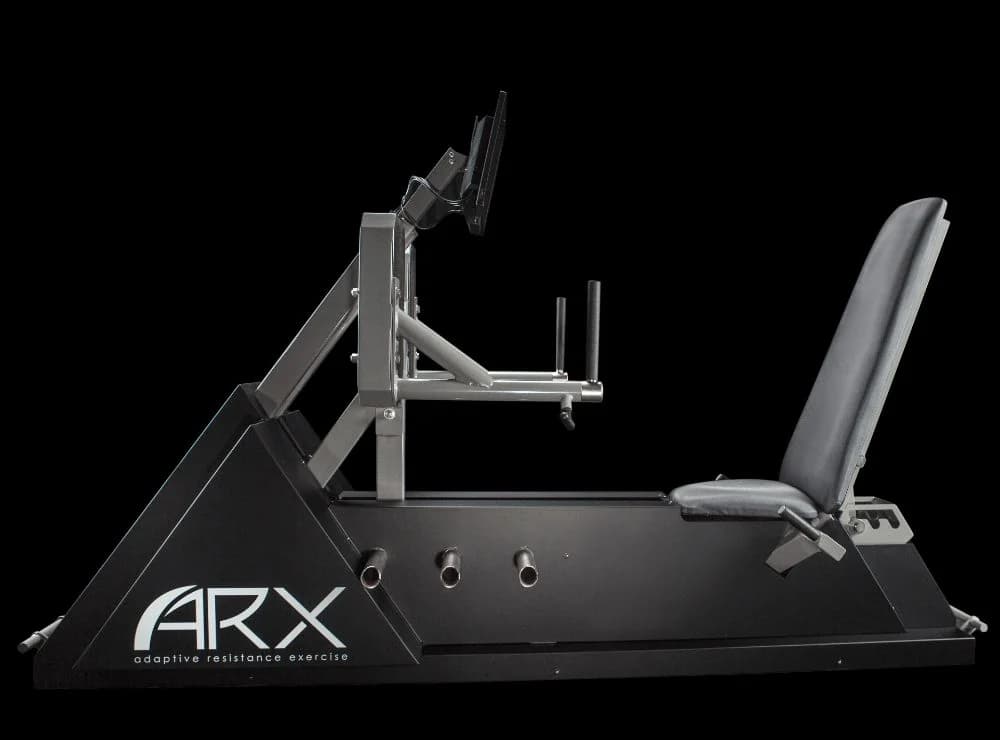
The Alpha is the smaller of the two machines ARX builds in Austin, Texas. Its resistance rides on a guided sled across six exercises: leg press, chest press, row, calf raise, torso flexion and torso extension. The footprint is 21 square feet, 32 by 94 by 66 inches, at 655 pounds. Hardware is $43,000 (verified 2026-09-17), with the same software and data as the Omni and a complimentary one-year warranty. There is no checkout; the purchase runs through a Talk to ARX call. The case for a home buyer over 50 is a full session on a fixed path with the fewest decisions per rep.
Where it gives ground: six movements is the whole list. There is no belt squat, deadlift, hamstring curl or pulldown, and no grips or attachments to change; those live only on the Omni. The guided path that makes it easy to learn is also why it does not train balance or stabilization, which ARX credits to barbells. It is a $43,000 single-purpose machine with a $200 a month bill, and if the subscription lapses the machine stops.
ARX Omni: sixteen movements, 37 square feet
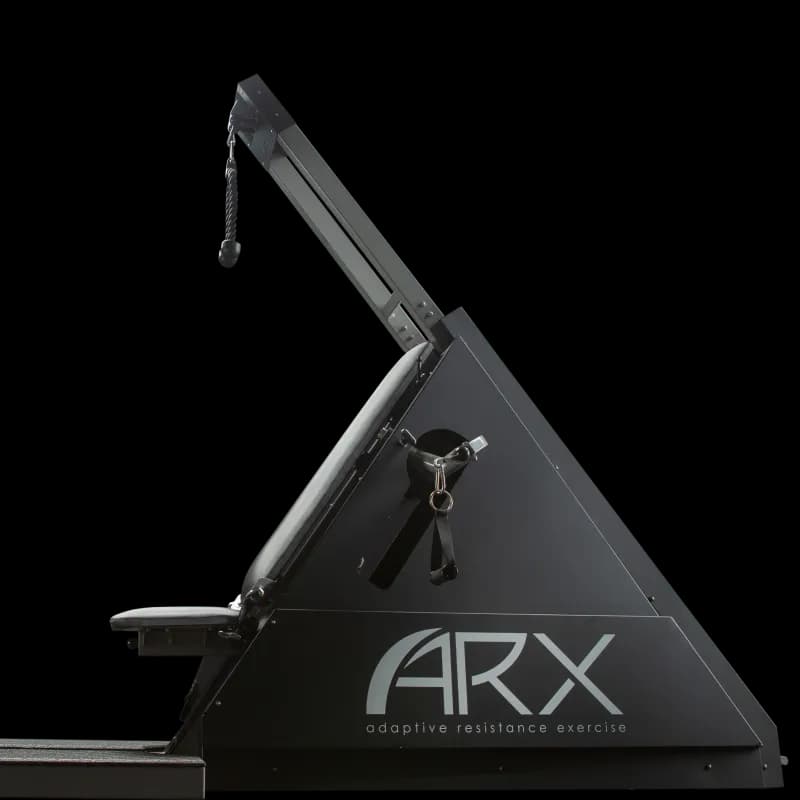
The Omni is the flagship. The same motor-matched resistance runs through a cable system with clip-on handles and attachments, so one machine covers sixteen exercises: belt squat, deadlift, Romanian deadlift, hamstring curl, calf raise, horizontal press, incline press, decline press, overhead press, pec fly, pulldown, pullover, row, high pull, biceps curl and triceps pressdown. The footprint is 37 square feet, 42 by 128 by 90 inches, at 680 pounds. Hardware is $46,000 (verified 2026-09-17), $3,000 above the Alpha, with identical software, warranty, lead time and purchase process. ARX names founders building a studio around one machine, clinics that need movement-specific loading, and home-gym owners replacing a room of equipment. For the strength-after-50 buyer the argument is the hinge: deadlift, Romanian deadlift and hamstring curl exist only here.
Where it gives ground: sixteen square feet more floor, 25 pounds more to site and $3,000 more to spend, for a library many owners over 50 will use a third of. Cables and clip-on attachments mean more setup per movement than a sled; ARX says the Alpha is faster through all of its exercises.
Whose evidence this is
ARX's headline numbers are large: twice the muscle gain, 90 percent greater strength gain, 2.5 times the fat loss, 3.5 times the cardiovascular improvement, in 72 percent less training time. They come from one 12-week study at Western Colorado University, commissioned by the American Council on Exercise in 2021 and published in the International Journal of Research in Exercise Physiology, comparing ARX at 15 minutes twice a week against moderate-intensity weight training at 45 minutes three times a week. Those are the brand's figures from the brand's cited study; we have not replicated them or tested either machine.
ARX also cites a 2023 Sports Medicine review and its use in the XPRIZE Healthspan training arm. What that review covers is not in our verified data, and the XPRIZE Healthspan training arm has not reported results. If that role is part of why you are looking at ARX, wait for the report.
Five-year cost of ownership
ARX publishes a hardware price and a software price and never adds them up. Here is the sum at the home rate and the twice-weekly cadence ARX describes, 520 sessions over five years. Financing is excluded because a lender payment is not the price; the electrician is not in our verified data.
| Configuration | Hardware | Software over 5 years | 5-year total | Per session (520) |
|---|---|---|---|---|
| ARX Alpha, home license | $43,000 | $200 x 60 = $12,000 | $55,000 | $105.77 |
| ARX Omni, home license | $46,000 | $200 x 60 = $12,000 | $58,000 | $111.54 |
| Speediance Gym Monster 2, Basic, no subscription | $3,272 | $0 | $3,272 | $6.29 |
At the $400 commercial rate, add another $12,000 to either ARX total. Software is about 22 percent of the Alpha's five-year home cost and 21 percent of the Omni's, so a lifetime license under $12,000 changes the math; ask on the call. The gap to a digital cable trainer is about 17 to 1 per session; what that ratio buys is the motor-matched lowering phase, the guided path and the force data.
If $43,000 is not on the table
The Speediance Gym Monster 2 is the closest thing in our catalog to the ARX idea at a fraction of the price: dual motors generate cable load electronically, up to 220 pounds total or 110 per arm, in one-pound steps, with four modes, Standard, Chain, Eccentric and Constant. Speediance describes its Eccentric mode as heavier on the lowering phase. Bundles run $3,272 to $4,649 (verified 2026-08-14), and Speediance states that core training, all four resistance modes and data tracking are free with no required subscription. We set it against a Smith machine in our all-in-one home gym comparison and ranked the fee-free machines in best smart home gym with no subscription.
Where it gives ground: the mechanisms differ. Speediance's Eccentric mode is a heavier programmed load on the way down; its catalog entry does not describe it as matching your output rep by rep the way ARX describes its motor. The 220-pound total is a real ceiling that a strong leg press can pass; the 2S variant does 130 pounds per arm at a higher price. Listed prices are sale figures against $3,849 to $4,599 compare-at, the rowing bench ships only with the Works Plus and Family Plus bundles, warranty is two years, and Speediance is a Shenzhen company founded in 2020.
Then there is the barbell, which ARX itself concedes wins on cost and track record. If you have a partner and the hours, the Best Home Gym Equipment guide covers plate-loaded and digital options by the job each does.
How to choose
- Over 50, training alone, want the fewest decisions per rep: the ARX Alpha, $43,000 plus $200 a month.
- Want deadlift, Romanian deadlift and hamstring curl on the machine: the ARX Omni, $46,000 plus $200 a month.
- Running a studio or clinic: either machine at the $400 a month commercial rate; ARX names the Omni for clinics that need movement-specific loading.
- Want the lowering phase loaded heavier without a five-figure ticket: the Speediance Gym Monster 2, $3,272 to $4,649, no required subscription.
- Have a partner, the hours and a garage: a barbell, by ARX's own admission.
Verdicts by buyer type
For the home buyer over 50 who stopped lifting because of the bar and the spotter, the Alpha is the ARX to look at: six guided movements, the smallest ARX footprint and force data on the lowering phase, for $43,000 plus $200 a month. For the buyer whose strength work is built around the hinge, the Omni's extra $3,000 buys the deadlift family and the pulling variations the Alpha does not have. For the clinic or studio, ARX names the Omni. For everyone who winces at $55,000 over five years, the Speediance Gym Monster 2 gets a programmable heavier lowering phase and no subscription for $3,272, with a 220-pound ceiling to check against your leg press first. There is no absolute winner, because the machine for the person who can no longer catch a bar is not the machine for the person who still can.
Bottom line
ARX's case for strength after 50 rests on three things you can verify from its own spec sheet: a motor that loads the lowering phase with whatever you produce, a guided path with no bar to catch on the Alpha, and a force number on every rep in both directions. The Alpha at $43,000 (verified 2026-09-17) is the machine for that buyer at home; the Omni at $46,000 (verified 2026-09-17) is the machine for the full library and for clinics. Add $200 a month for the software both need, file the joint-load argument as mechanism rather than measurement, and treat the outcome figures as the brand's cited study until the XPRIZE Healthspan training arm reports. If the ticket is too high, the Speediance Gym Monster 2 at $3,272 loads the lowering phase heavier for about $6 a session, and a barbell remains, by ARX's own concession, the winner on cost and track record.
Is an ARX machine worth it for strength training after 50?
It depends on whether the two things ARX removes are what stopped you lifting. There is no bar to control on the way down, no spotter required, and the software records max force in both directions on every rep. The Alpha costs $43,000 plus $200 a month for the required software, verified 2026-09-17. The outcome figures are from ARX's own cited study; we have not tested either machine.
How much does an ARX Alpha or Omni really cost over five years?
Hardware is $43,000 for the Alpha and $46,000 for the Omni, verified 2026-09-17, plus required software at $200 a month for home use or $400 commercial. Over five years that is $55,000 for an Alpha at home and $58,000 for an Omni, before an electrician for the dedicated circuit. ARX quotes about $1,200 a month through third-party lenders, but a lender payment is not the price.
Does ARX load the eccentric phase more than free weights do?
That is ARX's central claim, not a measurement we have made. ARX says weights cannot load the lowering phase; its motor pushes back with exactly the force you produce at every point in the rep, including the lowering phase. The software records max force separately for the concentric and eccentric directions on the $43,000 Alpha and $46,000 Omni, so an owner can compare the two numbers directly.
Can I use an ARX at home without a trainer or spotter?
ARX says all its machines can be programmed and controlled by the software so you can train alone, and personal onboarding through ARX Academy plus the ARX Certified Course come with every new machine. The Alpha is the one ARX calls its easiest to learn. The Alpha weighs 655 pounds, needs a dedicated 110V 20A or 220V 15A circuit, and is not compatible with GFCI outlets per ARX.
Has ARX's XPRIZE Healthspan involvement reported any results?
No. ARX cites its use in the XPRIZE Healthspan training arm, and that arm has not reported results. The outcome figures ARX leads with, including 90 percent greater strength gain and twice the muscle gain, come from a separate 12-week Western Colorado University study commissioned by the American Council on Exercise in 2021, which we have not replicated. Treat the XPRIZE role as pending, not as evidence.
The products this post references
The Longevity Gear Buyer's Checklist
The specs that actually decide whether a sauna, cold plunge, red light panel, or smart ring is worth it, plus the real price range for each. Get the free PDF, plus one weekly email on the gear worth buying.