Lifespan Vault earns an affiliate commission when you buy through links on this page, at no extra cost to you. It does not change our rankings or our verdicts.
ARX and OsteoStrong are different machines that sound alike. OsteoStrong, as its published studies describe it, is isometric: once a week at a franchised center, you press or pull against a handle that doesn't move for about 15 to 20 seconds per device. ARX moves: a motor runs the handle or sled through a full rep and pushes back with the force you produce, up and down, for about 15 minutes twice a week at home. ARX can also hold a static position; both published OsteoStrong studies describe a static push, and OsteoStrong's own science page describes no lowering phase.
The mix-up makes sense: both sell a short, force-measured session on proprietary hardware. The money splits them. You buy an ARX: $43,000 for the ARX Alpha or $46,000 for the ARX Omni, plus $200 a month in home software, checked on arxfit.com on 2026-10-13. You join OsteoStrong, whose independently owned centers set their own prices: $149 to $359 a month at the 2 we read, rechecked 2026-10-13. We haven't tested either.
Quick answer
- Your clinician is already discussing bone density, and a center is nearby: an OsteoStrong membership at $149 to $359 a month where we checked, because it's a supervised weekly slot of static loading and the first session is free.
- You want full-range strength at home and can pay to own it: the ARX Alpha at $43,000 plus $200 a month, because it loads the lifting and the lowering half of every rep and logs the force; the ARX Omni at $46,000 for 17 exercises instead of 6.
- You want neither price: the Speediance Gym Monster 2 at $3,387 to $3,999 on sale (read 2026-10-13), motorized cable resistance with an Eccentric mode and no required subscription.

That card is an affiliate link. ARX pays us a referral fee if you buy after mentioning the code LIFESPANVAULT, at no cost to you, and OsteoStrong pays us nothing; the ARX and OsteoStrong links go to our catalog pages.
What each machine does, side by side
| ARX Alpha and Omni | OsteoStrong Spectrum devices | |
|---|---|---|
| What moves | A motor drives the handle or sled through a full range; it can also hold a fixed position (ARX) | Nothing: you press or pull against a fixed handle or platform (2026 trial) |
| Phases loaded | Lifting (concentric) and lowering (eccentric), plus static holds (ARX) | Isometric only, muscle length held constant (2026 trial) |
| Effort per exercise | 4 to 6 reps at 7 seconds up and 7 down, plus 60 to 90 second static holds (2021 ACE study protocol) | About 15 to 20 seconds of force per device (2026 trial) |
| Time per session | About 15 minutes (ARX) | 10 minutes a week (brand); 20 minutes with warm-up in the 2026 trial |
| Sessions a week | 2 (ARX); most users 1 to 2 | 1 |
| Where | Your home or a studio that owns one; 21 or 37 sq ft and a dedicated non-GFCI circuit (ARX) | Franchised centers only (franchise page) |
| What is measured | Force both ways, rep speed, range of motion, fatigue and more, on a dashboard (ARX) | Force on each device's display, against body-weight targets up to 4.2 times on the leg press (2026 trial) |
| Supervision | Software-run; you can train alone (ARX) | Center staff assist every session (Colleyville East) |
| Stated purpose | Strength training (ARX machines page) | Skeletal strength; "not a gym, diet, supplement, pharmaceutical, or a medical treatment" (OsteoStrong) |
| How you pay | Buy: $43,000 or $46,000, plus $200 a month home software (2026-10-13) | Join: $149 to $359 a month at 2 centers, $199 enrollment at 1 (2026-10-13) |
ARX's page on isometric machines, updated June 2026, says they "do real, valuable work" and argues that a fixed hold can't train the lifting or the lowering phase. It doesn't name OsteoStrong.
Inside an OsteoStrong session
OsteoStrong is a franchise of over 200 independently owned centers, per the brand, and corporate publishes no device specs or protocol. The clearest public account is the 2026 Swedish trial below: 4 Spectrum machines, each pushed or pulled for about 15 to 20 seconds while a display shows the force, against targets of 4.2 times body weight on the leg press, 2.5 times on the chest press and deadlift, and 1.5 times on the pull-down.
You can't take it home: the franchise page calls Spectrum patent-pending and available only to OsteoStrong centers. Colleyville East publishes month-to-month plans from $149 to $199, lists no enrollment fee, and says FSA and HSA funds can be used in most cases; Palos Verdes publishes $259, $309 and $359 tiers, the top one adding other wellness modalities 3 times a week, plus a one-time $199 enrollment fee.
The outcome language is the brand's. OsteoStrong states members have reported improved bone density, balance and strength, and its footer adds: "Results may vary. Consult your physician. Statements have not been evaluated by the FDA and are not intended to diagnose, treat, cure, or prevent any disease or health condition."
Inside an ARX session
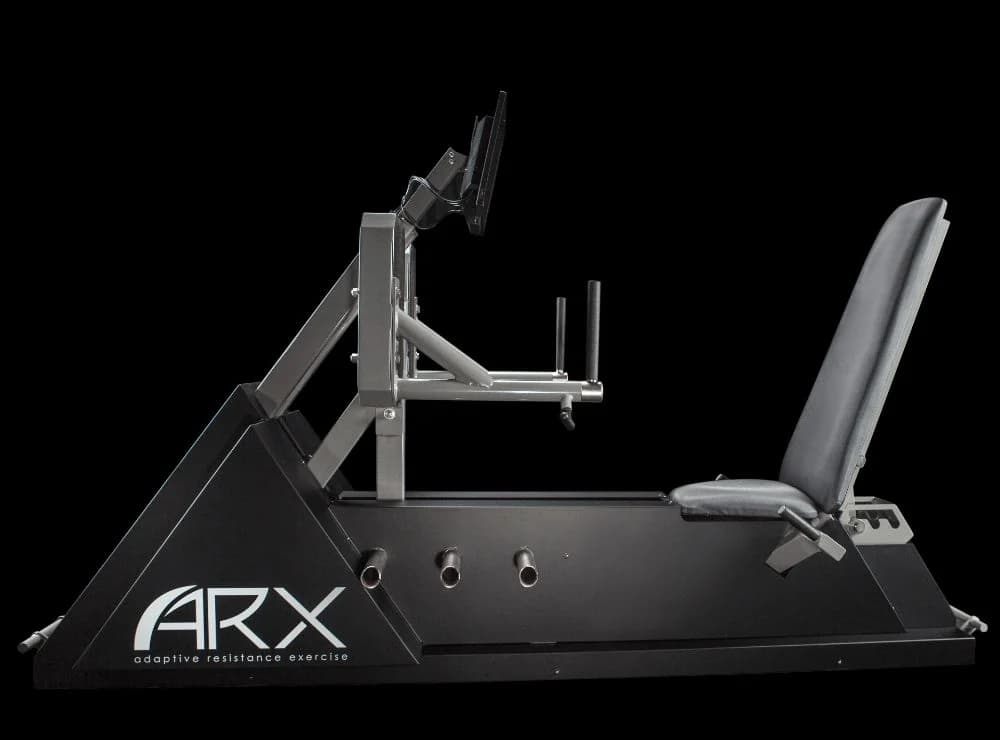
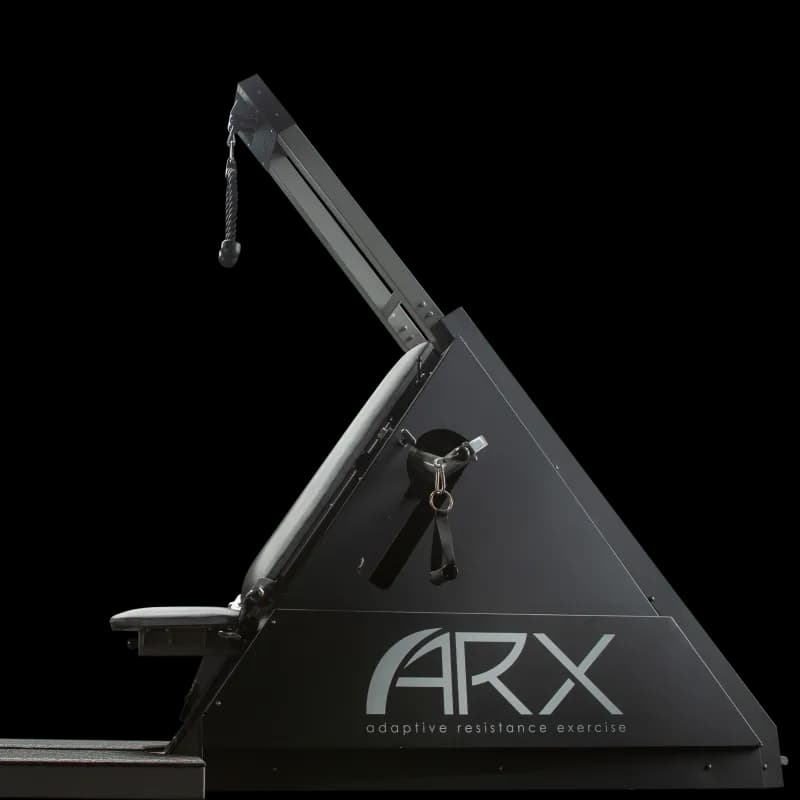
ARX builds 2 machines in Austin, Texas. A motor replaces the weight stack and pushes back with exactly the force you produce through the rep, including the lowering, or eccentric, phase that ARX says weights can't load. The Alpha runs 6 exercises on a guided sled in 21 square feet; the Omni runs 17 on cables in 37.
Static holds are where the 2 brands overlap. ARX says its machines can lock a position and load a static effort, and the 2021 study protocol it cites included 60 to 90 second holds. Neither company publishes figures showing whether those holds match OsteoStrong's positions and loads.
5 years of each: buying against joining
Our 5-year math uses ARX's published prices and the 2 OsteoStrong center pages, all checked 2026-10-13, assumes 1 ARX home license covers a household of 2 (ARX shows one dashboard for every user; confirm on the call), and charges each OsteoStrong member their own dues and enrollment. Sessions count at twice a week for ARX and once for OsteoStrong. The electrician and trips to a center are left out, since neither cost is in our verified data. The full ARX cost sheet is in what an ARX costs to own.
| 60 months | 1 person | Per session, 1 person | Household of 2 | Per session, household |
|---|---|---|---|---|
| ARX Alpha: $43,000 + $200/mo | $55,000 | $105.77 (520 sessions) | $55,000 | $52.88 (1,040 sessions) |
| ARX Omni: $46,000 + $200/mo | $58,000 | $111.54 | $58,000 | $55.77 |
| OsteoStrong: $149/mo, no enrollment fee published | $8,940 | $34.38 (260 sessions) | $17,880 | $34.38 (520 sessions) |
| OsteoStrong: $359/mo + $199 enrollment | $21,739 | $83.61 | $43,478 | $83.61 |
| Speediance Gym Monster 2: Basic bundle, no subscription | $3,387 | $6.51 | $3,387 | $3.26 |
The break-even is one line: months = (ARX hardware minus enrollment fees) divided by (monthly dues minus ARX's $200 software). At $149, a membership costs less each month than ARX's software alone, so for 1 person an ARX never catches up. At $359 plus $199, 1 person's dues pass a home Alpha after about 269 months, roughly 22 years. A second member changes that. For 2 members at $359, dues run $718 a month, $518 more than the software, so they pass a home Alpha at ($43,000 minus $398) divided by $518: about 82 months, just under 7 years. An Omni takes about 88.
Read the table with 2 caveats: every membership line assumes a center within reach for 5 years, and the per-session columns compare 15 minutes of moving strength work with 10 minutes of static loading. Then ask ARX about its lifetime license. Its machines page, read 2026-10-13, lists a $10,000 one-time license in a studio business note without saying whether home buyers pay the same. ARX studios are another route: ARX says boutique studios charge $250 to $600 or more a month per client, a range it labels illustrative.
What the studies measured, and who paid
None of the 3 studies behind these brands compares ARX with OsteoStrong, and they measured different things in different people.
ARX cites a 12-week study commissioned by the American Council on Exercise in 2021 and run by Lance Dalleck's team at Western Colorado University. Per ACE's write-up, which ARX links, 45 adults aged 18 to 65 with no resistance training in the prior 6 months were randomized to twice-weekly ARX on an Alpha, moderate-intensity weights, or no exercise. The ARX group improved more on most strength measures, body fat and VO2max, in sessions averaging 15 minutes against 45. Each group averaged about 40 years old, and bone wasn't measured. Our ARX study breakdown covers its limits.
The 2025 OsteoStrong paper in the Journal of Clinical Endocrinology & Metabolism (Papadopoulou-Marketou and colleagues) is a case series without randomization: 147 peri- and postmenopausal women with osteoporosis at one Greek center, 75 doing weekly 10-minute OsteoStrong sessions and 72 not, each group split by antiresorptive medication, over 12 months. The lumbar spine gains that held up after statistical correction were in the 2 medication subgroups, one of which did no OsteoStrong; the 53 women doing OsteoStrong without medication aren't among them. The authors call the gains modest and ask for randomized trials. Per the journal's correction notice, readers raised design and statistics problems, the editors upheld them, and the authors revised the title, results and conclusions. Osteofit SA Hellas funded it, and OsteoStrong's Greek site names Osteofit A.E. as the company handling its trial-session sign-ups.
The 2026 trial is the stronger design. Lindberg and colleagues at Karolinska Institutet randomized 194 women aged 65 to 79 with osteopenia or osteoporosis to 9 months of OsteoStrong once a week for 20 minutes or multicomponent exercise twice a week for 60 minutes (Archives of Osteoporosis, 2026). The main outcome was bone material strength index, measured at the tibia. OsteoStrong was non-inferior: a between-group difference of 1.16 (95 percent confidence interval minus 1.51 to 3.82) stayed above the pre-set margin of minus 5.2. The OsteoStrong arm's index rose 2.9 percent, the exercise arm's lumbar spine density 0.8 percent, and the groups didn't differ on any outcome. The authors note the comparison program didn't move the main measure, which limits the finding, and call for a placebo-controlled study. Bonetrigger AB, owner of OsteoStrong Sweden, partly funded it and, per the paper, had no role in design, analysis or writing.
The ARX evidence is about strength in adults around 40, and the OsteoStrong evidence is about bone measures in women. None of it predicts your own scan. If bone density is the question, take your DXA report to your clinician.
ARX: where it gives ground
Price first: a home Alpha is $55,000 over 5 years before the electrician, about 6 times the cheapest OsteoStrong line, and it won't run without an active software license. It needs 21 to 37 square feet, about 700 pounds through the door and a dedicated non-GFCI circuit, and the warranty is 1 year. Its cited study didn't measure bone, so a bone density question gets no ARX data. And a buyer who'd only use the static setting is paying for a motor built to move.
OsteoStrong: where it gives ground
You have to live near a center, and keep living near it. Prices, add-ons and insurance-program acceptance vary by owner, and there's no home version. By its own description it isn't a gym, and a 10-minute weekly session won't stand in for strength work; Colleyville East says you can keep other exercise alongside it, and we'd treat that as a requirement. And both studies behind it had funding from companies tied to OsteoStrong.
If neither price works
For motor-driven strength at home without the $43,000, the Speediance Gym Monster 2 borrows part of the ARX idea: dual motors, up to 220 pounds of cable load in 1-pound steps, and an Eccentric mode Speediance describes as heavier on the lowering phase. Its 4 in-stock bundles ran $3,387 to $3,999 on sale on 2026-10-13, and core training needs no subscription. Where it gives ground: Speediance doesn't describe that mode as matching your output rep by rep, 220 pounds is a ceiling a strong leg press can pass, and our data shows no isometric mode. More in ARX for strength after 50 and is ARX worth it for a home gym.
How to choose
- Your clinician is discussing bone density and a center is close: OsteoStrong, $149 to $359 a month where we checked. Book the free session and get the price sheet in writing.
- Full-range strength at home, training alone: the ARX Alpha, $43,000 plus $200 a month.
- That plus deadlift and Romanian deadlift: the ARX Omni, $46,000 plus $200 a month.
- 2 of you would each pay $359 a month locally: run the break-even, because 2 top-tier memberships pass a home Alpha in under 7 years.
- The lowering phase loaded at home for under $4,000: the Speediance Gym Monster 2.
- No center nearby and no $43,000: start with the Best Home Gym Equipment guide.
Bottom line
OsteoStrong is a static push once a week at a center you join for $149 to $359 a month; ARX is a moving, motor-matched rep you own for $43,000 or $46,000 plus $200 a month. Join OsteoStrong if your clinician is already in the bone density conversation, a center is close, and a supervised 10-minute slot is a habit you'll keep. Buy an ARX if full-range strength at home is the goal and $55,000 to $58,000 over 5 years is money you can spend, especially for 2 people who'd each otherwise pay a top-tier membership. Skip both if the nearest center is far and the hardware price stops you.
Is ARX the same as OsteoStrong?
No. The published OsteoStrong studies describe isometric loading: at a center, once a week, you press or pull against a fixed handle or platform for about 15 to 20 seconds per device. An ARX motor moves through a full rep and loads both the lifting and lowering phases, about 15 minutes twice a week, and it can also hold a static effort. You join OsteoStrong. You buy an ARX.
Can I buy an OsteoStrong machine for home?
No. OsteoStrong's franchise page describes its Spectrum devices as patent-pending and available only to OsteoStrong centers, and corporate sells no equipment online. You join a center instead: the 2 we read, rechecked 2026-10-13, charge $149 to $359 a month, with a $199 enrollment fee at one. If you want loading equipment you own, an ARX Alpha is $43,000 plus $200 a month in software.
Is OsteoStrong cheaper than buying an ARX?
For 1 person, by a wide margin. Over 5 years, $149 a month comes to $8,940, and $359 a month plus a $199 enrollment fee to $21,739, against $55,000 for a home ARX Alpha with its required $200 monthly software. For 2 people each paying $359, the memberships pass the Alpha's total cost, hardware plus software, after about 82 months. Both figures assume a center within reach.
Does OsteoStrong really improve bone density?
That's OsteoStrong's claim, and its footer says the FDA hasn't evaluated its statements. In a 2025 case series of 147 women, the lumbar spine gains that held up statistically were in the 2 subgroups on antiresorptive medication, one of which did no OsteoStrong. A 2026 randomized trial of 194 older women found OsteoStrong non-inferior to a comparison exercise program on a bone strength index. Ask your clinician.
Can an ARX do isometric training like OsteoStrong?
It can run a static hold. ARX says its machines can lock a position and load a static contraction, and the 2021 study protocol ARX cites included static holds of 60 to 90 seconds on 2 exercises. Neither company publishes figures that let us compare those holds with OsteoStrong's targets, which reached 4.2 times body weight on the leg press in a 2026 trial.
The products this post references
- ARX Alternatives: What Else Loads the Lowering Phase →
- ARX vs a Personal Trainer: 5-Year Cost per Session →
- ARX for Strength After 50: Eccentric Loading and Joints →
- What an ARX Costs to Own: Machine, Software, Power →
- The ARX Study: What the 2021 ACE Trial Shows, and Does Not →
- Is ARX Worth It for a Home Gym? Who 15 Minutes Fits →
The Longevity Gear Buyer's Checklist
The specs that actually decide whether a sauna, cold plunge, red light panel, or smart ring is worth it, plus the real price range for each. Get the free PDF, plus one weekly email on the gear worth buying.