Lifespan Vault earns an affiliate commission when you buy through links on this page, at no extra cost to you. It does not change our rankings or our verdicts.
Home hyperbaric used to mean a clinical commitment. Ten years ago the category was a $200,000 install; in 2026 a soft shell mild-HBOT chamber ships free to your door for $6,799, runs on a standard 120V outlet, and fits in a spare bedroom. The decision is no longer whether home hyperbaric is possible. It is which shell type you actually need, and how much brand you are paying for.
For most home buyers the answer is soft shell, and the 2026 field sorts cleanly by budget. The AirVida Portable Lying is the lowest-priced credible entry at $6,799 to $9,799 with every price listed on the site. The Summit to Sea Dive starts at $9,995 from an established US manufacturer. The OxyHealth Vitaeris 320 remains the category default at roughly $18,000 to $23,000 through a dealer. Hard shell is the step past this tier: the AirVida Ultra lists from $27,999, the AirVida Elite at $45,999, and clinical chambers rated 2.0 ATA and above run $50,000 to $150,000.
Quick answer
- Budget-first buyer: the AirVida Portable Lying Hyperbaric Chamber at $6,799 to $9,799, transparent listed pricing at roughly a third of the established soft shell tier.
- Value buyer who wants an established US manufacturer: the Summit to Sea Dive at $9,995 and up, FDA 510(k) cleared at 1.3 ATA from the second-largest US home-HBOT maker.
- Buy-once, buy-the-network buyer: the OxyHealth Vitaeris 320 at $18,000 to $23,000 by dealer quote, listed under 510(k) K001409, with a 5-year warranty and the largest installed base in the category.

The 2026 field at a glance
| Chamber | Verified price | Pressure | Shell | FDA status | Warranty | Interior diameter |
|---|---|---|---|---|---|---|
| AirVida Portable Lying | $6,799 to $9,799 direct (June 2026) | 1.2 to 1.5 ATA, adjustable valve | Soft | Not FDA approved per manufacturer; prescription required | 1 year plus lifetime support | 32 or 36 in |
| Summit to Sea Dive | From $9,995 (August 2026) | 1.3 ATA (4.4 PSI) | Soft | 510(k) cleared | 2 years standard, 3-year extension available | 33 in |
| OxyHealth Solace 210 | $9,000 to $14,000, dealer quote (May 2026) | 1.3 ATA | Soft | 510(k) cleared | 5 years | 21 in |
| OxyHealth Vitaeris 320 | $18,000 to $23,000, dealer quote (June 2026) | 1.3 ATA | Soft | 510(k) cleared | 5 years | 32 in |
All four are soft shell mild-HBOT chambers. The AirVida, the Vitaeris 320 and the Solace 210 run on a standard 120V outlet with no electrical upgrade; Summit to Sea does not publish a power spec for the Dive. For hard shell context: the AirVida Ultra lying chamber lists from $27,999, its Elite sitting model at $45,999, and clinical-grade hard chambers run roughly $50,000 to $150,000 before install. Both are covered below.
Soft shell vs hard shell: what you are actually buying
A soft shell chamber is an inflatable cabin that pressurizes to the mild-HBOT tier, 1.2 to 1.5 ATA depending on model, fed by an oxygen concentrator rather than the roughly 100 percent medical oxygen used in clinical hyperbaric. That framing matters before any purchase: a soft chamber is not the 2.0 to 2.8 ATA hard-shell clinical HBOT used in the higher-pressure studies people cite, and no home soft shell covers clinical applications like decompression protocols.
It is, however, the tier most of the research home buyers actually reference. The microcirculation and cognitive work cited around mild HBOT (Efrati and Hadanny among the most-quoted groups) runs at 1.3 to 2.0 ATA, which is why 1.3 ATA became the soft shell standard, and it is the tier both brands cleared at. Summit to Sea holds its own FDA 510(k) on the Dive chamber, K072757 from 2008. OxyHealth lists the Vitaeris 320 and Solace 210 under K001409, a clearance held by its contract manufacturer. AirVida's adjustable 1.2 to 1.5 ATA valve brackets the same tier, though AirVida's own disclaimer states its chambers are not FDA approved, that home use requires a prescription, and that pressure above 1.4 ATA is medical-grade territory needing physician supervision.
Hard shell buys you pressure headroom and a rigid hull at three to twenty times the price. Unless a physician has given you a specific reason to run above the mild tier, the soft shell chambers below are where the home market genuinely lives.
AirVida Portable Lying: the transparent-priced entry
AirVida does the one thing no established hyperbaric brand will: it lists every model and every price on its site and sells direct. The Portable Lying is its volume chamber, an 89-inch soft shell in 32-inch (five windows) or 36-inch (seven windows) diameters with an adjustable 1.2 to 1.5 ATA valve. The $6,799 base configuration is chamber plus air pump; the $9,799 all-in-one bundles the compressor, an air cooler, and an oxygen concentrator. Shipping is free from its Kansas warehouse, financing runs through Affirm, and coverage is a 1-year warranty with lifetime customer support.
Where it gives ground: AirVida is a US-based reseller (Lenexa, Kansas, with a Las Vegas showroom) of chambers built by overseas manufacturing partners it does not name, not a long-tenured manufacturer with its own factory. That is exactly how the sticker lands near $6,799 instead of $18,000, and it is also the trade: less pedigree, a smaller service footprint, a 1-year warranty against OxyHealth's 5, and a 30-day return that carries a 10 percent restocking fee with the buyer paying return shipping. AirVida shows a Multiple SGS pill on most of its chamber product pages, with no certificate number, scope or link attached, and we found no SGS certificate anywhere on its site. Its Alpha hard shell is the one model with real documentation, naming CE (MDD) 93/42/CEE, CE (PED) 2014/68/UE, ISO 13485 and ASME / PVHO-1 on the product page itself. And per its own disclaimer, the chambers are not FDA approved and home use requires a prescription.
Verdict: the pick for budget-conscious buyers who want daily mild-HBOT access at the lowest verified sticker, and for anyone who needs formats the legacy brands do not sell, like the $10,499 Pro90 sitting chamber or the $14,499 wheelchair-accessible Chair Pro. Not the pick if brand tenure and a large parts network are what you are paying for.
Summit to Sea Dive: the established-manufacturer value pick
Summit to Sea is the second-largest US home-HBOT manufacturer after OxyHealth, and the Dive is its case for the value slot: a 33-inch diameter, 90-inch-long soft shell at 1.3 ATA (4.4 PSI), FDA 510(k) cleared, from $9,995 as verified in August 2026. That is established-manufacturer credibility at roughly half the Vitaeris dealer quote. The standard warranty is 2 years with a purchasable 3-year extension, and a sitewide 10 percent discount for military, first responders, and firefighters is advertised.
Where it gives ground: the dealer network is roughly 30 US dealers against OxyHealth's 100-plus, the standard warranty is 2 years against 5, and the brand carries less visibility in the longevity press. Parts ship direct and most service issues are handled by mail-in or in-home visits, so metro buyers are unlikely to feel the gap; ultra-rural buyers might.
Verdict: the spec-per-dollar pick for buyers who want a 510(k)-cleared chamber from an established US maker without paying the OxyHealth premium.
OxyHealth Vitaeris 320: the category default
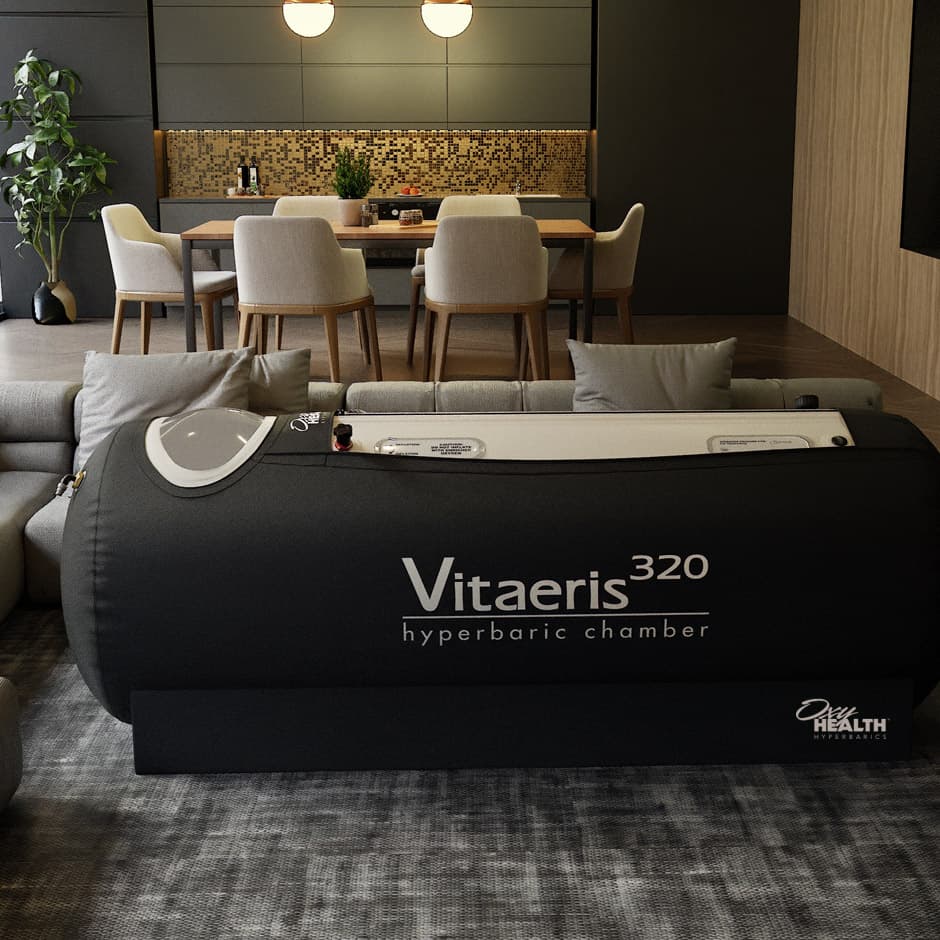
The Vitaeris 320 is the chamber that turned home HBOT into a category: 32-inch diameter, 89 inches long, 1.3 ATA, FDA 510(k) cleared, a 60 dB compressor (similar to a window AC), 60 to 90 minute sessions, a 10 by 4 foot footprint with 8-foot ceiling clearance, and a 5-year warranty. Real-world owner reports put OxyHealth soft shells at 10 to 15 years of normal use, with the compressor as the first service item at 5 to 8 years and replacement parts stocked for decades.
Where it gives ground: price and purchase friction. OxyHealth sells through authorized dealers and publishes no fixed list price; the common street range is $18,000 to $23,000, cash purchase, with financing via medical-equipment lenders. You are paying roughly double the Dive and close to triple the AirVida base for the same 1.3 ATA soft shell tier, and what that buys is the largest installed base, the densest dealer network, and the longest warranty in the category.
Verdict: the buy-once pick for buyers who want the most-installed brand, the 5-year warranty, and easy parts and service for a decade-plus, and who can absorb dealer pricing.
OxyHealth Solace 210: the compact and portable pick
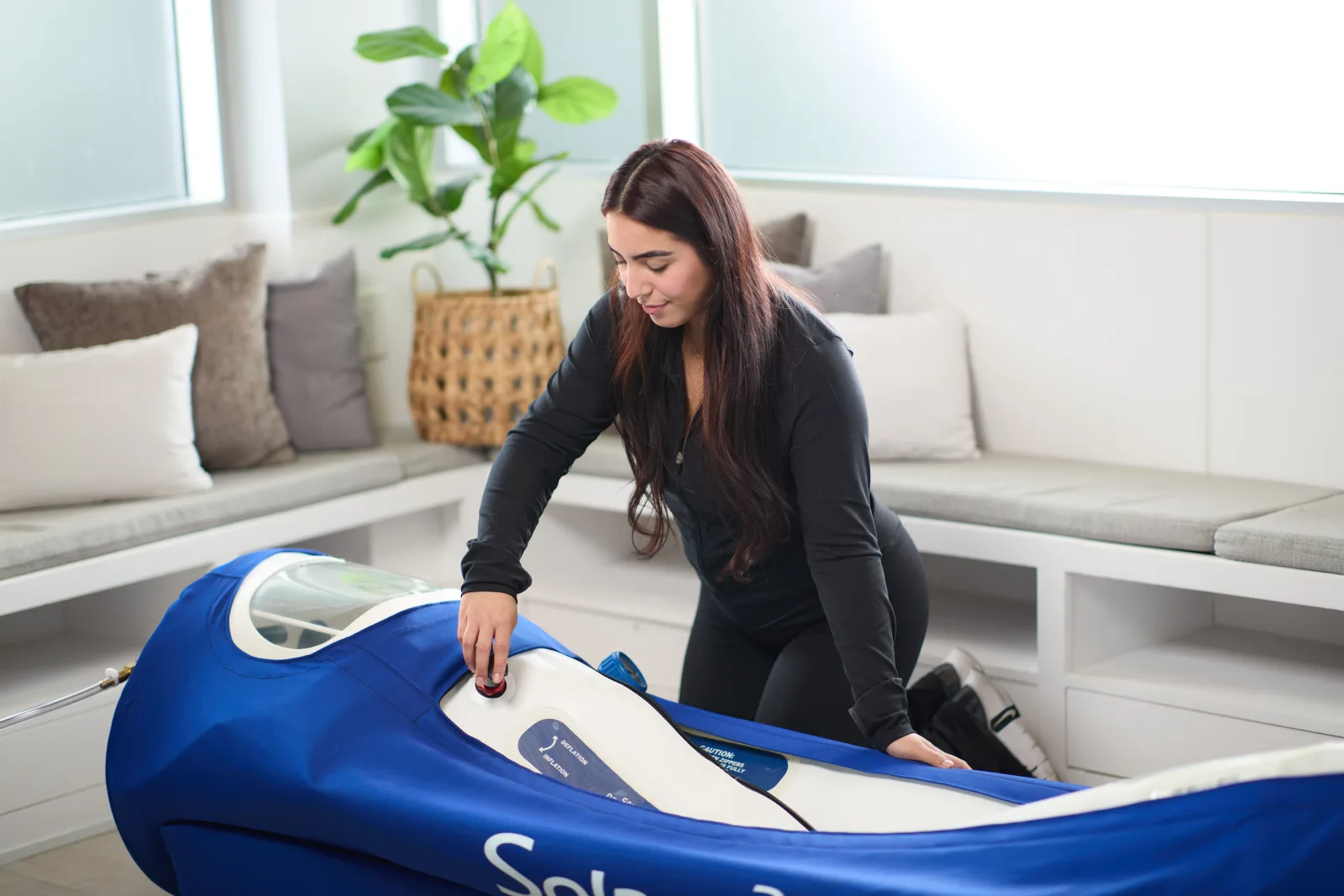
The Solace 210 is OxyHealth's smallest chamber: the same 1.3 ATA spec, the same K001409 listing and the same 5-year warranty as the Vitaeris, built around a 21-inch interior so it packs down, relocates, and stores far more easily. Dealer quotes run roughly $9,000 to $14,000, which puts OxyHealth's brand and warranty within reach of a Dive-tier budget.
Where it gives ground: room. The 21-inch interior is the snuggest in this field, and side-sleepers or anyone who wants to read through a 60 to 90 minute session will feel the difference against the 32-inch Vitaeris or 33-inch Dive. Pricing is also dealer-quoted rather than listed, so confirm current numbers with an authorized dealer before budgeting.
Verdict: the pick when floor space or portability is the binding constraint and you still want the OxyHealth warranty and parts network behind the chamber.
AirVida sitting and hard shell chambers: when a soft lying cabin is not the fit
Three AirVida models answer questions the four soft picks above do not, and all three can be set above the 1.4 ATA line AirVida itself describes this way: "Any usage over 1.4 ATA is considered medical grade hyperbaric pressure. Medical grade hyperbaric therapy requires physician supervision." AirVida also states its chambers are not currently FDA approved, and none of the three product listings publishes ASME PVHO-1 certification, although AirVida does publish ASME certification on other chambers in its range, including an Alpha chamber at $79,000.

The AirVida Pro90 is the sitting option: a soft shell with a reclining chair, rated to 1.5 ATA, at $10,499 for the three-machine Standard kit or $10,999 for the Pro All-In-One cabinet, plus $1,999 for professional setup. AirVida asks US home buyers for a prescription before it ships, and its published warranty terms conflict between 1 and 2 years, so get the term in writing.
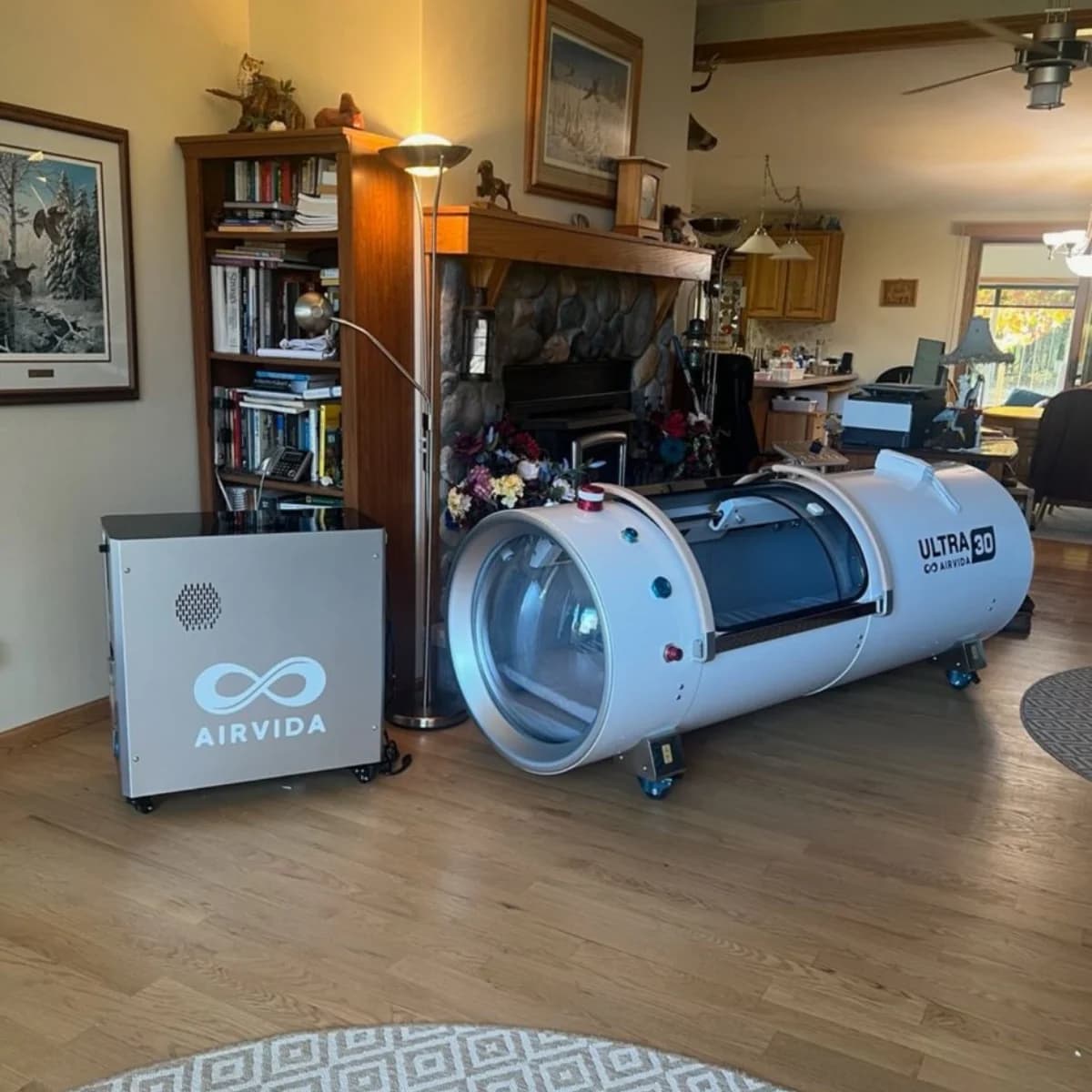
The AirVida Ultra is the cheapest listed way into AirVida's 2.0 ATA hard shell tier: a one-person stainless steel lying chamber at $27,999, $28,999 or $29,999 by diameter, with a $3,999 installation and about six weeks of lead time. AirVida files it inside a clinical grade collection whose copy claims ASME certification, while the listing and catalog for the Ultra publish none, so ask which certificate covers the unit on your quote.

The AirVida Elite is the single-seat version at $45,999, with its concentrator, chiller, dehumidifier and purifier in one included cabinet and oxygen delivered by BIBS mask. AirVida publishes a weight of roughly 2,000 to 2,100 lb and a 38 inch minimum doorway and recommends a ground floor, and no interior dimensions, occupant limits or noise rating are published.
Outside hyperbaric, the AirVida Aura is a $17,999 enclosed red light bed with delivery and installation included, also sold in a $27,999 bundle with a Pro90. Its irradiance is not published at any stated measurement distance, which is the number you would need to compare it against another bed.
The cost-per-session math chamber brands do not print
Every brand in this category sells against clinic pricing without showing the arithmetic, so here it is in the open. Assume the schedule frequent-protocol buyers actually run: 3 sessions a week for 5 years, 780 sessions. Sticker price only, no electricity or service items, prices as verified May to September 2026, clinic access at the roughly $200 per session figure commonly cited for mild HBOT.
| Chamber | Sticker | Cost per session (780 sessions) | Sticker break-even vs $200 clinic sessions |
|---|---|---|---|
| AirVida Portable Lying, 32 in base | $6,799 | $8.72 | 34 sessions |
| AirVida Portable Lying, 36 in all-in-one | $9,799 | $12.56 | 49 sessions |
| Summit to Sea Dive | $9,995 | $12.81 | 50 sessions |
| AirVida Pro90, Standard kit | $10,499 | $13.46 | 53 sessions |
| OxyHealth Solace 210 | $9,000 to $14,000 | $11.54 to $17.95 | 45 to 70 sessions |
| OxyHealth Vitaeris 320 | $18,000 to $23,000 | $23.08 to $29.49 | 90 to 115 sessions |
Two honest caveats. First, at 1 or 2 sessions a month the ownership math collapses and clinic access stays cheaper; a chamber only earns its sticker with a real cadence. Second, sticker-only math flatters the cheapest chamber: OxyHealth's 5-year warranty, 10 to 15 year service-life reports, and decades of parts supply are worth real money this table cannot see, while AirVida's coverage runs 1 year. The gap is real either way; whether it is worth $11,000-plus is a brand-risk decision, not a spec decision.
How to choose
- Lowest verified price and transparent checkout: the AirVida Portable Lying at $6,799 base or $9,799 all-in-one.
- Established US manufacturer close to the $10,000 line: the Summit to Sea Dive from $9,995.
- Smallest footprint and easiest to relocate: the OxyHealth Solace 210 at a $9,000 to $14,000 dealer quote.
- Largest installed base, longest warranty, most interior room: the OxyHealth Vitaeris 320 at $18,000 to $23,000.
- Sitting format: the soft shell AirVida Pro90 at $10,499 to $10,999, or the hard shell AirVida Elite at $45,999.
- Working beyond mild HBOT on physician guidance: hard shell territory, where the AirVida Ultra lists from $27,999 and clinical units run $50,000 to $150,000.
- One or two sessions a month: skip ownership and pay roughly $200 per clinic session.
Bottom line
The 2026 home hyperbaric market is a soft shell market, and the honest ranking is a budget ladder rather than a single winner. AirVida's Portable Lying is the transparent-priced way in at $6,799 to $9,799 if you accept a reseller model and a 1-year warranty, while the Summit to Sea Dive at $9,995 and the OxyHealth Solace 210 buy a 510(k) listing and established-manufacturer service in the same budget band. The OxyHealth Vitaeris 320 at $18,000 to $23,000 remains the buy-once default for anyone who values the 5-year warranty and the largest parts network over sticker price. For a sitting or 2.0 ATA hard shell format, the AirVida Pro90, Ultra and Elite are the listed-price options covered here, each with settings above the 1.4 ATA line AirVida says calls for physician supervision. Hyperbaric is one pillar of a larger stack: see our best recovery tech pillar, the cold plunge guide, and this month's recovery massage chairs and Pulsetto coverage.
What is the difference between a soft shell and a hard shell hyperbaric chamber?
Soft shell chambers are inflatable mild-HBOT units running 1.2 to 1.5 ATA, fed by an oxygen concentrator rather than the roughly 100 percent medical oxygen used clinically. Hard shell chambers cost far more: AirVida's hard-shell Ultra lists at $27,999 to $29,999 and its hard-shell Elite at $45,999, and clinical-grade hard chambers rated 2.0 ATA and above run roughly $50,000 to $150,000 with dedicated installs.
How much does a home hyperbaric chamber cost in 2026?
Verified pricing runs from $6,799 for the 32-inch AirVida Portable Lying (chamber and air pump) to roughly $23,000 for an OxyHealth Vitaeris 320 through a dealer. Summit to Sea's Dive starts at $9,995, and OxyHealth's compact Solace 210 quotes around $9,000 to $14,000. Hard shell home units start near $27,999 and climb past $45,000.
Is 1.3 ATA enough pressure for a home hyperbaric chamber?
1.3 ATA is the standard soft shell spec, and it sits inside the 1.3 to 2.0 ATA range used in the microcirculation and cognitive research buyers most often reference (Efrati and Hadanny among the cited groups). Above 2.0 ATA is clinical territory requiring hard chambers, and AirVida's own disclaimer states anything above 1.4 ATA needs physician supervision.
Do home hyperbaric chambers need a prescription or FDA clearance?
It varies by brand. OxyHealth's Vitaeris 320 and Solace 210 are listed with the FDA under 510(k) K001409, and the Fortius 420 under K041007. Those clearances are held by contract manufacturers rather than by OxyHealth, which is itself FDA registered as a repacker and relabeler under registration 3006777109. That arrangement is normal. The Summit to Sea Dive holds its own clearance, K072757 from 2008, and the indication written on it is acute altitude sickness, prescription use. AirVida states its chambers are not FDA approved and that home use requires a prescription. Check the clearance status on the exact model, and involve your own physician before buying any chamber.
Is buying a home hyperbaric chamber cheaper than paying for clinic sessions?
At roughly $200 per clinic session, the math flips fast for frequent users. The $6,799 AirVida base configuration reaches sticker break-even around 34 sessions, the $9,995 Summit to Sea Dive around 50, and an $18,000 to $23,000 Vitaeris 320 at 90 to 115 sessions. At one or two sessions a month, clinic access stays the cheaper route.
The products this post references


The Longevity Gear Buyer's Checklist
The specs that actually decide whether a sauna, cold plunge, red light panel, or smart ring is worth it, plus the real price range for each. Get the free PDF, plus one weekly email on the gear worth buying.