Lifespan Vault earns an affiliate commission when you buy through links on this page, at no extra cost to you. It does not change our rankings or our verdicts.
ARX and Vasper get compared constantly because both sell a short session at a five-figure price to the same clinic and family-office buyer, and both are quote-only purchases. Put them side by side on what each session actually does and the rivalry dissolves. An ARX machine is a strength trainer: a computer-controlled motor replaces the weight stack and pushes back with exactly the force you produce at every point in the rep, including the lowering phase, in about 15 minutes twice a week per ARX. A Vasper Pro is a seated cardio and recovery apparatus: 21 minutes on a recumbent-style unit while limb cuffs deliver compression, cooling and low-intensity EMS. Direct answer: if the job is strength, buy ARX, either the ARX Alpha at $43,000 or the ARX Omni at $46,000, both verified 2026-09-17. If the job is daily cardio conditioning and recovery in a wellness room, the Vasper Pro at $26,000 to $32,000, verified 2026-05-04, is the machine, and most installs that want both jobs done in compressed time end up running both.
That is also why this is not a piece with a winner. The two ARX machines share one technology, one software subscription and one price tier, and differ on exercise count and footprint, so the ARX decision is Alpha versus Omni. The Vasper decision is whether you buy the multi-modality premise at all. Below: what each session does, the full cost of ownership including ARX's separate software bill and the circuits all three need, where each gives ground, and verdicts by buyer. Every price and spec here comes from our catalog entries; where a number is not in our verified data, we say so rather than guess.
Quick answer
- Home strength buyer with one room and no spotter: the ARX Alpha at $43,000, verified 2026-09-17, because six guided-sled movements and per-rep force data fit in 21 square feet, the smallest footprint ARX makes.
- Clinic or studio that needs the full movement library: the ARX Omni at $46,000, verified 2026-09-17, because sixteen cable-driven exercises with clip-on handles cover belt squat, deadlift and Romanian deadlift that the Alpha cannot.
- Wellness room built for daily cardio and recovery: the Vasper Pro at $26,000 to $32,000, verified 2026-05-04, because a 21-minute seated session with compression, cooling and EMS cuffs does a job neither ARX machine attempts.
At a glance
| Machine | Job | Session | Verified price | Footprint and power |
|---|---|---|---|---|
| ARX Alpha | Strength, 6 exercises on a guided sled | About 15 min, twice weekly per ARX | $43,000, verified 2026-09-17, plus $200/mo home or $400/mo commercial software | 21 sq ft, 655 lb; dedicated 110V 20A or 220V 15A circuit, not GFCI |
| ARX Omni | Strength, 16 cable-driven exercises | About 15 min, twice weekly per ARX | $46,000, verified 2026-09-17, plus $200/mo home or $400/mo commercial software | 37 sq ft, 680 lb; dedicated 110V 20A or 220V 15A circuit, not GFCI |
| Vasper Pro | Cardio conditioning and recovery, seated | 21 min | $26,000 to $32,000, quote basis, verified 2026-05-04 | 8 x 6 ft; 240V dedicated circuit; weight not in our verified data |
All three are quote-only: ARX has no checkout and routes every sale through a Talk to ARX call, and Vasper's price is a quote range with lease available. The rule we apply to five-figure cryo chambers in our Vacuactivus cryotherapy chamber review holds here too: at these prices the paperwork is part of the product, so verify the price the day you buy.
What an ARX session actually is
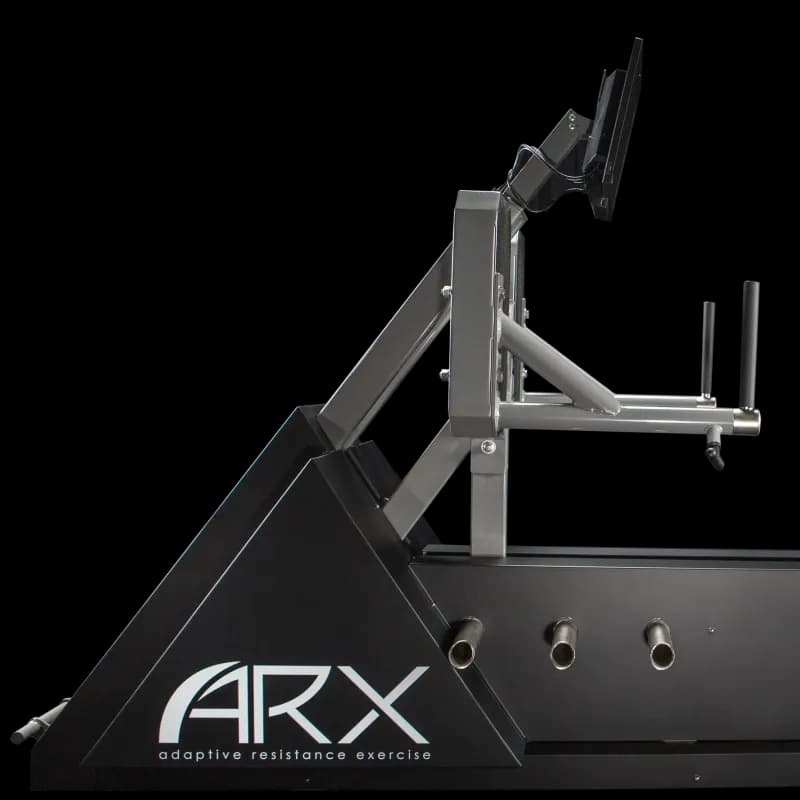
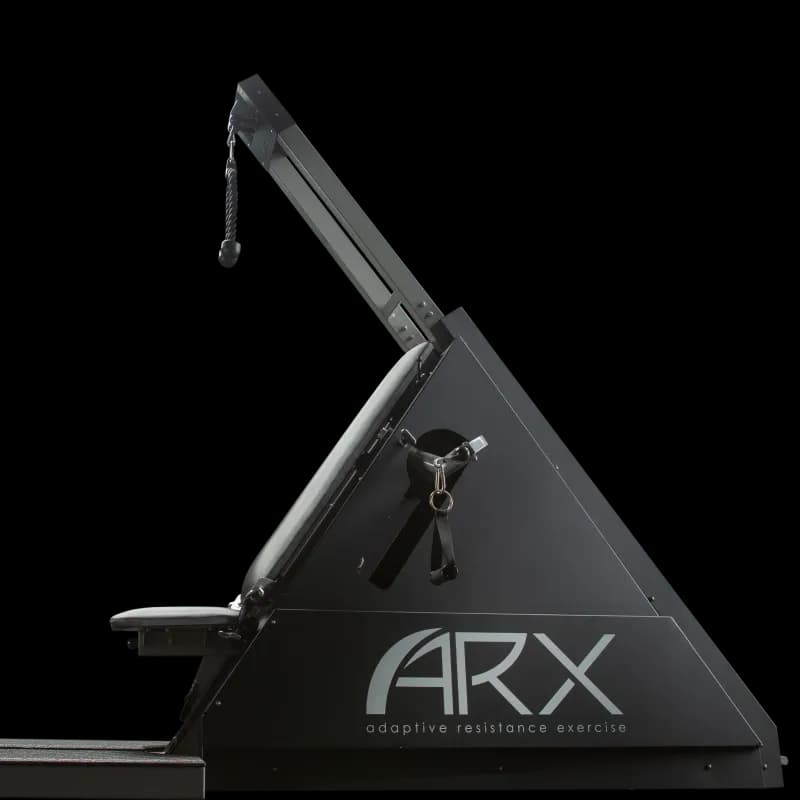
ARX, founded in 2011, builds two machines in Austin, Texas, and both run the same idea. In place of a weight stack, a computer-controlled motor pushes back with exactly the force you produce at every point in the rep. ARX says this loads the lowering, or eccentric, phase in a way weights cannot. The software records total force, max force in both the concentric and eccentric directions, rep speed, range of motion, intensity, exercise time and fatigue to a cloud dashboard, and ARX says any rep scheme runs on it, from standard sets to negative-only, static and partial-range work. ARX describes the workout as about 15 minutes, full body, twice a week, and our catalog notes most users train one to two times a week.
The two machines differ in how that resistance reaches you. The Alpha delivers it through a guided sled that keeps every rep on one path across six exercises: leg press, chest press, row, calf raise, torso flexion and torso extension. ARX calls it the easiest of its machines to learn and, in its own words, faster through all of them. The Omni delivers it through a cable system with clip-on handles and attachments, which is how one machine reaches sixteen exercises: belt squat, deadlift, Romanian deadlift, hamstring curl, calf raise, horizontal press, incline press, decline press, overhead press, pec fly, pulldown, pullover, row, high pull, biceps curl and triceps pressdown. ARX says the Omni does the work of 10+ machines.
Be clear whose numbers the marketing leans on. The figures ARX leads with, twice the muscle gain, 90 percent greater strength gain, 2.5 times the fat loss and 3.5 times the cardiovascular improvement in 72 percent less training time, come from a 12-week study at Western Colorado University commissioned by the American Council on Exercise in 2021, comparing ARX at 15 minutes twice a week against 45 minutes of moderate-intensity weight training three times a week, later published in the International Journal of Research in Exercise Physiology. That is the brand's cited study. We have not tested either machine, ARX's XPRIZE Healthspan involvement has not reported results, and "trusted by Tony Robbins, Dave Asprey and Ben Greenfield" is ARX's line, not ours. The ARX brand hub carries both machines with the full recorded specs.
What a Vasper session actually is
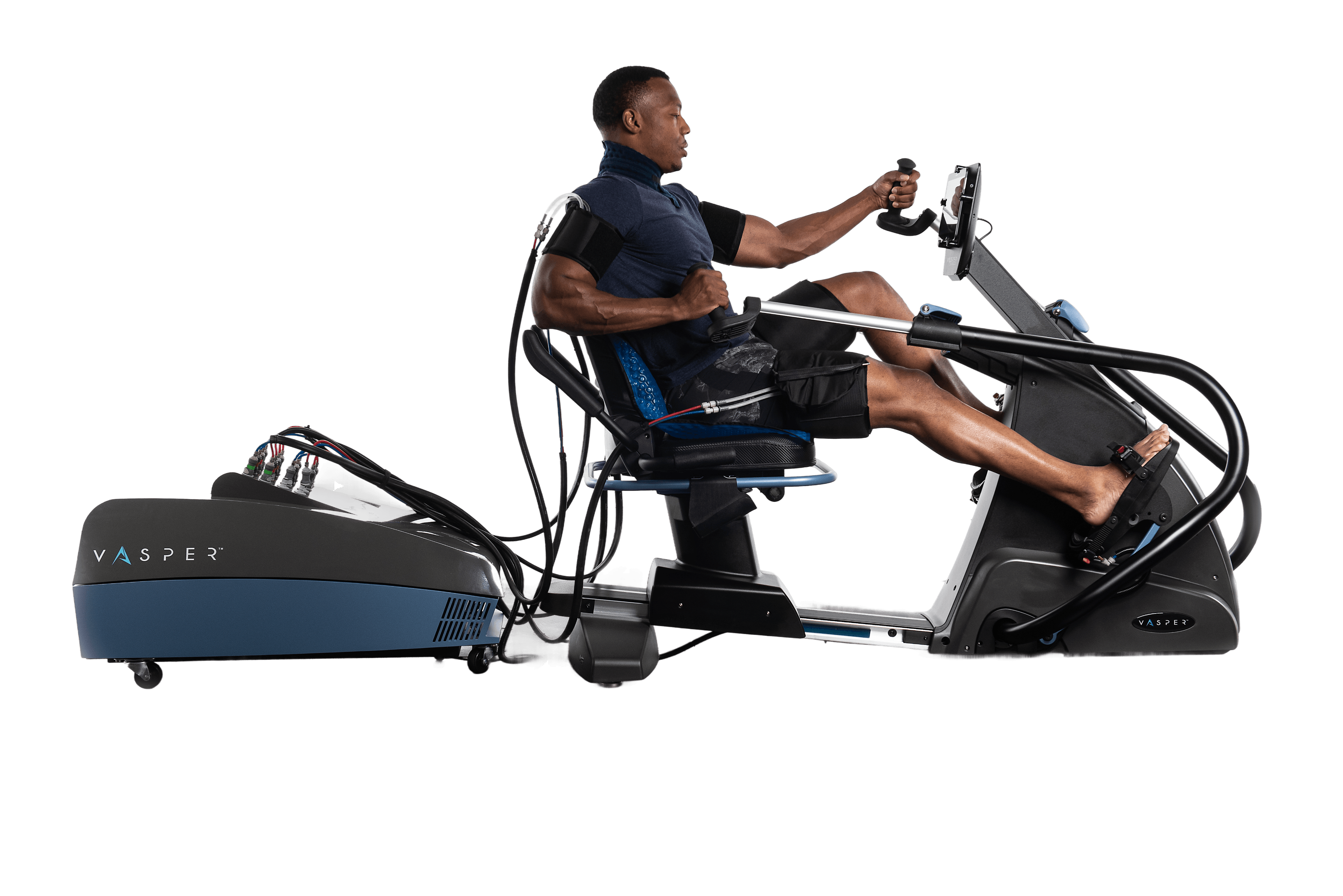
Vasper, a US company founded in 2014, makes a different object. The Pro is a stationary, recumbent-style apparatus you sit on for a 21-minute session while cuffs on the arms and legs deliver combined compression, cooling and low-intensity EMS during the work. The use case Vasper markets to longevity buyers is a daily session for cardiovascular conditioning and recovery, and the brand describes it as a 21-minute workout that triggers hormonal responses comparable to longer training sessions. That comparison is Vasper's statement, not a finding of ours.
The evidence base is thinner than the price implies, and buyers should go in knowing it. Vasper has published case studies showing growth hormone and HRV responses after sessions, and the brand points to use in NASA astronaut training programs and, by its own count, installation in more than 100 NFL and NBA training facilities. Independent peer-reviewed trials are limited. For a buyer comfortable with case-study evidence and the occlusion-plus-EMS mechanism story, Vasper is interesting; for one who wants randomized-trial-grade proof, the literature is not there yet. Our Vasper brand hub carries the single unit we track.
What is concrete: an 8 by 6 foot footprint, a 240V dedicated circuit, a $26,000 to $32,000 quote range verified 2026-05-04 with lease available, and installation plus remote training included in the purchase. The training is not a courtesy: operating the machine requires it to run the cuff protocols correctly. Vasper handles white-glove install in most US metros, lease is how most clinic buyers acquire it, and most units sit in clinics or family-office wellness rooms rather than individual homes.
The full cost of owning each
The sticker is not the number on any of these three. Start with ARX. The hardware price is $43,000 for the Alpha and $46,000 for the Omni, both verified 2026-09-17 on the figure ARX publishes. The software is a separate, required subscription, identical on both machines: $200 a month for home use, $400 a month commercial, with lifetime licenses available. Run the arithmetic over five years and the home subscription adds $12,000 while the commercial one adds $24,000, so a clinic Omni is closer to $70,000 of commitment than $46,000. ARX quotes third-party financing at about $1,200 a month and does not finance in-house; a lender payment is never the price. Every new machine includes a complimentary one-year warranty, a typical two-to-four-week lead time, delivery and install arranged with ARX, and the ARX Certified Course. ARX says the software can run a session on its own, so you can train alone.
Then the room. Both ARX machines need their own circuit, 110V on a dedicated 20A or 220V on a dedicated 15A, and ARX states its machines are not compatible with GFCI outlets. The Alpha is 21 square feet, 32 by 94 by 66 inches, at 655 pounds; the Omni is 37 square feet, 42 by 128 by 90 inches, at 680 pounds. ARX does not state which dimension is which, so plan the route in with the installer, not from the spec sheet.
Vasper's cost picture is simpler on paper and thinner in our data: a $26,000 to $32,000 quote range, lease available, installation and remote training included. Warranty term, weight, any software subscription and per-session running cost are not in our verified data, so a clinic buyer should get all four in writing before a deposit moves.
One ownership note that applies only to ARX: the software license is non-transferable, and without an active license the machine will not run at all. ARX reviews every serial number before it will sell a new license, not every machine qualifies, the warranty ends when the machine changes hands, and resale buyers must complete ARX Certified Training before use. A third-party used ARX is a bet on a license you may not be granted.
ARX Alpha: where it gives ground
Six exercises is the whole list, and ARX built the guided sled to be its fastest and easiest machine to learn, but there is no belt squat, no deadlift, no Romanian deadlift, no overhead press and none of the Omni's grips and attachments. If a clinic needs movement-specific loading, the Alpha is the wrong ARX. It is also still a $43,000 single-purpose machine with a $200 a month software bill on top, 655 pounds to site, and a dedicated non-GFCI circuit to run. ARX itself concedes that barbells win on cost and track record and teach you to balance and stabilize real loads, which is worth taking seriously. And the $3,000 it saves against the Omni is small next to the total.
ARX Omni: where it gives ground
The Omni's trade is space and complexity for range. It is 37 square feet against the Alpha's 21, 680 pounds against 655, and ARX designed the Alpha, not the Omni, to be the easiest to learn and the faster of the two through its exercises. The $46,000 hardware price is the highest here, and the software subscription is the same $200 or $400 a month, so the extra $3,000 buys ten more exercises and the attachments, nothing else. A home buyer who will realistically run six movements twice a week is paying for a library they will not open. Everything else that limits the Alpha, the dedicated circuit, the non-transferable license and the brand-cited rather than independently replicated evidence, limits the Omni identically.
Vasper Pro: where it gives ground
Vasper gives ground on evidence and on documentation. The research base is case studies and a mechanism argument, not independent randomized trials, and the headline that a 21-minute seated session compares to a longer workout is the brand's claim. In our own data the gaps are wide: no verified warranty, no weight, no stated software subscription, and a price that is a quote range rather than a published figure, last verified 2026-05-04, more than four months older than the ARX numbers. It needs a 240V dedicated circuit, an 8 by 6 foot floor, trained operators, and a buyer who accepts the premise of compression, cooling and EMS at once. It is not a strength machine. A buyer whose only job is to get stronger in less time should not be reading the Vasper quote at all.
Verdicts by buyer type
For the home strength buyer with one room, no training partner and a real interest in the force data, the ARX Alpha at $43,000 is the pick. It is the smallest ARX footprint at 21 square feet, the easiest to learn by ARX's own account, and the six sled movements make a full-body session; ARX names studios running clients back-to-back, athletes in season and busy professionals for it. Budget the $200 a month home software on top and an electrician for the circuit.
For the clinic, studio or serious home gym that needs the full library, the ARX Omni at $46,000 is the pick. ARX names founders building a studio around one machine, clinics that need movement-specific loading, and home-gym owners replacing a room of equipment, and the sixteen-exercise cable system is what earns the extra $3,000 and 16 square feet. Belt squat, deadlift and Romanian deadlift exist only here. A commercial buyer should plan on the $400 a month software tier.
For the family office, clinic or dedicated wellness room whose job is daily cardio conditioning and recovery in a short seated session, the Vasper Pro at $26,000 to $32,000 is the pick, with the caveat that it is a quote-basis price from 2026-05-04 and the evidence is case-study grade. Lease is how most clinic buyers acquire it, install and remote training are included, and it should be sited on its own 240V circuit.
For the install that wants both jobs done in compressed time, the answer in our catalog data is both: Vasper for the daily 21-minute cardio and recovery session, one ARX machine for the 15-minute strength session once or twice a week. That is what most ultra-premium installs that pursue time compression actually run. If neither five-figure ticket is realistic, our Amazon home-gym essentials piece covers strength and Zone 2 gear at everyday prices, and the best home gym equipment guide covers digital-resistance machines and an adjustable bench that do a household version of the ARX job.
Bottom line
ARX and Vasper are not rivals; they are two answers to two different jobs that happen to share a price tier and a buyer. Pick ARX when the job is strength: the Alpha at $43,000 for six guided movements in 21 square feet, the Omni at $46,000 for sixteen cable-driven exercises, both with a required $200 or $400 a month software subscription and a dedicated non-GFCI circuit. Pick the Vasper Pro at $26,000 to $32,000 when the job is a daily seated cardio and recovery session, and go in knowing the price is a quote from 2026-05-04 and the evidence is the brand's case studies. If the room and the budget allow both, that is the configuration most time-compressed installs actually run.
Is ARX or Vasper better for building strength?
ARX, because Vasper is not a strength machine. Both ARX models replace the weight stack with a motor that matches your force through every rep, including the lowering phase, across six exercises on the Alpha at $43,000 or sixteen on the Omni at $46,000, verified 2026-09-17. The Vasper Pro is a seated 21-minute cardio and recovery session with compression, cooling and EMS cuffs.
How much does ARX cost per month after the purchase?
The software is a separate, required subscription, identical on Alpha and Omni: $200 a month for home use or $400 a month commercial, with lifetime licenses available. ARX quotes third-party financing at about $1,200 a month and does not finance in-house; that is a lender payment, not the price. Every new machine includes a one-year warranty and the ARX Certified Course.
Can I run both an ARX and a Vasper at home?
Yes, if the room and the wiring allow it. An ARX Alpha needs 21 square feet and a dedicated 110V 20A or 220V 15A non-GFCI circuit; a Vasper Pro needs an 8 by 6 foot floor and a 240V dedicated circuit. Most installs that run both use Vasper for daily 21-minute cardio and recovery and ARX for a 15-minute strength session once or twice a week.
What does the Vasper Pro cost and does it include installation?
Our catalog carries the Vasper Pro at $26,000 to $32,000 on a quote basis, verified 2026-05-04, with lease available. The purchase includes installation and remote training, and Vasper handles white-glove install in most US metros. Warranty term, weight and any software subscription are not in our verified data, so get them in writing before a deposit moves.
Is the ARX 15-minutes-twice-a-week claim independently proven?
Treat it as the brand's cited evidence. ARX's figures, 2 times the muscle gain, 90 percent greater strength gain and 72 percent less training time, come from one 12-week Western Colorado University study commissioned by the American Council on Exercise in 2021, comparing 15 minutes twice a week against 45 minutes three times a week. We have not tested an ARX machine.
The products this post references
The Longevity Gear Buyer's Checklist
The specs that actually decide whether a sauna, cold plunge, red light panel, or smart ring is worth it, plus the real price range for each. Get the free PDF, plus one weekly email on the gear worth buying.