Lifespan Vault earns an affiliate commission when you buy through links on this page, at no extra cost to you. It does not change our rankings or our verdicts.
An ARX is not a piece of exercise equipment you unbox; it is a 655 or 680 pound machine that needs its own electrical circuit, so the install decision comes before the model decision. The direct answer: the ARX Alpha at $43,000, verified 2026-09-17, needs 21 square feet, 32 by 94 by 66 inches, and weighs 655 pounds; the ARX Omni at $46,000, verified 2026-09-17, needs 37 square feet, 42 by 128 by 90 inches, and weighs 680 pounds. Both run on 110V from a dedicated 20A circuit or 220V from a dedicated 15A circuit, and ARX states its machines are not compatible with GFCI outlets. That last line catches home buyers, because the garage and the basement, the two rooms most people have in mind for a machine this size, are exactly where a US home's receptacles are most likely to be GFCI-protected.
This is the siting checklist to have in hand before a Talk to ARX call: floor plan, route in, floor load, the circuit, the lead time, and the software bill that keeps the machine running. It draws only on what ARX publishes and our catalog has dated; where ARX does not state a number, we say so. Our best home gym equipment guide covers the conventional alternatives, and the ARX brand hub holds both machine pages.
Quick answer
- Tightest room, easiest machine to learn: the ARX Alpha at $43,000, verified 2026-09-17, because 21 square feet and 655 pounds is the smallest footprint ARX makes and ARX calls it its easiest machine to learn.
- Full exercise library replacing a room of equipment: the ARX Omni at $46,000, verified 2026-09-17, because sixteen cable-driven exercises in 37 square feet is what ARX means by the work of 10 or more machines.
- Studio or clinic install: the ARX Omni at $46,000, verified 2026-09-17, because ARX names founders building a studio around one machine and clinics that need movement-specific loading, on the same $400 a month commercial software either machine runs.
At a glance: what each machine asks of your building
| Machine | Footprint | Dimensions (in) | Weight | Power | Verified price |
|---|---|---|---|---|---|
| ARX Alpha | 21 sq ft | 32 x 94 x 66, unlabeled by ARX | 655 lb | 110V dedicated 20A or 220V dedicated 15A, non-GFCI | $43,000, verified 2026-09-17 |
| ARX Omni | 37 sq ft | 42 x 128 x 90, unlabeled by ARX | 680 lb | 110V dedicated 20A or 220V dedicated 15A, non-GFCI | $46,000, verified 2026-09-17 |
Both prices are ARX's published hardware figures. Software is a separate subscription on either machine, $200 a month for home use or $400 a month commercial, and the purchase runs through a Talk to ARX call rather than a checkout. Both machines are designed and manufactured in Austin, Texas, and share the same motorized adaptive resistance and the same software. The outcome figures ARX advertises come from a 12-week study it cites, commissioned by the American Council on Exercise in 2021 at Western Colorado University; those are the brand's numbers, and we have not tested either machine.
Footprint: 21 or 37 square feet, and which number is the height
ARX lists the Alpha at 32 by 94 by 66 inches and the Omni at 42 by 128 by 90 without saying which dimension is length, width or height. The arithmetic settles most of it: 32 times 94 inches is 3,008 square inches, or 20.9 square feet, matching the 21 ARX quotes for the Alpha, so the floor plan is almost certainly 32 by 94 with 66 inches, 5 feet 6 inches, of height. On the Omni, 42 times 128 is 5,376 square inches, 37.3 square feet, matching the 37 quoted, which leaves 90 inches, 7 feet 6 inches, as the height. That is our arithmetic, not an ARX label, so confirm it on the call.
Two consequences follow. Length: 94 inches is 7 feet 10 inches and 128 inches is 10 feet 8 inches, so the Omni wants a wall nearly 11 feet long before any working room, and the square-foot figures describe the machine's outline, not the space to get on and off it. ARX publishes no recommended clearance, so that is not in our verified data. Height: a standard 8-foot ceiling is 96 inches, which leaves 6 inches over a 90-inch Omni, and ARX does not state whether it wants more than the machine's own height for the overhead press and pulldown. A basement with ductwork at 84 inches is a different room from a garage with a 10-foot ceiling; the Alpha's 66 inches clears both.
Route in: 655 or 680 pounds through your doors
The Alpha weighs 655 pounds and the Omni 680, and how they get from the truck to the room is ARX's job: delivery and install come arranged with ARX on every new machine. Whether either machine ships in sections or as one assembled unit is not in our verified data, and it is the first question for ARX, since it decides whether a 128-inch Omni can turn a stairwell corner at all.
What you can settle before the call is the path: exterior door width, hallway turns, stair width and landing depth, the interior door, and whether the floor along that route can carry 680 pounds rolling over it. Measure the narrowest point and the tightest turn, not the door alone. Two more ARX statements matter here: moving the machine later requires consulting ARX, and the software license is non-transferable. Site it once, in the room it will live in.
Floor load: the number to give your contractor
Averaged over its own footprint, the Alpha puts about 31 pounds per square foot on the floor, 655 pounds across 21 square feet, and the Omni about 18, 680 across 37. Those averages flatter the machines, because the weight sits on feet and concentrates there; how many feet each machine has, and where, is not in our verified data.
A concrete slab on grade is the easy case and where most garage and basement installs land. A wood-framed floor above a basement or on an upper story is a question for a contractor or structural engineer, and the number to hand them is 655 or 680 pounds plus your own body weight, plus the reaction force of every rep. We will not tell you a residential floor can or cannot take it; that depends on joist size, span and spacing, and we have not seen your floor.
The circuit: dedicated, sized to your voltage, and never GFCI
Every ARX machine runs on one of two supplies: 110V on a dedicated 20A circuit, or 220V on a dedicated 15A circuit. Dedicated means the circuit serves the machine and nothing else: a new run from the panel, not the existing garage outlet. ARX does not say one voltage is preferred, so pick whichever your electrician can run cleanly; every machine ships with a power supply set to your outlet voltage at install, so ARX needs to know which you chose.
Then the rule that gives this piece its subtitle: ARX states its machines are not compatible with GFCI outlets. A GFCI is the ground-fault protection behind the test and reset buttons on a bathroom receptacle, and in a US home the garage, the unfinished basement, the bathroom, the kitchen counter and the outdoors are where receptacles most often carry it. Why is not in our verified data; the incompatibility is ARX's own statement, and our practical reading is that the dedicated circuit must not have GFCI protection anywhere on it.
Whether your jurisdiction permits a non-GFCI receptacle in that room is a question for your electrician and inspector, not for this page or ARX's spec sheet, and the answer varies by local code and the age of the wiring. Raise it before the deposit: the electrical work is the one part of an ARX install ARX does not arrange, and it has to be finished inside the 2 to 4 week typical lead time.
Timeline: what happens in the 2 to 4 weeks
ARX lists a typical lead time of 2 to 4 weeks from order, and there is no online checkout; the purchase runs through a Talk to ARX call. In order:
1. Before the call: measure the room and the route, decide 110V or 220V with your electrician, and put the GFCI question to your inspector. 2. On the call: give ARX the voltage, the route dimensions and the floor construction, and ask whether the machine ships assembled or in sections. 3. During the lead time: the electrician runs the dedicated circuit. This is your job, not ARX's. 4. Delivery and install: arranged with ARX and included with every new machine, along with the ARX Certified Course and personal onboarding through ARX Academy. 5. After install: activate the software. Without an active license, ARX says the machine will not run at all, so a $43,000 install without one is a 655-pound sculpture.
A complimentary 1 year warranty comes with every new machine; terms beyond that first year are not in our verified data.
ARX Alpha: six exercises on a guided sled
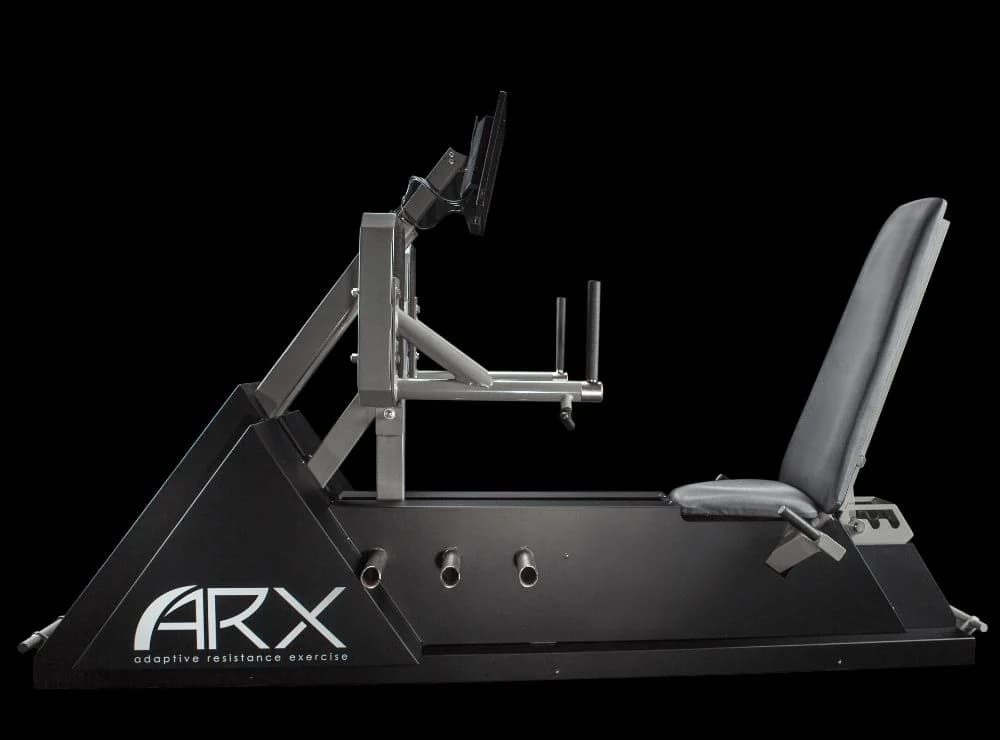
The Alpha is the smaller machine and the one ARX designed to be easiest to learn at any skill level. Resistance rides on a guided sled that keeps every rep on one path across six exercises: leg press, chest press, row, calf raise, torso flexion and torso extension. It is $43,000 in hardware, verified 2026-09-17, and its 21 square feet at 655 pounds is the smallest footprint ARX makes. Where the Omni's 128-inch dimension will not fit, this is the machine that does.
Where it gives ground: six exercises is the whole list. There is no belt squat, deadlift or Romanian deadlift, no overhead press, and none of the cable system's clip-on handles and attachments; those ten movements live only on the Omni. You still need the dedicated non-GFCI circuit, still site 655 pounds, and still pay $200 a month in software for a machine that does six things. And ARX itself concedes that barbells win on cost and track record. The Alpha's case is the footprint and the learning curve, not the range.
ARX Omni: sixteen exercises on a cable system
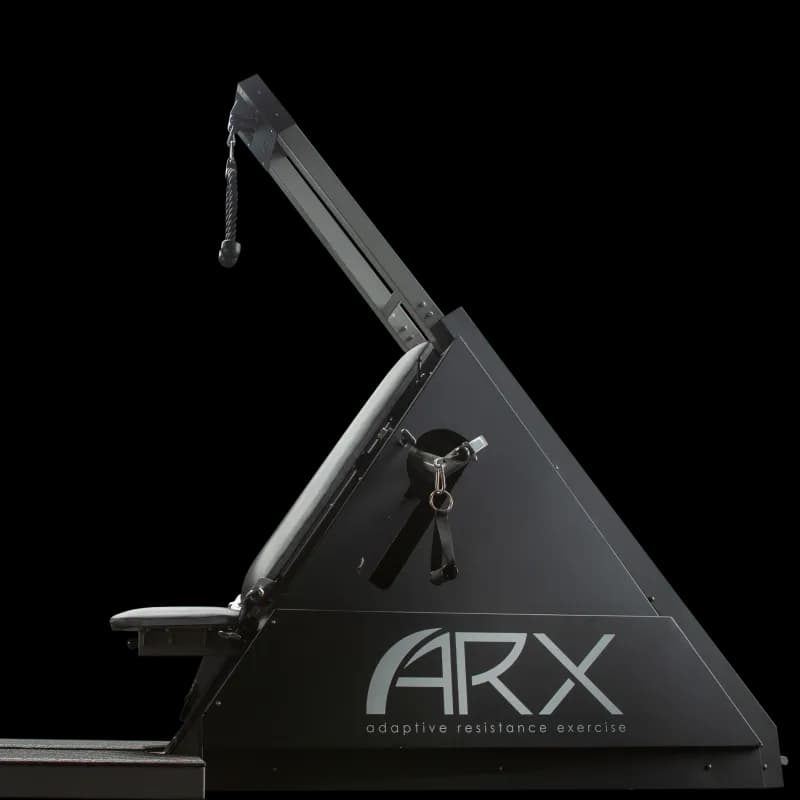
The Omni is the flagship. The same motorized resistance runs through a cable system with clip-on handles and attachments, and one machine covers belt squat, deadlift, Romanian deadlift, hamstring curl, calf raise, horizontal press, incline press, decline press, overhead press, pec fly, pulldown, pullover, row, high pull, biceps curl and triceps pressdown. ARX says it does the work of 10 or more machines, and at $46,000 in hardware, verified 2026-09-17, it costs $3,000 more than the Alpha for ten more exercises and every grip option.
Where it gives ground: the building asks are larger on every line. It needs 37 square feet against 21, weighs 680 pounds against 655, and carries a 128-inch dimension that has to turn every corner on the way in. If 90 inches is its height, an 8-foot ceiling leaves 6 inches and a 7-foot ceiling, 84 inches, is 6 inches too short. ARX calls the Alpha its easiest machine to learn; sixteen movements and a set of attachments is more to be certified on. The software bill is identical, so the Omni's only extra cost is the $3,000 and the space.
Five-year cost of ownership, with the electrician left blank
This is the table a brand page will not print, because it adds the subscription ARX sells separately to the hardware price. The software is required, identical on both machines, at $200 a month for home use or $400 a month commercial, so over 60 months it is $12,000 at home or $24,000 in a studio.
| ARX Alpha, home | ARX Omni, home | ARX Alpha, commercial | ARX Omni, commercial | |
|---|---|---|---|---|
| Hardware, verified 2026-09-17 | $43,000 | $46,000 | $43,000 | $46,000 |
| Software, 60 months | $12,000 | $12,000 | $24,000 | $24,000 |
| Five-year total | $55,000 | $58,000 | $67,000 | $70,000 |
| Per session at twice a week, 520 sessions | about $106 | about $112 | about $129 | about $135 |
Three lines are deliberately blank. The electrician's bill is not in our verified data and depends on your panel and the run. The price of a lifetime software license, which ARX says is available, is not in our verified data; under $12,000, it changes the home column. And ARX quotes about $1,200 a month through third-party lenders, but does not finance in-house, and a lender payment is never the price. The software is the same on both, so the Alpha versus Omni gap stays at $3,000 over any period; the choice is sixteen square feet and ten exercises, not a running cost.
Who should install which, and who should not
- Basement corner, 7-foot ceiling, or no 11-foot wall: the Alpha at $43,000, verified 2026-09-17. Its 66-inch height and 94-inch length fit rooms the Omni does not.
- Room to spare and a full lift list: the Omni at $46,000, verified 2026-09-17. If belt squat, deadlift or Romanian deadlift is on your list, only the Omni has them.
- Studio or clinic: the Omni, because ARX names founders building a studio around one machine and clinics that need movement-specific loading, and paying clients make the $400 a month commercial license the smaller line.
- Anyone who cannot run a dedicated non-GFCI circuit: neither. A renter, a condo on a shared panel, or a garage where the inspector will not sign off should start with our renter longevity gear setup.
- Strength at home for a fraction of this: a conventional machine. Our all-in-one home gym comparison weighs a digital cable trainer against a Smith machine, and our no-subscription smart gym roundup covers connected machines with no monthly fee; neither carries a 655-pound, dedicated-circuit install.
Bottom line
An ARX install is decided by three numbers before any model comparison matters: 21 or 37 square feet, 655 or 680 pounds, and one dedicated circuit, 110V at 20A or 220V at 15A, with no GFCI protection on it. The Alpha at $43,000 fits rooms and ceilings the Omni cannot, and the Omni at $46,000 buys ten more exercises and every grip for $3,000 and sixteen more square feet, both verified 2026-09-17. Settle the circuit with your electrician and inspector before the Talk to ARX call, and budget the $200 a month home software as part of the price, because without it the machine does not run. ARX arranges delivery and install; the wiring and the room are yours. With the circuit settled, the machine decision comes down to the 21 or 37 square feet you just measured.
How much space does an ARX machine need at home?
The ARX Alpha needs 21 square feet, listed as 32 by 94 by 66 inches, and the Omni needs 37 square feet at 42 by 128 by 90 inches. ARX does not label which dimension is which; the arithmetic points to 66 and 90 inches as the heights. Those figures are the machine outline only, since ARX publishes no working clearance around it.
Can I plug an ARX into a garage or basement outlet?
Not into the existing one. ARX requires a dedicated circuit, 110V at 20A or 220V at 15A, and states its machines are not compatible with GFCI outlets. Garage and basement receptacles in US homes are commonly GFCI-protected, so plan on an electrician running a new circuit and ask your inspector whether a non-GFCI receptacle is permitted in that room.
How heavy is an ARX and will my floor hold it?
The Alpha weighs 655 pounds and the Omni 680. Averaged over their footprints that is about 31 and 18 pounds per square foot, but the load concentrates at the feet, and foot placement is not in our verified data. A slab-on-grade garage or basement is the easy case; for a wood-framed or upper floor, hand the weight to a contractor.
How long does it take to get an ARX installed?
ARX lists a typical lead time of 2 to 4 weeks from order, and delivery and install are arranged with ARX for every new machine. There is no checkout; the order runs through a Talk to ARX call. The dedicated circuit is the one step ARX does not handle, so book the electrician as soon as the order is placed.
What does an ARX cost to run after the install?
The software is a separate, required subscription, identical on both machines: $200 a month for home use or $400 a month commercial, with lifetime licenses available at a price not in our verified data. Over five years that is $12,000 at home on top of $43,000 for the Alpha or $46,000 for the Omni. Without an active license, ARX says the machine will not run.
The products this post references
The Longevity Gear Buyer's Checklist
The specs that actually decide whether a sauna, cold plunge, red light panel, or smart ring is worth it, plus the real price range for each. Get the free PDF, plus one weekly email on the gear worth buying.