Lifespan Vault earns an affiliate commission when you buy through links on this page, at no extra cost to you. It does not change our rankings or our verdicts.
An ARX costs $43,000 for the Alpha or $46,000 for the Omni in hardware, verified 2026-09-17, and that number is the beginning of the bill, not the end. Every ARX machine also needs a software subscription to run at all: $200 a month for home use or $400 a month commercial, with lifetime licenses available; the lifetime price is not in our verified data. Put those together and a home Alpha is $45,400 in year one and $55,000 over five years by our arithmetic; a home Omni is $48,400 and $58,000. Nothing in this piece is a test result. We have not trained on either machine, and every figure here comes from the catalog entries we verified against ARX's own pages.
Three more lines belong on the sheet before you take the Talk to ARX call. Financing, which ARX quotes at about $1,200 a month through third-party lenders, is a lender payment and not a price; ARX does not finance in-house. Power, because both machines need their own dedicated 110V 20A or 220V 15A circuit and ARX states they are not compatible with GFCI outlets, so an electrician is part of the purchase for most homes. And what ARX includes, a complimentary one-year warranty, delivery and install arranged with ARX, and the ARX Certified Course, so you do not pay for them twice.
Quick answer
- Home buyer who wants the smallest ARX footprint: the ARX Alpha at $43,000 (verified 2026-09-17) plus $200 a month software, six guided movements in 21 square feet.
- Home-gym owner replacing a room of equipment: the ARX Omni at $46,000 (verified 2026-09-17) plus $200 a month software, sixteen cable exercises with grips and attachments in 37 square feet.
- Studio running clients back-to-back: the ARX Alpha at $43,000 plus $400 a month commercial software, the machine ARX calls its easiest to learn and, in ARX's own words, faster through its six exercises.
ARX cost of ownership at a glance (2026)
Both prices are the hardware figures ARX publishes on its machines page, verified on the date shown; software, financing and power are the same on both. ARX is not an affiliate partner of ours; links go to our catalog pages and the ARX brand hub.
| Machine | Hardware price (verified) | Software, home | Software, commercial | Exercises | Footprint | Weight | Power |
|---|---|---|---|---|---|---|---|
| ARX Alpha | $43,000 (v 2026-09-17) | $200/mo | $400/mo | 6, guided sled | 21 sq ft | 655 lb | Dedicated 110V 20A or 220V 15A, non-GFCI |
| ARX Omni | $46,000 (v 2026-09-17) | $200/mo | $400/mo | 16, cable driven | 37 sq ft | 680 lb | Dedicated 110V 20A or 220V 15A, non-GFCI |
The takeaway: the two machines are $3,000 apart on hardware and identical on everything that recurs. The choice between them is exercise range against floor space, not cost.
The hardware price is the only number ARX prints as a price
ARX builds both machines in Austin, Texas, and publishes exactly two prices: $43,000 for the Alpha and $46,000 for the Omni, both carried in the structured data of its machines page and verified by us on 2026-09-17. There is no checkout. The purchase runs through a Talk to ARX call, which is also where the financing conversation happens, so it pays to walk in knowing which figure is the price and which is a payment.
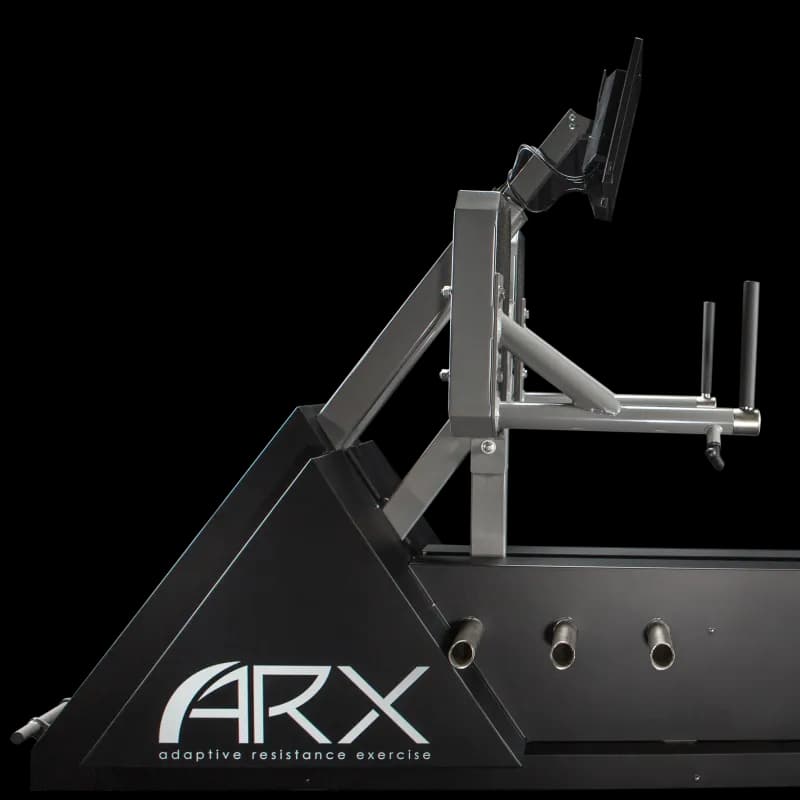
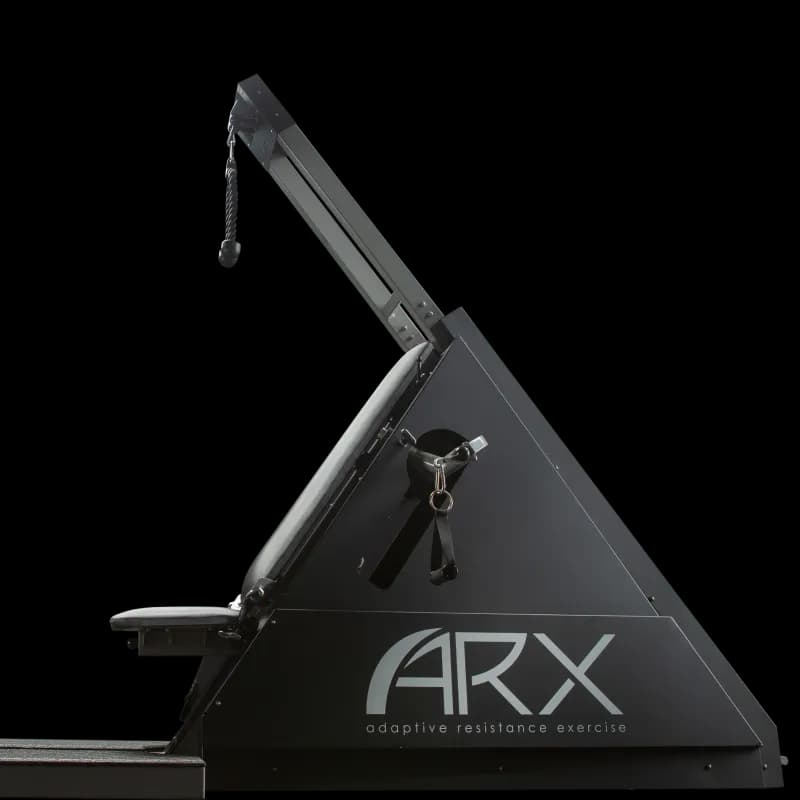
What the hardware buys is the same mechanism on both machines. In place of a weight stack, a computer-controlled motor pushes back with the force you produce at every point in the rep, including the lowering phase ARX says weights cannot load. The Alpha delivers that through a guided sled across six exercises: leg press, chest press, row, calf raise, torso flexion and torso extension. The Omni delivers it through a cable system with clip-on handles and attachments across sixteen, adding belt squat, deadlift, Romanian deadlift, hamstring curl and the rest of the cable library. That ten-exercise gap is the whole $3,000.
Software: the subscription the machine will not run without
This is the line most buyers miss on the first pass, and it is not optional. ARX software is a separate subscription, identical on the Alpha and the Omni: $200 a month for home use, $400 a month for commercial use, with lifetime licenses available. The lifetime license price is not in our verified data, so ask for it on the call. At $200 a month, twelve months is $2,400 and five years is $12,000, which is the number a lifetime figure has to beat.
What the subscription buys is the part of the machine that makes it an ARX rather than a very heavy leg press. The software records total force, max force in both the concentric and eccentric directions, rep speed, range of motion, intensity, exercise time and fatigue to an online dashboard, and ARX says any rep scheme runs on it, from standard sets to negative-only, static and partial-range work, without a trainer in the room. Without an active license the machine does not run at all: no workout, no force data. That fact matters twice, once for your monthly budget and once if you ever consider a used machine, which we come back to below.
If a subscription on top of the hardware is the part that bothers you, that is a fair instinct; the no-subscription smart home gym roundup is built around exactly that objection, at a very different price tier.
Financing: why about $1,200 a month is not the price
ARX quotes financing at about $1,200 a month through third-party lenders, and it does not finance in-house. Treat that figure as what it is: a lender payment on a loan whose term, rate and down payment are not in our verified data. We are not going to multiply it out into a total because we do not know the term, and neither should a sales call that leads with the monthly number.
What we can say is what leaves the account each month if you finance a home machine: roughly $1,200 to the lender and $200 to ARX for software, about $1,400 a month before electricity. For a commercial installation that is about $1,600 a month. If you buy the hardware outright, the recurring bill drops to the software alone. Either way, write the $43,000 or $46,000 on the sheet as the price and the $1,200 as a payment option.
Power: the dedicated circuit and the GFCI rule
Both machines need their own circuit: 110V on a dedicated 20A circuit, or 220V on a dedicated 15A circuit. Every machine ships with a power supply set to your outlet voltage at install. The line that trips people up is ARX's statement that its machines are not compatible with GFCI outlets. The reason is not in our verified data, so check the receptacle where the machine will sit and put the GFCI question to your electrician along with the dedicated circuit.
That means an electrician is part of the purchase for most buyers. What that costs is not in our verified data; it depends on your panel, the distance and your local rates, so get a quote before the ARX call rather than after delivery. Running electricity cost is not in our verified data either, and we will not estimate one.
What ARX includes: warranty, install, course, lead time
Every new machine comes with a complimentary one-year warranty, delivery and install arranged with ARX, and the ARX Certified Course. ARX also says personal onboarding through ARX Academy comes with the machine. Typical lead time from order is two to four weeks. Whether delivery and install carry a separate charge on top of the hardware price is not in our verified data; the site says arranged with ARX, not free, so ask.
The one-year warranty is short for a $43,000 to $46,000 machine, and there is nothing in our data about an extended plan, so budget as if year two onward is on you. The Certified Course is worth counting because ARX treats training as part of ownership: new buyers get the Certified Course included, and resale buyers must complete ARX Certified Training before use.
The all-in math by year (our arithmetic)
These are our sums from ARX's published hardware and software prices. They exclude the electrician, electricity, any delivery charge and financing interest, because none of those numbers are in our verified data.
| Scenario | Hardware | Software | Year-one total | Five-year total |
|---|---|---|---|---|
| Alpha, home ($200/mo) | $43,000 | $2,400/yr | $45,400 | $55,000 |
| Omni, home ($200/mo) | $46,000 | $2,400/yr | $48,400 | $58,000 |
| Alpha, commercial ($400/mo) | $43,000 | $4,800/yr | $47,800 | $67,000 |
| Omni, commercial ($400/mo) | $46,000 | $4,800/yr | $50,800 | $70,000 |
Two things fall out. First, over five years at home, software is about 22 percent of what you spend on an Alpha and about 21 percent on an Omni; commercially it is about 36 percent and 34 percent. Second, the $3,000 hardware gap between the machines never widens, because the recurring costs are identical. Nothing about owning an Omni costs more per month than owning an Alpha.
Cost per session at ARX's own cadence
ARX describes the workout as about 15 minutes, twice a week, and notes that most users train one to two times a week. At two sessions a week that is 104 sessions a year, 520 over five years. Divide the totals above by that and a home Alpha runs about $437 a session in year one and about $106 a session across five years; a home Omni is about $465 and about $112. The software alone is about $23 a session at home. Those are our numbers, and they move fast with usage: at once a week the five-year figure roughly doubles, so the economics depend on showing up twice a week for years.
ARX Alpha: where it gives ground
The ARX Alpha is the smaller machine, and its concessions are the ones ARX itself lists. Against the Omni it gives up ten exercises and the cable system's grips and attachments; belt squat, deadlift and Romanian deadlift exist only on the Omni. Its six movements run on a guided sled that keeps every rep on one path, which is what makes it ARX's easiest machine to learn and, in ARX's words, faster through all of them, but it also means you never balance or stabilize a load. ARX concedes that barbells win on cost and track record and teach exactly that. At 21 square feet, 32 by 94 by 66 inches, and 655 pounds, it is still a single-purpose machine with a monthly bill and a dedicated circuit, and the $3,000 you save over the Omni is fifteen months of home software.
ARX Omni: where it gives ground
The ARX Omni gives ground on space and setup. It needs 37 square feet, 42 by 128 by 90 inches, sixteen more square feet than the Alpha, and it weighs 680 pounds, so the route in matters as much as the room. Its cable system is what allows more exercises and more grips, and it is also what makes it the harder of the two to learn, by ARX's own framing of the Alpha as the easiest. The $3,000 premium buys the exercise library and nothing else: the motor-matched resistance, the software, the data it tracks, the warranty and the course are identical.
One caveat applies to both machines. The outcome figures ARX leads with, twice the muscle gain and 90 percent greater strength gain among them, come from a 2021 study commissioned by the American Council on Exercise at Western Colorado University that ARX cites. Those are the brand's numbers from the brand's cited study; we have not tested either machine, and none of the cost math above depends on them.
The used-machine trap
A used ARX looks like the obvious way around the $43,000 to $46,000 hardware price, and ARX strongly discourages it for reasons that are structural rather than commercial. The software license is non-transferable, and without an active license the machine will not run at all. ARX reviews every serial number individually before it will sell a new license to a resale buyer, and not every machine qualifies. The warranty ends when the machine changes hands. Resale buyers must complete ARX Certified Training before use, and moving the machine requires consulting ARX. ARX asks buyers to submit the serial number for verification before any money moves, and keeps its own waitlist for used machines it sells directly.
Read that list as a cost sheet: a new license fee that is not in our verified data, a training requirement, a move you cannot do yourself, no warranty, and the possibility that ARX declines to license the machine at all. If the used route is the only way the numbers work, the safer version is the waitlist for machines ARX sells directly.
Verdicts by buyer type
- Home buyer, smallest footprint, six movements is enough: the ARX Alpha at $43,000 plus $200 a month. Year one about $45,400, five years about $55,000, on a dedicated non-GFCI circuit in 21 square feet.
- Home-gym owner replacing a room of equipment: the ARX Omni at $46,000 plus $200 a month. Year one about $48,400, five years about $58,000, and the only ARX with belt squat, deadlift and Romanian deadlift.
- Studio founder or clinic on the commercial license: either machine at $400 a month software; the Alpha if clients move through back-to-back and you want the easiest learn, the Omni if you need movement-specific loading. Five years about $67,000 or $70,000.
- Buyer who needs the monthly number to work: neither, until you have a lender quote with a term on it. The $1,200 a month ARX cites is a payment, and the software is $200 or $400 on top of it every month.
- Buyer who enjoys free weights and has the hours: ARX's own answer is barbells, on cost and track record. The best home gyms guide and the all-in-one home gym comparison cover the machines most people are actually choosing between, at a fraction of this price.
Bottom line
An ARX is $43,000 or $46,000 in hardware plus $200 or $400 a month in software, and by our arithmetic that is $45,400 to $50,800 in year one and $55,000 to $70,000 over five years before an electrician, electricity or financing interest. The $1,200 a month ARX quotes is a lender payment, not a price, and the machine needs its own non-GFCI circuit whichever way you pay. Choose the Alpha for the smallest footprint and the easiest learn, the Omni for the full sixteen-exercise library; nothing that recurs is different between them. If twice a week for years is not a realistic promise to yourself, the per-session math says to look at the rest of the home gym field first. If the answer is still an ARX, which one fits your room is the decision that follows this one.
How much does an ARX machine cost in 2026?
ARX publishes two hardware prices, $43,000 for the Alpha and $46,000 for the Omni, both verified 2026-09-17. Software is a separate required subscription at $200 a month for home use or $400 a month commercial, with lifetime licenses available; the lifetime price is not in our verified data. There is no online checkout; every purchase runs through a Talk to ARX call.
Does an ARX need a software subscription to work?
Yes. ARX software is a separate subscription, identical on the Alpha and the Omni, at $200 a month for home use or $400 a month commercial, and without an active license the machine will not run at all. That subscription is what programs the rep schemes and records total force, rep speed, range of motion and fatigue to the online dashboard.
Is the $1,200 a month ARX financing the real price?
No. About $1,200 a month is what ARX quotes through third-party lenders; ARX does not finance in-house, and the loan term, rate and down payment are not in our verified data. The price is the hardware, $43,000 or $46,000, and the software adds $200 or $400 a month on top of any lender payment for as long as you own the machine.
What electrical work does an ARX need at home?
Both machines need a dedicated circuit, 110V at 20A or 220V at 15A, and ARX states they are not compatible with GFCI outlets. Each machine ships with a power supply set to your outlet voltage at install. Most buyers should budget an electrician to run that dedicated circuit; the electrician cost and the running electricity cost are not in our verified data.
What does ARX include with a new machine?
Every new Alpha or Omni comes with a complimentary 1-year warranty, delivery and install arranged with ARX, and the ARX Certified Course, with a typical lead time of 2 to 4 weeks from order. Whether delivery and install carry a separate charge on top of the hardware price is not in our verified data, so confirm it on the Talk to ARX call.
The products this post references
The Longevity Gear Buyer's Checklist
The specs that actually decide whether a sauna, cold plunge, red light panel, or smart ring is worth it, plus the real price range for each. Get the free PDF, plus one weekly email on the gear worth buying.