Lifespan Vault earns affiliate commissions on some outbound links elsewhere on this site. Nothing on this page earns us a commission. It does not change our rankings or our verdicts.
A studio owner reads an ARX price sheet differently from a home buyer. The ARX Alpha is $43,000, verified 2026-09-17, the ARX Omni is $46,000, verified 2026-09-17, and on top of either sits commercial software at $400 a month. In a studio those are a cost of goods, and the machine has to earn its floor against three figures that are not in our verified ARX data and have to be derived: sessions per hour, dollars per member and square feet per session. This piece runs that arithmetic for a studio of 100 members from the specs and prices in our catalog, all of them ARX's own figures. Everything ARX builds is on the ARX brand hub.
Here is the direct answer. For a studio that runs members back-to-back on a booked schedule, price the Alpha first: same motor-matched resistance and same software as the Omni, six exercises on a guided sled that ARX calls its easiest machine to learn and says is faster than the Omni through all of its exercises, in 21 square feet instead of 37, for $3,000 less. At 100 members training twice a week on ARX's stated 15-minute session, the financed path ARX quotes, about $1,200 a month through a third-party lender plus $400 for software, comes to about $16 per member per month, or roughly $1.85 per session. The Omni earns its extra $3,000 and 16 square feet when the studio's exercise menu, not its throughput, is the product. We have not trained on either machine.
Quick answer
- Semi-private studio running clients back-to-back: the ARX Alpha at $43,000, verified 2026-09-17, six guided-sled movements in 21 square feet on the machine ARX says is faster through all of its exercises.
- Founder building a boutique around one machine: the ARX Omni at $46,000, verified 2026-09-17, sixteen cable exercises with clip-on handles and attachments that ARX says do the work of 10-plus machines.
- Clinic or practitioner who needs movement-specific loading: the ARX Omni at $46,000, verified 2026-09-17, because belt squat, deadlift and Romanian deadlift exist only on the Omni.
Alpha and Omni at a glance
| Machine | Verified price | Price verified | Exercises | Footprint | Weight | Commercial software |
|---|---|---|---|---|---|---|
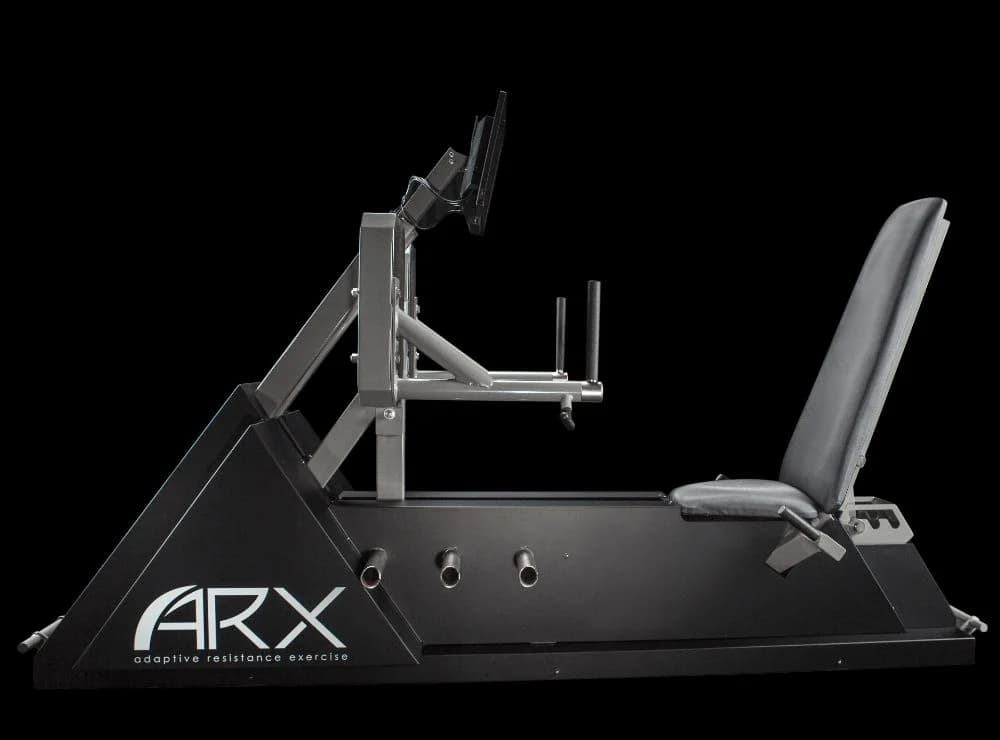
| ARX Alpha | $43,000 | 2026-09-17 | 6 on a guided sled | 21 sq ft, 32 x 94 x 66 in | 655 lb | $400 a month, lifetime license available |
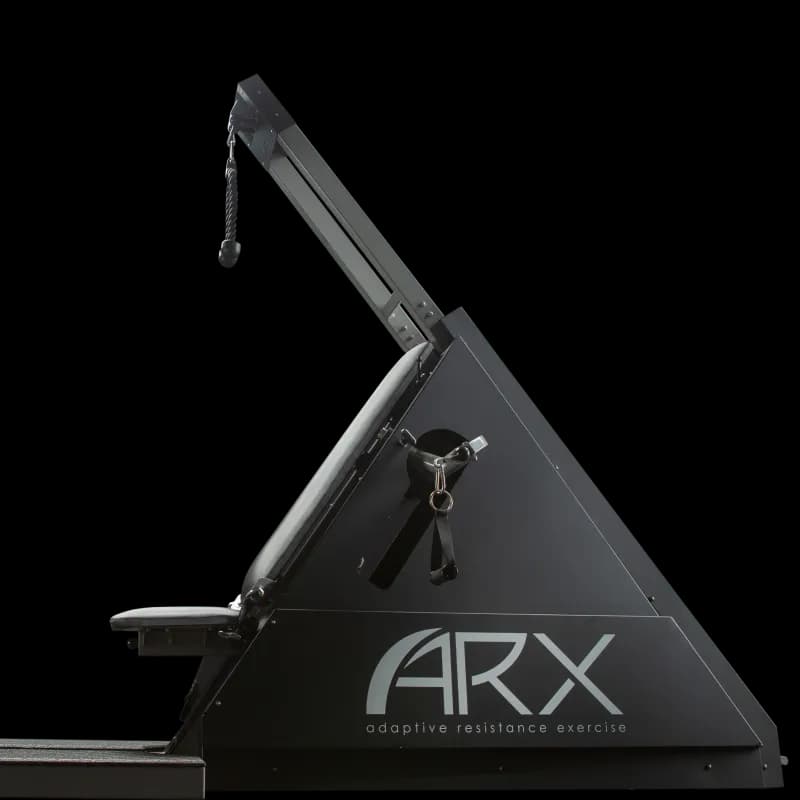
| ARX Omni | $46,000 | 2026-09-17 | 16 on cables with clip-on handles and attachments | 37 sq ft, 42 x 128 x 90 in | 680 lb | $400 a month, lifetime license available |
Both prices are ARX's published hardware figures; neither includes software, electrician or lender.
What ARX sells a studio, and what it does not
ARX builds both machines in Austin, Texas, and the technology is the same on each: in place of a weight stack, a computer-controlled motor pushes back with exactly the force the member produces at every point in the rep, including the lowering phase, which ARX says weights cannot load. The software is identical on both and records total force, max force in both directions, rep speed, range of motion, intensity, exercise time and fatigue to a cloud dashboard. What differs is delivery: six movements on a guided sled for the Alpha, sixteen through a cable system with clip-on handles and attachments for the Omni, and belt squat, deadlift and Romanian deadlift are on the Omni only.
ARX names the studio owner for both machines: studios running clients back-to-back for the Alpha, and founders building a studio around one machine plus clinics that need movement-specific loading for the Omni. Read that as ARX's own segmentation, throughput on the Alpha and menu on the Omni.
What ARX does not sell matters as much. There is no checkout; every purchase runs through a Talk to ARX call. There is no in-house financing. The warranty is one complimentary year, and whether commercial use changes its terms is not in our verified data. Whether either machine carries a duty cycle, a rated limit on back-to-back sessions, is not in our verified data either. Put the last two in writing, because a landlord or a lender will ask about them first.
The 100-member math
Start with the monthly carry, the number a member count has to cover. On the financed path ARX quotes about $1,200 a month through third-party lenders, and commercial software is $400 a month, so the machine costs about $1,600 a month before power, staff or rent. Across 100 members that is $16 per member per month. The software alone is $4 a head at 100, $8 at 50 and $2.67 at 150.
Now the sessions. ARX describes the workout as about 15 minutes, twice a week, and says most users train one to two times a week. Take the brand at its word and assume every member books twice: 100 members produce 200 sessions a week, about 867 a month. Divide the $1,600 carry by 867 and each session costs the studio about $1.85 in machine and software. At once a week, 433 sessions a month, it is about $3.69. Either way the machine's cost per session is small next to whatever you charge for it; the constraint is sessions per hour.
On the purchase path the shape changes. An Alpha bought outright is $43,000 plus $4,800 in software for year one, $47,800, which is $478 per member across 100 in the first twelve months. From year two the carry is software alone, $4,800 a year, or $4 per member per month. The Omni runs $50,800 in year one, $508 per member, then the same $4 a month. ARX lists lifetime software licenses as available; the price is not in our verified data, and it is the first question to ask if you plan to own past year three.
Sessions per hour, and the peak-hour wall
Sessions per hour equals sixty divided by session length plus turnover. At ARX's 15-minute session with zero turnover, one machine runs four an hour. Give each changeover five minutes for the next member to log in and set the sled or clip on a handle, and you are at three. A 100-member studio at two sessions each needs 200 machine slots a week: 50 machine-hours at four an hour, about 67 at three. Over six operating days that is 8.3 hours a day at the fast rate and 11.1 at the realistic one. One machine covers a 100-member studio on paper, and only if the bookings arrive evenly.
They will not. The model needs your calendar rather than ours, but the arithmetic is unforgiving: a single machine serves at most four members in any hour. If members cluster into two morning and two evening hours, that is 24 peak machine-hours a week across six days and at best 96 peak sessions, under half of the 200 the roster wants. The rest move off-peak or onto a second machine.
The Alpha is the machine to buy against that wall for a reason ARX states itself: it is faster through all of its exercises than the Omni. Six movements on a guided sled, without the Omni's clip-on handles and attachments, should also change over faster than sixteen through cables, but that is our inference. A changeover time is not in our verified data, so the five-minute figure is ours; measure your own at the demo.
Financing against purchase
ARX does not finance in-house. The figure it quotes, about $1,200 a month, comes from third-party lenders, and the term and rate behind it are not in our verified data, so neither we nor this page can tell you the total financed cost. Whether a lender writes the deal as a lease or a loan is also not in our data. One check to run before the call: $43,000 divided by $1,200 is about 36 months, so any term that runs meaningfully past three years is paying for the credit, and the lender's disclosure is where that number lives. The software is $400 a month on both paths and both machines, and it is required: ARX states that without an active license the machine does not run at all.
Twenty-one square feet against thirty-seven
The Alpha's footprint is 21 square feet, 32 by 94 by 66 inches; the Omni's is 37 square feet, 42 by 128 by 90 inches. ARX does not state which dimension is which, and the clearance a member and a coach need around the machine is not in our verified data, so the true floor claim is larger than either figure.
On hardware cost per square foot the Omni is the cheaper machine, about $1,243 a foot against about $2,048 for the Alpha. That is the wrong way round for a studio. Both run the same 15-minute session, so per hour they produce the same four slots, and the Alpha does it on 57 percent of the floor. Every square foot the Omni adds is menu, not throughput.
Put another way: two Alphas take 42 square feet and $86,000 and run eight sessions an hour. One Omni takes 37 square feet and $46,000 and runs four. If bookings hit the peak-hour wall, the second Alpha doubles the wall for $40,000 more than the Omni and five square feet more floor. Whether a second machine needs a second $400 software subscription is not in our verified data; ask on the call, because it changes the per-member figure at 150 or 200 members. Weight is 655 pounds for the Alpha and 680 for the Omni; floor loading is not in our data.
Power, install and the Certified Course
Both machines need their own circuit, 110V on a dedicated 20A circuit or 220V on a dedicated 15A circuit, and ARX states its machines are not compatible with GFCI outlets. Each ships with a power supply set to your outlet voltage at install. Book the electrician before the order: the typical lead time is two to four weeks, and a circuit not ready on delivery day loses you a month of sessions.
Every new machine includes the ARX Certified Course, and ARX says personal onboarding through ARX Academy comes with it. How many staff seats the course covers is not in our verified data, so ask in writing. ARX also says its machines can be programmed and controlled by the software so a person can train alone, and that a session can run without a trainer. Staffing cost per session is your input, not a spec, but it starts from that fact.
One more line for the owner who might one day sell the studio or the machine. The software license is non-transferable, ARX reviews every serial number before it will sell a new one and not every machine qualifies, the warranty ends when the machine changes hands, and a resale buyer must complete ARX Certified Training before use. Price the exit as a licensing question.
Whose results the marketing carries
The numbers ARX leads with, twice the muscle gain, 90 percent greater strength gain, 2.5 times the fat loss and 3.5 times the cardiovascular improvement in 72 percent less training time, come from a 12-week study at Western Colorado University commissioned by the American Council on Exercise in 2021 and cited by ARX. Those are the brand's figures from the brand's cited study; ARX's XPRIZE Healthspan involvement has not reported results, and we have not tested either machine. Do not put those percentages on your studio wall as your own.
Where the Alpha gives ground
- Six exercises is the whole menu. No belt squat, deadlift, Romanian deadlift, overhead press, pulldown or curl; a member who wants those trains elsewhere in your room.
- A guided sled means one path per movement and no grip variety, which is what makes it fast and what a coach programming for variety runs out of.
- The $3,000 saving against the Omni is hardware only. Software is the same $400 a month on both, so the per-member carry after year one is identical.
- Barbells win on cost and track record, in ARX's own words, and a 655-pound single-purpose machine cannot be repurposed if the model does not fill.
Where the Omni gives ground
- It takes 37 square feet to deliver the same four sessions an hour the Alpha delivers in 21, so every extra foot is paid for by menu, not by revenue-bearing slots.
- ARX itself says the Alpha is faster through all of its exercises; sixteen movements with clip-on attachments mean changeovers, the difference between three sessions an hour and four.
- At $46,000 it is $3,000 more up front, or $30 more per member across 100 in year one, for exercises a semi-private throughput model may never book.
- 680 pounds, the same dedicated non-GFCI circuit, the same one-year warranty with no commercial schedule in our data, and the same non-transferable license.
Verdicts by buyer type
- The semi-private studio selling 15-minute slots on a booked calendar: the ARX Alpha at $43,000. Throughput is the product, and ARX says the Alpha is faster through all of its exercises, on 21 square feet.
- The founder opening a boutique around a single machine: the ARX Omni at $46,000. ARX names this buyer for the Omni, and sixteen movements with grips and attachments is a menu a member stays on for years.
- The clinic or practitioner loading specific movements: the ARX Omni. Belt squat, deadlift and Romanian deadlift are Omni-only, and ARX names clinics needing movement-specific loading for this machine.
- The studio past the peak-hour wall: a second ARX Alpha before a first Omni. Two Alphas in 42 square feet run eight sessions an hour; one Omni in 37 runs four.
- The studio under about 50 members, or without a dedicated circuit yet: neither, this quarter. At 50 members the software alone is $8 a head and the financed carry is $32, and no ARX runs on a GFCI outlet. Our home gym guide covers machines that do not need a lender.
Bottom line
For a 100-member studio the ARX Alpha at $43,000, verified 2026-09-17, is the machine to price first: about $16 per member per month on the financed path ARX quotes, roughly $1.85 per session at two sessions a week, on 21 square feet and a dedicated non-GFCI circuit. The ARX Omni at $46,000, verified 2026-09-17, buys ten more exercises and a set of grips for $3,000 and 16 square feet, and it is the right machine when the menu is the business rather than the schedule. The number that decides the purchase is not either price but four sessions an hour, the most any one machine will ever give your peak window. Read the commercial buying questions (Sponsored by Sun Home Saunas) we put to sauna makers, most of which apply here unchanged, and the home-gym essentials that cover what an Alpha leaves out.
How many members does a studio need to cover an ARX machine?
Run it from the monthly carry. ARX quotes about $1,200 a month through third-party lenders, and commercial software is $400 a month, so about $1,600 before rent, power or staff. At 100 members that is $16 per member per month; at 50 it is $32. The software alone is $4 a head at 100 members. Your membership price, which is not our number, decides where that clears.
How many sessions an hour can one ARX machine run in a studio?
Four at the ceiling. ARX describes a full-body session as about 15 minutes, so sixty divided by fifteen is four sessions an hour with zero turnover, and three an hour at five-minute changeovers. A 100-member studio at two sessions a week needs 200 slots, which is 50 to 67 machine-hours a week. A changeover time is not in our verified data, so measure yours at the demo.
Does ARX offer commercial financing or leasing for studios?
Not in-house. ARX quotes about $1,200 a month through third-party lenders, and the term and rate behind that payment are not in our verified data, nor is whether a lender structures it as a lease or a loan. One check before the call: $43,000 divided by $1,200 is about 36 months, so a term much longer than three years is paying for the credit.
Which ARX is better for a studio, the Alpha or the Omni?
Alpha for throughput, Omni for menu. The Alpha runs six exercises on a guided sled in 21 square feet at $43,000, verified 2026-09-17, and ARX says it runs its exercises faster than the Omni. The Omni runs sixteen exercises on cables with clip-on handles in 37 square feet at $46,000. Both give the same four 15-minute slots an hour; the Omni's extra 16 square feet buy exercises, not sessions.
Does the ARX warranty cover commercial studio use?
Our data says one year, complimentary, on every new machine, and nothing about commercial use, so get the commercial schedule in writing before the order. ARX also states the software license is non-transferable, the machine does not run without an active license, and the warranty ends when the machine changes hands. Lead time is a typical 2 to 4 weeks, with delivery and install arranged with ARX.
The products this post references
The Longevity Gear Buyer's Checklist
The specs that actually decide whether a sauna, cold plunge, red light panel, or smart ring is worth it, plus the real price range for each. Get the free PDF, plus one weekly email on the gear worth buying.